The finance head thinks paper inspections are free because there is no software line item on the P&L, and the safety officer thinks digital is expensive because it shows up as a subscription. Both are wrong. When you actually add up the fully loaded cost of running paper inspections on an Indian construction or mining fleet — missed defects, downtime, penalty exposure, audit prep time, insurance impact and duplicate data entry — paper costs 3 to 5 times more per asset per year than digital, and the gap widens with fleet size. This guide walks through the real numbers in INR, benchmarks from Indian sites and a practical TCO framework you can present to your CFO tomorrow, and if you want to run the calculation on your own fleet you can start a free trial and see live cost data within the first week.
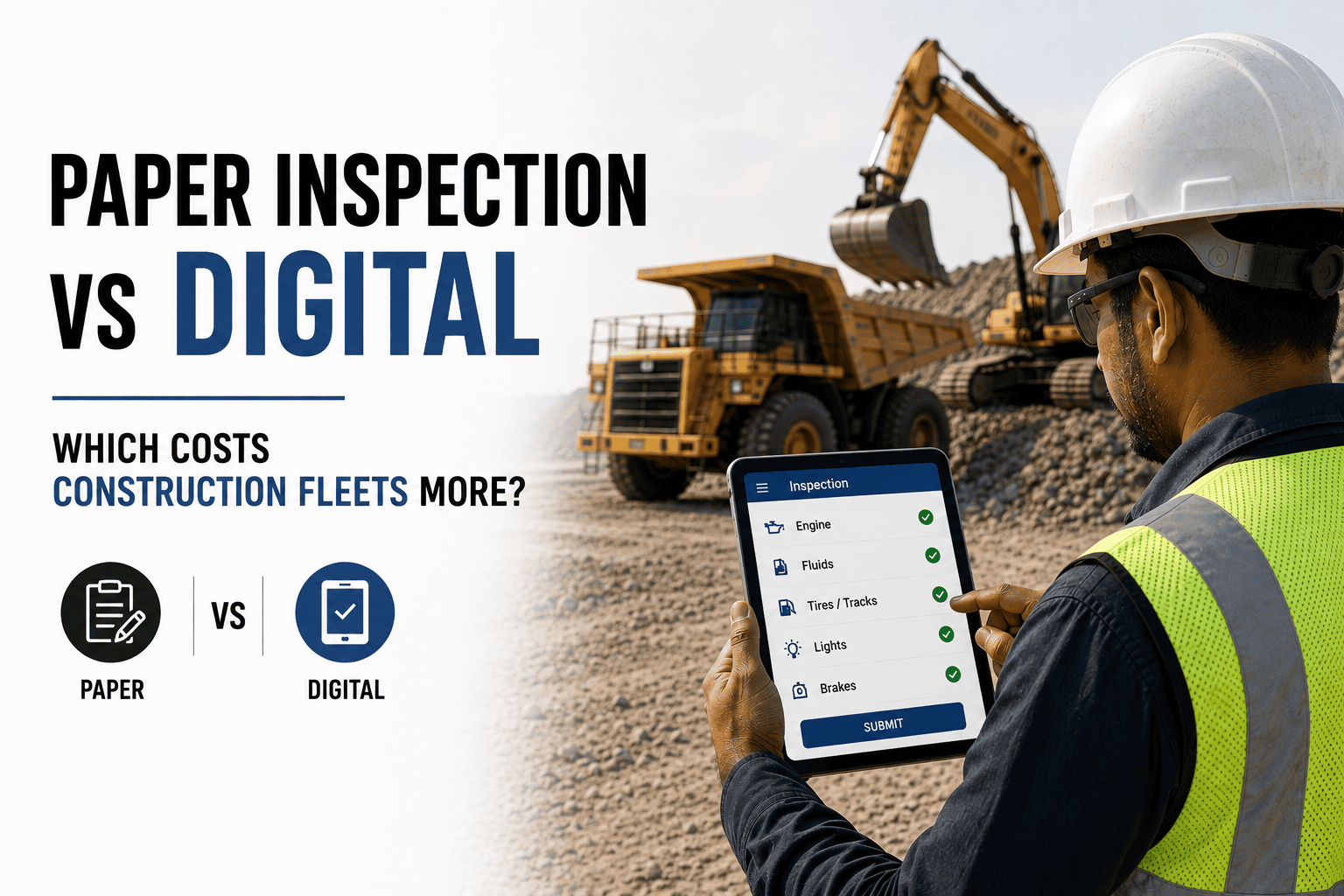
Paper Inspection Vs Digital: Which Costs Construction Fleets More?
A practical breakdown of true total cost of ownership for Indian construction, mining and infrastructure fleets — with INR numbers, benchmarks and the DGMS / Factories Act compliance angle most vendors leave out.
The Myth That Paper Is Free
Paper looks like it costs nothing because the cost is spread across 6 different budget lines and 3 different departments. Add them up and the truth is uncomfortable.
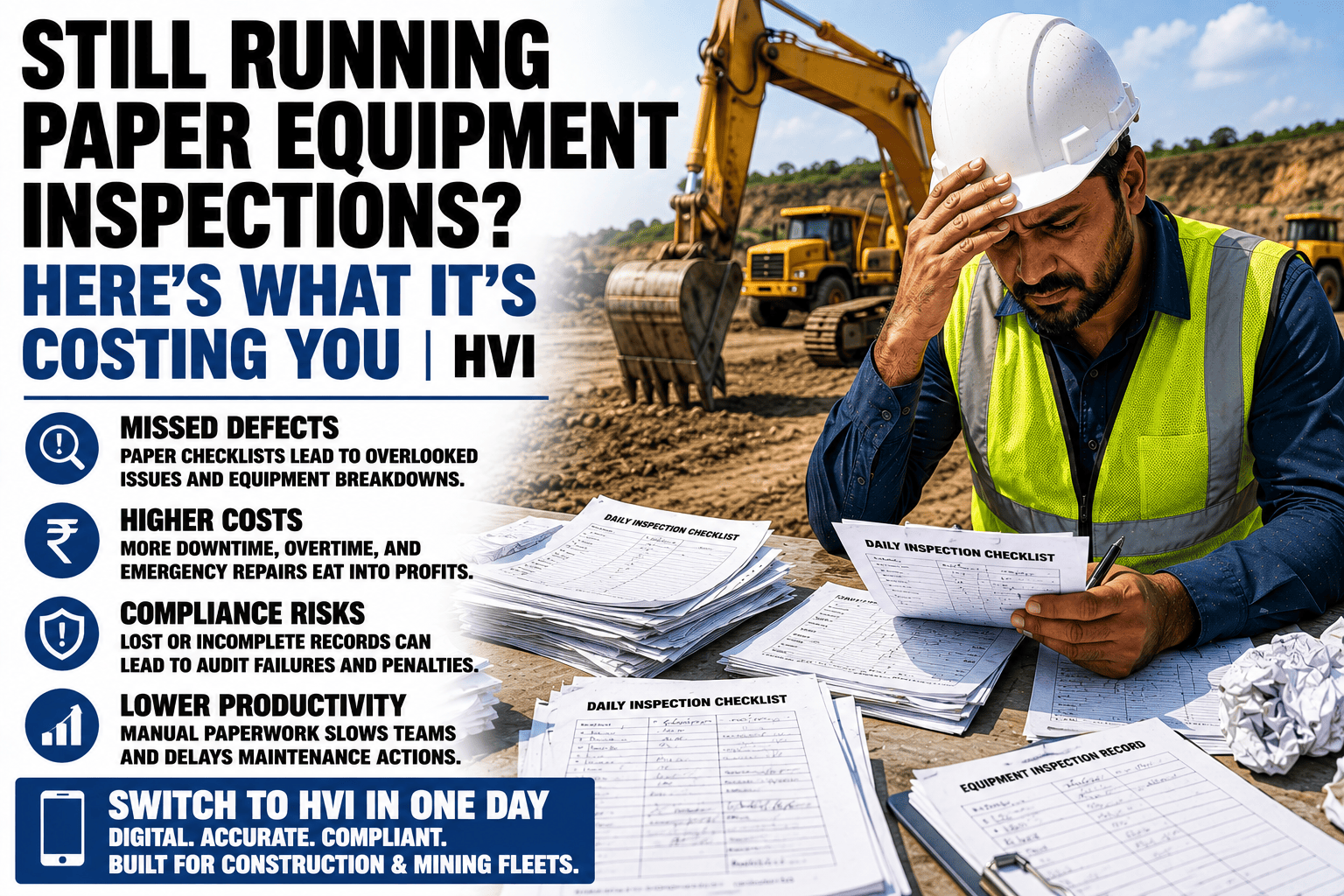
Ask any Indian fleet manager how much their paper inspection system costs and the answer is almost always "just printing charges." That answer misses roughly Rs 1.4 to 1.7 lakh per HEMM asset per year in real costs sitting invisibly across your operations, maintenance, safety, insurance, HR and finance budgets. This is not theoretical — these are the actual numbers Indian fleets discover when they run the exercise for the first time, usually 30 to 60 days after their first digital pilot when the finance team asks why the ERP looks so much cleaner.
Where Paper Actually Costs You
Six hidden cost buckets that quietly drain Indian construction and mining fleet budgets — none of which show up as a "paper inspection" line item.
Missed Defects & Emergency Repair
Roughly one in three paper defects never reaches the workshop, and each missed defect that escalates into a component failure costs 3 to 5 times the original repair. Per asset per year, this is the biggest hidden cost.
Unplanned Downtime
A dumper down 10 hours in a year that was preventable, at Rs 15,000 to 2 lakh per hour of production loss, adds up quickly. Digital catches most of these before they happen.
Manual Data Entry & Reconciliation
Site clerks, supervisors and workshop admins each re-typing the same defect into Excel, WhatsApp and ERP. Per asset per year, this is a full week of admin time nobody accounts for.
Compliance & Audit Prep
DGMS and Factories Act audit prep from paper takes days per asset per event. Add penalty exposure for missing or unsigned checks and the number climbs sharply.
Insurance Premium Load
Fleets with weak safety documentation pay 15 to 25 percent higher premiums at renewal. Digital audit trails move you into the preferred risk tier over 12 to 18 months.
Repeat Failure Blindness
On paper, the same starter motor failing every 4 months on the same dumper is invisible. Digital surfaces the pattern and drives OEM escalation or component upgrade.
Full TCO Comparison Per Asset Per Year
The line-by-line breakdown for a typical dumper or excavator operating 20 hour shifts on an Indian mining or highway site.
| Cost Bucket | Paper (INR / yr) | Digital (INR / yr) | Savings With Digital |
|---|---|---|---|
| Software subscription | Zero | Rs 12,000 | Rs 12,000 higher |
| Missed defects & emergency repair | Rs 75,000 | Rs 15,000 | Rs 60,000 saved |
| Unplanned downtime cost | Rs 55,000 | Rs 8,000 | Rs 47,000 saved |
| Manual data entry & reconciliation | Rs 15,000 | Rs 2,000 | Rs 13,000 saved |
| Compliance & audit prep | Rs 12,000 | Rs 1,500 | Rs 10,500 saved |
| Insurance premium load | Rs 10,000 | Rs 2,000 | Rs 8,000 saved |
| Repeat failure blindness | Rs 8,000 | Rs 1,500 | Rs 6,500 saved |
| Paper, printing, filing overhead | Rs 5,000 | Zero | Rs 5,000 saved |
| Total Cost Of Ownership | Rs 1,80,000 | Rs 42,000 | Rs 1,38,000 saved |
The Number Scales Faster Than You Think
A Rs 1.38 lakh saving per asset per year sounds modest until you multiply it across a real Indian fleet.
Small contractor fleet running mixed HEMM on a single project site.
Mid size EPC contractor or medium mining operator across 2 to 4 sites.
Large infrastructure contractor with 4 to 8 active project sites nationwide.
Enterprise mining or roads major with pan-India fleet operations.
Run The TCO Analysis On Your Own Fleet
Start a free trial and use HVI's cost per asset dashboard to see your actual missed-defect, downtime and admin costs within 30 days. Or book a 30 minute call with our team to walk through the TCO framework on your specific fleet.
The 5 Questions Your CFO Will Ask
When you take the digital pitch to finance, these are the questions that come back. This section is the ammunition you need.
"How do you know the missed-defect number is real?"
Because it is the delta between defects flagged on paper versus digital in every parallel run we have ever seen. Digital fleets consistently capture 3 to 4 times more defects per asset per month than paper — the paper number was always missing them, not the digital number over-counting.
"What if operators do not adopt the app?"
Real Indian sites see 90 to 98 percent adoption within two weeks, including senior operators. Hindi UI, voice notes and 60 second inspections make the app faster than paper once operators do it twice. Non adoption is almost always a training or enforcement gap, not a technology one.
"What is the payback period?"
Most Indian fleets recover the full year software cost within 6 to 9 months, primarily through unplanned downtime reduction. Fleets running high-value HEMM in mining see payback in 3 to 5 months because a single prevented shovel breakdown covers 12 months of platform cost.
"Do we need to hire IT staff to run this?"
No. HVI is designed for site operations teams, not IT integrators. Setup is handled by the India onboarding team, day-to-day admin is done by your safety officer or workshop head, and no server, on-premise install or IT resource is required.
"What happens if we cancel after year one?"
All your data can be exported as PDF, Excel and CSV before cancellation, so you retain the audit trail. But most fleets that pilot HVI never go back to paper — the operational visibility and cost per asset reporting become unmissable after the first month.
The DGMS And Factories Act Angle Most Vendors Miss
Compliance risk is often the tipping point in the paper vs digital decision for Indian fleets. Here is what changes when you go digital, mapped to the specific statutes.
Mining Compliance
DGMS circulars require documented pre-shift inspections on every HEMM deployment. Paper regularly fails audit due to missing signatures, unreadable entries or lost forms. Digital produces monthly returns from live data.
Industrial Sites
Form 21, Form 22, safety committee minutes and incident registers auto-generated from live inspection and observation data instead of typed up at month end.
Construction Workers
Accident notifications, training records and safety observation logs stored with photo and timestamp evidence rather than in fragile paper files at site offices.
Motor Vehicle Rules
Fitness, PUC, permit and driver licence documents stored with expiry alerts. One click audit export replaces days of manual assembly.
Contractual Standards
NHAI, NTPC, Coal India and private EPC contracts each require specific inspection formats. Digital publishes contract-specific checklists per site without duplication.
Occupational Safety
The consolidated OSH Code 2020 formalises digital record-keeping expectations. Fleets on paper are already behind the regulatory direction of travel.
4 Things To Test Before Signing Any Annual Contract
If you are evaluating digital inspection software, run these four tests during the pilot. Anything that fails these fails on your real fleet too.
Complete An Inspection In Airplane Mode
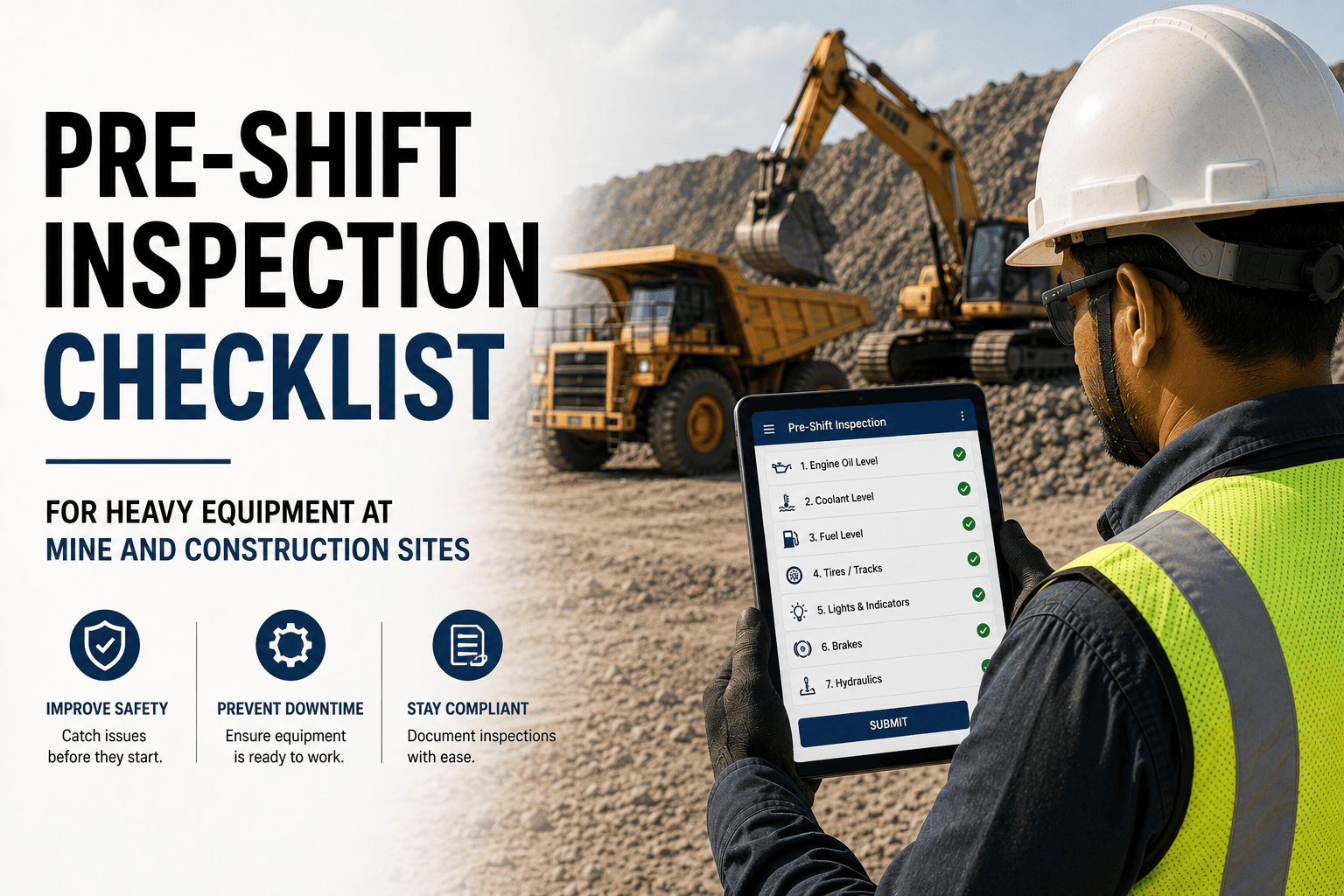
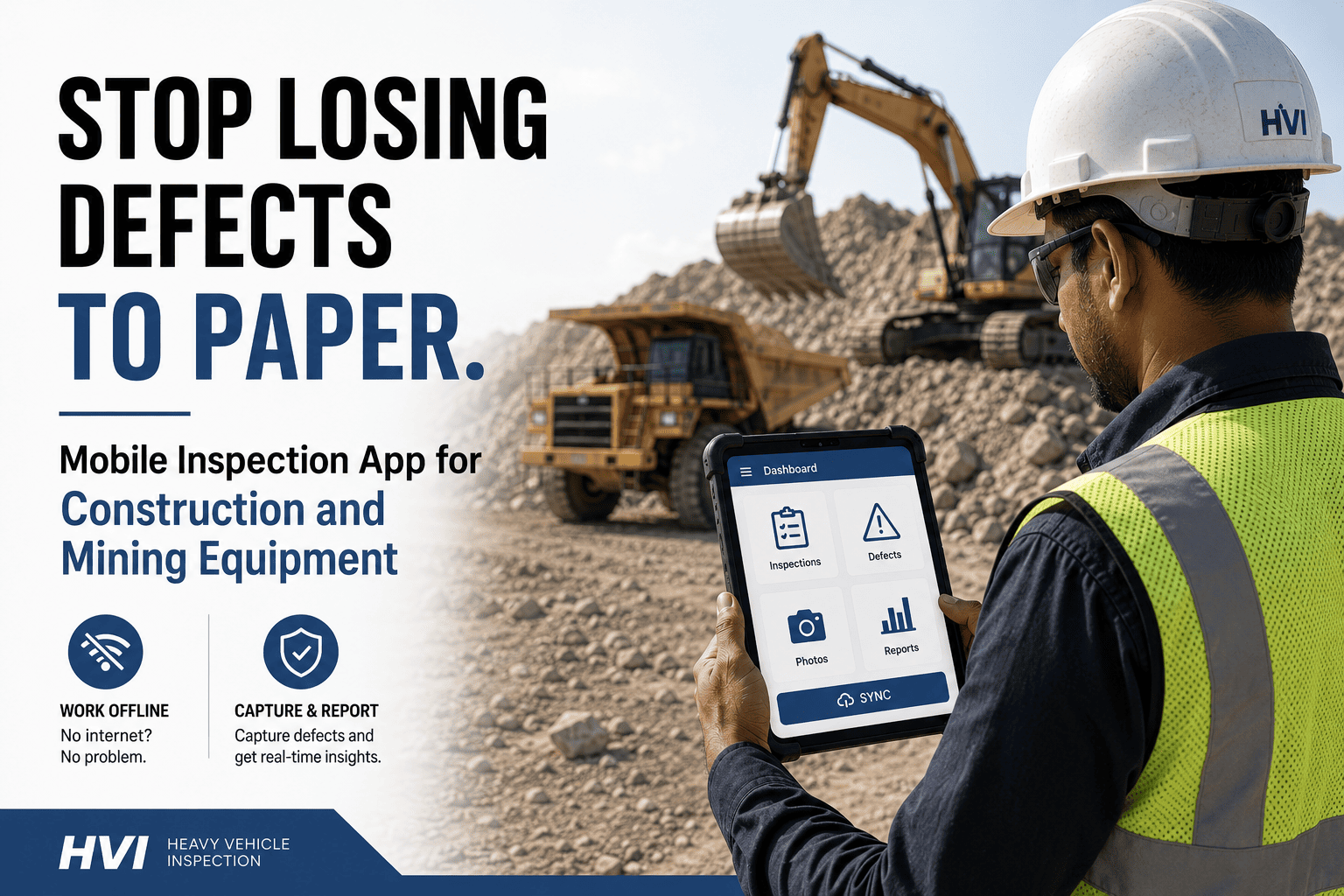
Turn cellular off, complete a full pre-shift, capture photos, sign and submit. Then turn cellular back on and confirm every field, photo and timestamp arrives intact on the dashboard.
Export A 90-Day Compliance Bundle
Ask the vendor to export a 90 day DVIR or pre-shift bundle for one specific asset. It should take under a minute and be formatted for regulator submission. Anything slower fails your next audit.
Fire A Corrective Work Order From A Failed Item
Flag a fake defect during pre-shift. Confirm the WO auto-generates with photos, priority, asset ID and mechanic notification within 60 seconds — with no manual intervention.
See Cost Per Asset Per Hour Update Live
Close a WO with parts and labour logged. Confirm the cost per hour metric on your asset dashboard updates in real time. If it needs manual reconciliation, the analytics layer is fake.
Frequently Asked Questions
Move Your Fleet Off Paper And Recover Rs 1.38L Per Asset Per Year
HVI is live on construction, mining and infrastructure fleets across India, replacing paper inspections with digital DVIR, auto work orders, cost per asset dashboards and DGMS ready compliance exports. Start a free trial or block 30 minutes with our team to walk through your specific fleet economics.