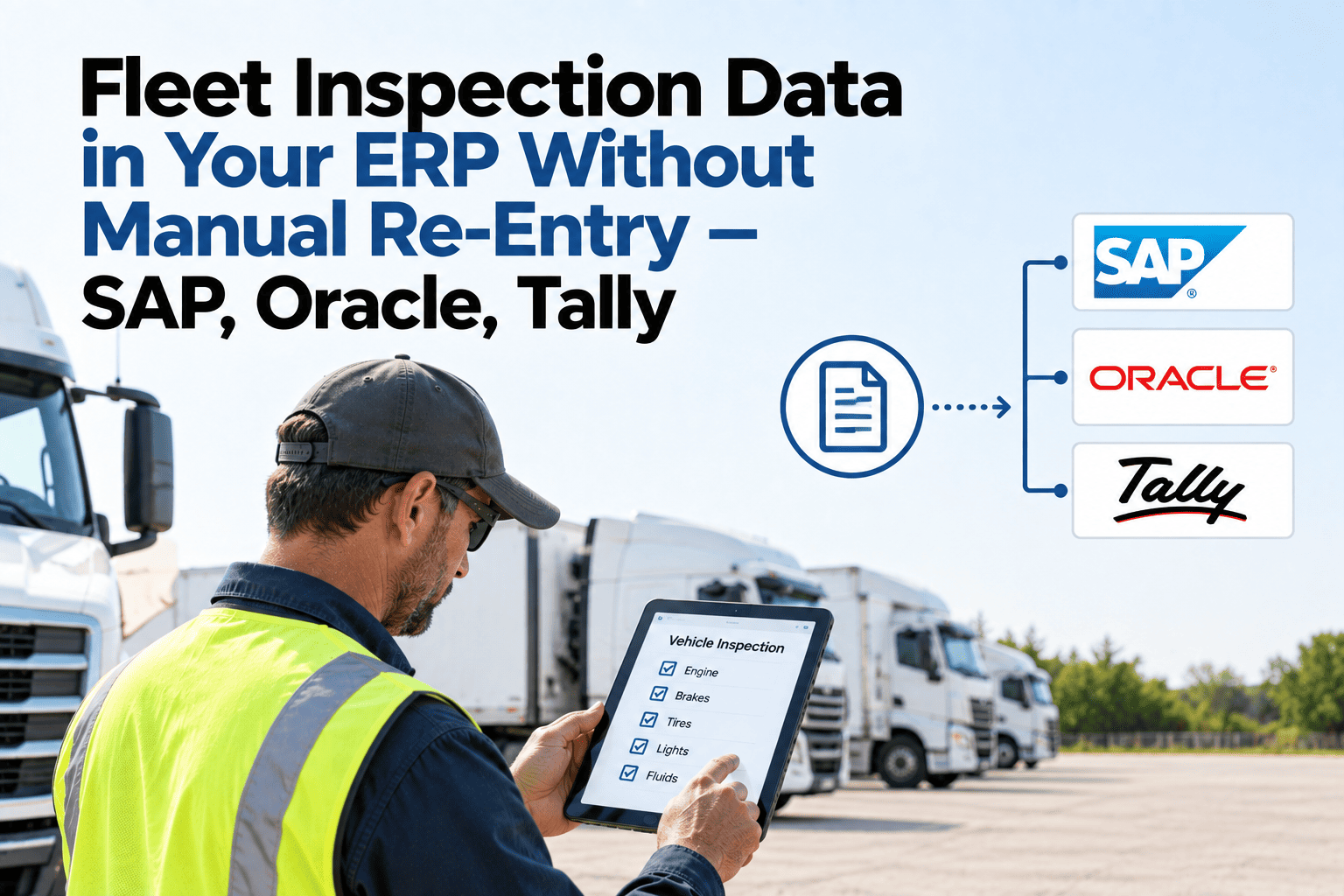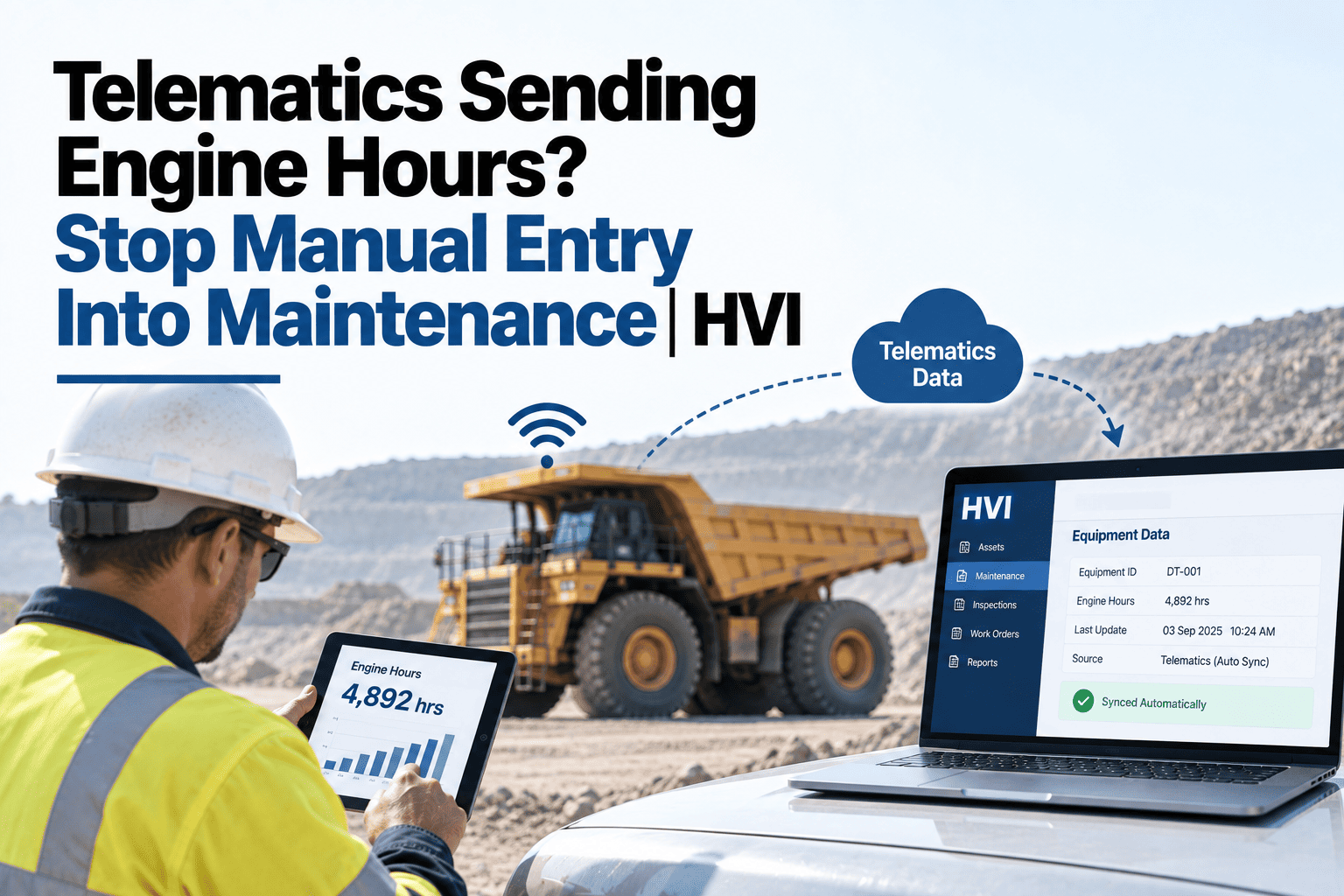
Every meter-based PM plan is only as good as the meter reading behind it — and on most Indian fleets, that reading is a number an operator remembered to write down last Tuesday. Update hours weekly and a 250-hour service quietly becomes a 290-hour service; skip a site's readings during a breakdown-heavy fortnight and machines cross their intervals with nobody noticing until the oil analysis, or the seized turbo, says so. Meanwhile the data to fix this already streams off your fleet: AIS-140 VLTD boxes mandated on every commercial vehicle, Samsara, Geotab, and Verizon Connect subscriptions, and OEM telematics like JCB LiveLink and Komatsu KOMTRAX reporting hours, kilometres, location, and fault codes all day long — usually into a portal nobody connects to maintenance. HVI closes that loop: live engine hours and GPS kilometres update every machine's meters continuously, PM plans count down in real time, and work orders generate themselves with lead time to plan parts and people — while machines without telematics feed the same engine through operator checklist readings, photo-verified, offline-capable. The service falls due on the machine's clock, not the register's — sign up free and connect your first data feed this week.
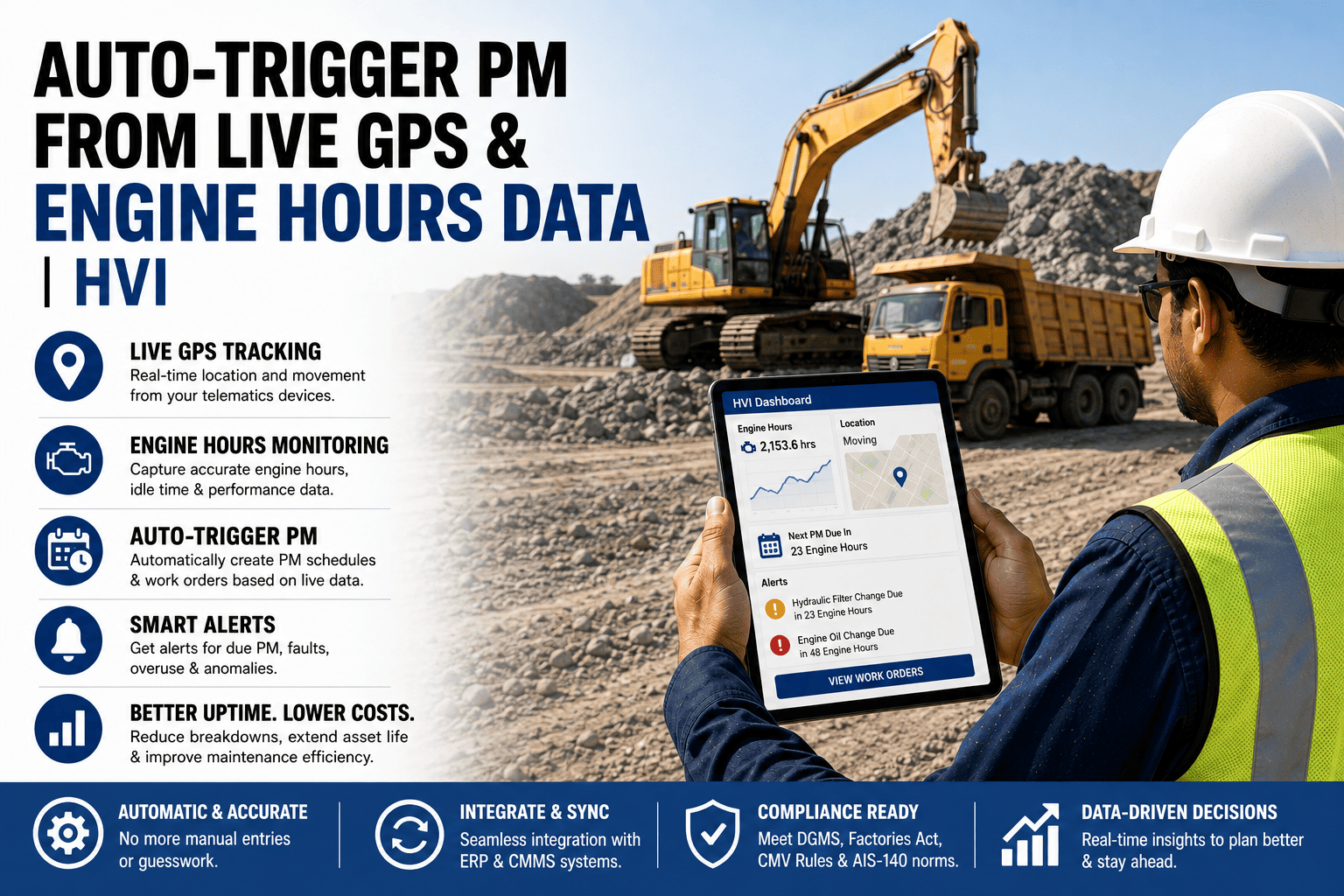
Auto-Trigger PM from Live GPS & Engine Hours Data
Live hours, kilometres, and fault codes from AIS-140 VLTD, Samsara, Geotab, Verizon Connect, and OEM telematics flow straight into PM schedules and work orders — no manual meter updates, no missed intervals.
The Same 250-Hour Service, Two Ways of Catching It
Manual meters: hours written weekly — sometimes — from a cab gauge, typed into Excel later. The 250-hour interval is detected at the next update, and the service actually happens at 280–310 hours, every cycle, on every machine.
Live feed: the meter updates itself all day. At "due in 40 hours" the work order is already created, parts reserved, and a slot planned — the service happens at 250 hours because nothing depended on anyone remembering.
Chronic 15–20% interval overshoot is the silent norm on manually-metered fleets — and it compounds: late oil changes accelerate wear, warranty claims get questioned on service history, and resale valuations discount machines whose records show drift. The fix is not more discipline; it is removing the human from the meter.
From Device Ping to Scheduled Service — The Trigger Chain
Devices Report
VLTD boxes, telematics units, and OEM systems stream hours, kilometres, location, and fault codes on their normal schedule — no new hardware needed.
Meters Update Live
Every machine's hour and odometer meters in HVI stay current automatically — the same meters PM plans, cost-per-hour, and utilisation reports all read.
PM Plans Count Down
Each interval — 250-hour service, 10,000 km check, seasonal tasks — counts down against live usage, per machine, visible on one due-list.
Work Orders Fire With Lead Time
At your threshold — say, due-in-40-hours — the work order generates itself with the task list and parts attached, before the interval passes, not after.
People and Parts Line Up
The PM crew sees the job in their queue, stores sees the parts demand, and the supervisor slots the machine's downtime into the production plan — days ahead.
Connect What You Already Run
Bring Your Tracker List — Leave With Live Meters
In a 30-minute session, tell us what is on your machines — VLTD vendors, telematics platforms, OEM systems — and our India team maps the feeds, connects a sample machine live, and shows its PM plan counting down on real hours. Fleets typically see their first auto-generated PM work order within days of connecting, with no new hardware bought.
Beyond Hours: What Live Data Can Trigger
| Live Signal | Example Rule | What Fires Automatically |
|---|---|---|
| Engine hours | 250 / 500 / 1,000-hour intervals per machine class | PM work order with task list and parts, at your lead-time threshold |
| Kilometres | 10,000 km service; tyre rotation due on dumpers and tippers | Distance-based service and rotation orders on the right axle positions |
| Fault codes (DTC / J1939) | Coolant temperature, DPF, low oil pressure codes | Inspection task or work order on that machine, severity-ranked, engineer alerted |
| Excess idling | Idle share above the site's band for the machine class | Flag on the fuel dashboard; operator coaching entry on the record |
| Geofence & after-hours movement | Machine leaves site or runs outside shift hours | Alert to the site engineer — misuse caught the day it happens |
| Device silence | No report from a tracker for your set window | Device-health task — so a dead tracker cannot quietly stop the meters |
Two Details That Make It Work in Practice
Lead Time, Not Overdue Alarms
The trigger fires at "due in 40 hours," and because the system knows each machine's usage rate, it can say what that means in days — a machine running 10 hours a day gives the planner four days to reserve parts and slot downtime. PM stops being a fire drill and becomes a scheduled appointment the production plan already expects.
Mixed Fleets Are the Normal Case
Telematics on the new Volvos, VLTD on the tippers, nothing on the ten-year-old dozer — all three feed the same PM engine, live where devices exist and operator-entered with meter photos where they do not. One due-list, one discipline, no machine left on a separate manual system.
Frequently Asked Questions
Is AIS-140 VLTD data enough to drive PM, or do we need full telematics?
VLTD gives location and ignition, from which running hours and kilometres are derived reliably enough for PM triggering on most vehicles — full telematics adds true ECU hours and fault codes on top. Start with what the mandate already put on your fleet, and upgrade machine classes where diagnostics justify it.
Do we keep our existing telematics contracts and portals?
Yes — HVI consumes data through the platforms' APIs alongside your existing use; nothing is replaced, reinstalled, or renegotiated. The tracking portal keeps doing tracking; the maintenance system finally gets the meters it was starving for.
Do fault codes work on construction equipment, not just trucks?
Where the machine and device expose J1939 or OEM diagnostic streams, yes — codes map to inspection tasks or work orders with severity rules you control. On older HEMM without diagnostics, hour-based PM and operator daily checks carry the load, which is exactly what they are designed for.
What happens when a tracker fails or a machine goes to a no-signal pit?
Device silence beyond your window raises a device-health task automatically, and the machine falls back to operator meter entry — photo-verified, offline-capable — so PM never silently stalls on a dead box. When the feed resumes, the meters reconcile and the plan recalculates; sign up free and set your fallback rules in minutes.
How long does connecting a feed take?
API-based platforms typically connect in days — credentials, machine mapping, and a validation run against known meters — and VLTD integrations depend on your vendor's data access but follow the same path. The PM plans themselves are configuration, not a project; see a live connection made in a 30-minute demo with our India team.
Your Machines Already Report Their Hours. Let the Hours Do the Scheduling.
Connect telematics to maintenance and let real machine data drive PMs. Keep meters current, trigger services on time, convert fault codes into work orders, and manage every machine in one place. Start free or connect your first feed in 30 minutes.