India's construction equipment market crossed ₹90,000 crore in 2025 and is headed for ₹1.58 lakh crore by 2034. Yet more than half of Indian EPC contractors are still making the same expensive mistake: calculating equipment cost by EMI alone, completely missing the 60–70% of true ownership cost that never shows up in the purchase invoice. Whether you run a fleet of 5 machines or 50, the rent vs own decision directly shapes your project margin, cash flow, and NHAI compliance burden. This guide breaks down the real numbers for Indian site conditions in 2026, so your next decision is based on total cost — not just the price tag. Explore how HVI helps you track fleet costs and compliance in one place — free to start.
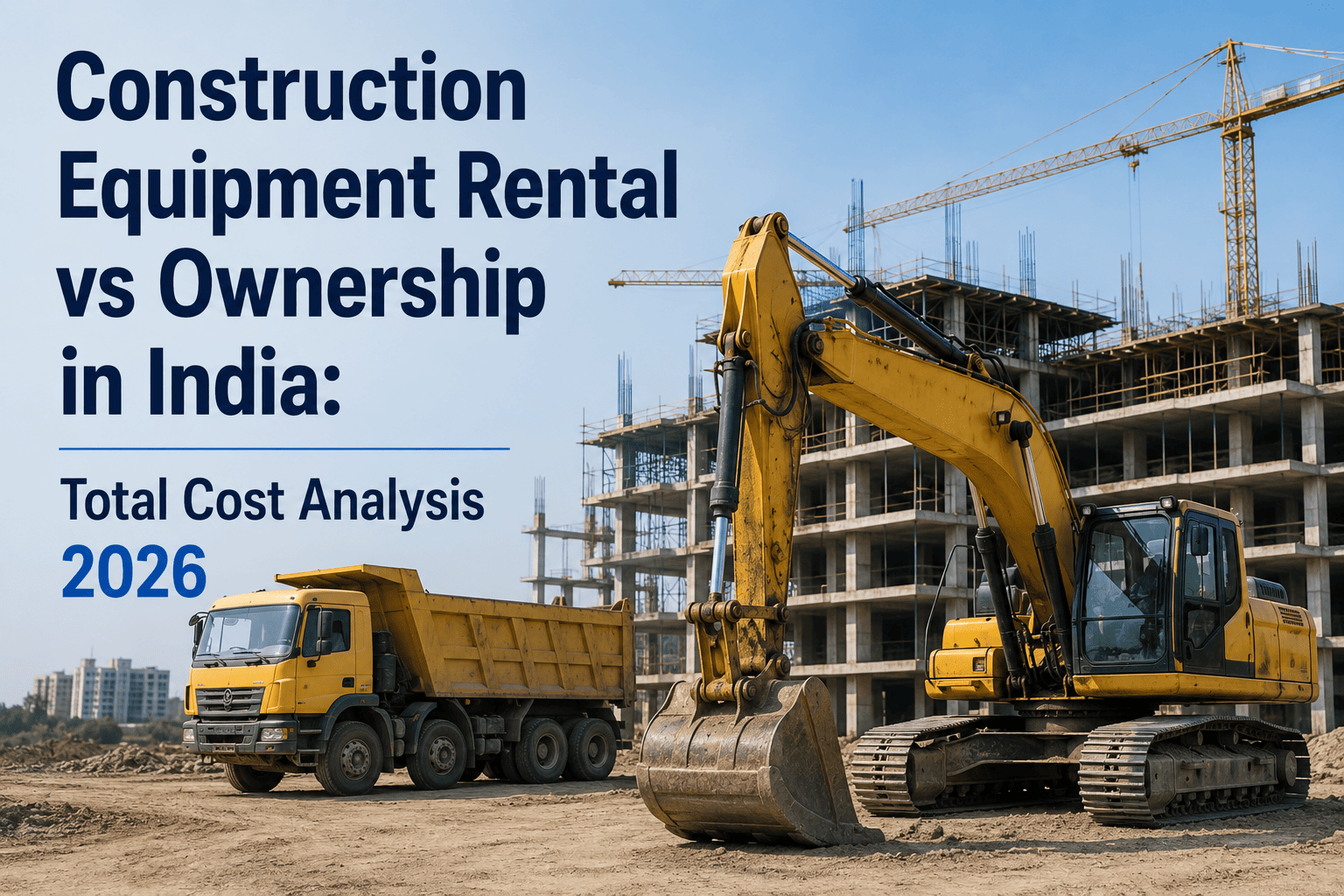
Construction Equipment Rental vs Ownership in India: What the Real Numbers Say in 2026
A practical total-cost analysis for EPC contractors, project managers, and fleet owners running highway, building, and infrastructure projects across India. Covers JCB, excavators, cranes, pavers, and transit mixers.
Why Most Contractors Get the Math Wrong
The purchase price is only the entry fee. On a typical Indian construction project, the full ownership cost of a machine is 3 to 4 times the sticker price over its useful life. Here is what gets missed.
Rental vs Ownership: Head-to-Head for Indian Contractors
Neither model wins every time. The decision depends on how many hours the machine actually works on your projects each year. Here is how each model performs across six real factors.
| Factor | Rental | Ownership | Winner |
|---|---|---|---|
| Short project (under 6 months) | Pay only for working days. Zero idle cost. | Machine depreciates whether it works or not | Rental |
| Long project (2+ years, 70%+ utilisation) | Rental cost accumulates and exceeds purchase over time | Per-hour cost drops as fixed costs spread across more hours | Ownership |
| Maintenance responsibility | Supplier handles breakdowns. You pay for productive hours. | Your team manages PM, repairs, spare parts sourcing | Rental |
| NHAI / IQA compliance records | Limited visibility into rental fleet maintenance history | Full control over inspection logs, PM records, defect closure | Ownership |
| Capital tied up | Zero upfront capital. Working capital stays liquid. | ₹24–65 lakh locked per machine. EMI commitments for 3–5 years. | Rental |
| Remote or Tier 3 locations | Rental supply thin in remote areas. Mobilisation costs high. | Owned fleet available on demand. No mobilisation delays. | Ownership |
| Specialised equipment (cranes, pavers) | Rent as needed. No idle asset when the specialised phase ends. | Expensive machine sits idle between specialised phases | Rental |
| Bid credibility for large NHAI packages | May count toward bid qualification only if rental agreements are formal | Owned fleet boosts bid score and demonstrated capacity | Ownership |
The Break-Even Calculator: When Does Buying Beat Renting?
Break-even depends on three variables: daily rental rate, machine utilisation, and true monthly ownership cost. Here are the numbers for three of the most common machines on Indian highway and building projects.
Knowing the break-even is step one. Tracking it live is where contractors win margin.
HVI gives every machine its own cost and inspection dashboard — PM hours tracked, idle time flagged, and NHAI-ready reports generated in one click. No spreadsheets. No paper logs.
The 4 Situations Where Renting Wins Every Time
Experienced Indian EPC contractors have learned to identify the situations where deploying capital into owned assets destroys value. Here are the four clearest ones.
Short or Uncertain Project Duration
Projects under 6 months rarely generate enough utilisation hours to justify ownership costs. If the project timeline can shift or the pipeline beyond this contract is unclear, rental keeps capital liquid and eliminates residual-value risk when the project closes.
Specialised Equipment Used Infrequently
Large cranes, long-reach excavators, pavers, and soil stabilisers are needed for specific project phases — not continuously. Owning these machines means carrying idle depreciation and maintenance cost for months between phases. Renting transfers this burden to the supplier.
Surge Capacity on Peak-Load Projects
When you win a large package and need to rapidly scale equipment beyond your owned fleet, renting fills the gap without permanent fleet expansion. This is how leading contractors maintain high utilisation on owned assets while still meeting peak-load demand.
Early-Stage or Capital-Constrained Contractors
Tying up ₹2–5 crore in owned equipment at the start of a business limits your ability to invest in working capital, bid bonds, and skilled staff. Renting lets you grow the topline before locking capital into depreciating assets — this is the path most successful mid-size EPC firms followed.
The 4 Situations Where Owning Beats Renting
Ownership has a clear advantage when the utilisation maths work — but also when project conditions make rental impractical or compliance-risky.
High Utilisation Across Continuous Projects
When machine utilisation exceeds 70% annually across back-to-back projects, the per-hour cost of ownership drops well below rental rates. Three or more projects at the same site type, running without long gaps, is the clearest signal to own.
Remote Sites with Poor Rental Supply
Tier 3 towns, forest stretches, and remote highway corridors in states like Arunachal Pradesh, Manipur, and parts of Rajasthan have thin rental markets. Mobilisation costs for rented machines in these areas (₹8,000–25,000 per trip) quickly erode any rate advantage.
NHAI and HAM Compliance Requirements
NHAI's 2026 compliance framework requires 90-day equipment inspection records, PM logs by engine hours, and defect closure trails. With a rental fleet, this documentation is almost impossible to maintain. Owned fleet gives you full control over every compliance record — essential for passing Independent Engineer audits without NCRs.
Bid Credibility for Large Packages
NHAI's tightened "similar work" and fleet-ownership criteria in 2026 mean that contractors bidding for highway EPC and HAM packages above ₹200 crore need to demonstrate a committed owned fleet. A rental-only fleet may not satisfy pre-qualification requirements for large bids.
The Smart Model: What Leading Indian Contractors Actually Do
Leading Indian contractors — the ones consistently winning NHAI and BharatMala packages — do not debate rent vs own as an either/or question. They run a deliberate hybrid model built on one principle: own the core, rent the rest.
This keeps owned fleet utilisation above 75%, the threshold where ownership is financially superior to rental, while maintaining flexibility and controlling compliance risk on NHAI audits.
Compliance Cost: The Factor That Changes the Entire Equation
One factor that most rent vs own analyses ignore: NHAI compliance cost. From 2026, failing equipment audits can cost far more than the savings from any fleet decision.
Notice of Non-Conformance
First audit failure from an Independent Engineer. Triggers re-inspection, document scramble, and goes on file for future bids. Average time lost: 5–7 working days of site management attention per NCR.
Liquidated Damages
Daily LD of 0.05–0.1% of contract value for delays caused by compliance failures. On a ₹100 crore NHAI package, that is ₹50,000–1 lakh per day. A 3-week compliance issue costs ₹10–20 lakh.
Blacklisting
Repeat non-compliance can trigger a 1–3 year ban from NHAI bids. For a contractor running ₹500 crore+ in highway projects annually, this is an existential penalty — far exceeding any fleet cost saving.
Your Fleet Decision Is Only Half the Work. Managing It Is the Other Half.
Whether you own 5 machines or 50, HVI keeps every inspection, PM log, defect record, and compliance report audit-ready — without paperwork. Indian highway contractors use HVI to pass NHAI Independent Engineer visits without NCRs, every time.