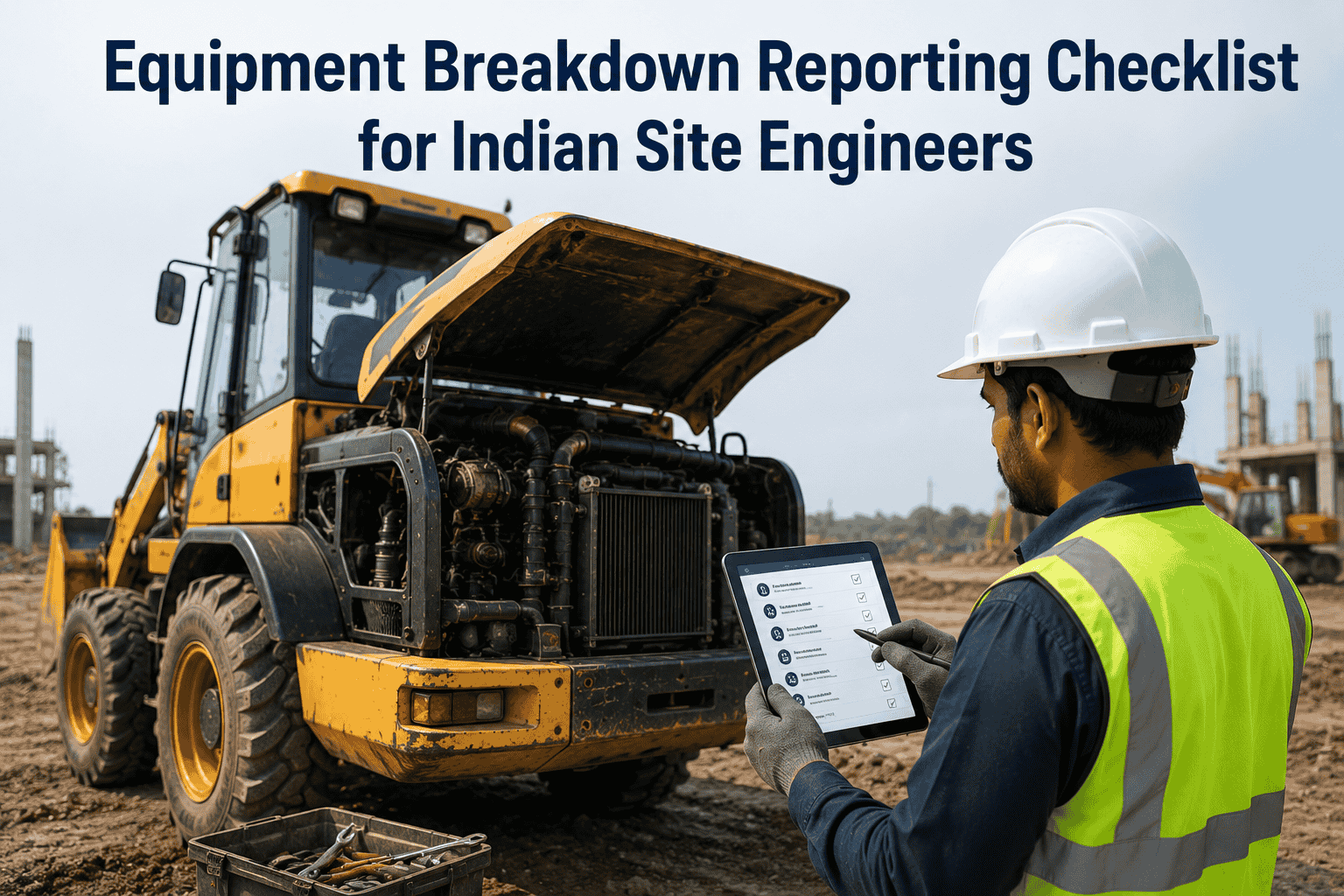
A cracked hydraulic line spotted at 06:00 that gets logged on a scrap of paper and forgotten is the Rs 4 lakh breakdown at 14:00. On Indian construction, highway, mining, and EPC sites, equipment defects reported informally — verbally, on WhatsApp, or not at all — are the single biggest source of unplanned downtime. A structured equipment fault and defect card forces every defect through a five-step chain: raise, classify, assign, fix, close. Nothing slips. Nothing festers. The workshop in-charge knows exactly what is open, what is critical, and what is overdue. This page gives you a complete construction equipment fault and defect card format for Indian sites, covering all defect types, priority levels, photo capture, and work-order creation. Start free with HVI to run a live defect register across your entire fleet.
Construction Equipment Fault & Defect Card Format
A complete equipment defect card template for Indian EPC, highway, and mining sites. Asset ID, defect type, severity, photo proof, work-order creation, and digital closure — all in one traceable record per fault.
Of all unplanned downtime on Indian sites is caused by defects that were visible but never formally reported
EPC fleet maintenance data, IndiaHigher repair cost when a defect escalates from P2 to breakdown vs fixing at P2 stage
OEM maintenance cost benchmarksTarget ratio — 70% defects caught at inspection stage, only 30% from breakdowns
Industry best practice, IndiaTarget response time for a P1 critical defect to have a mechanic on-site and work order open
EPC SLA standards, IndiaDefect Priority Classification — P1 to P4
The single most important decision when raising a defect card is assigning the right priority. Wrong classification either triggers a crisis response for a minor fault, or — far more dangerous — delays a critical repair until a machine breaks down.
Critical
Machine must stop. Defect is a safety risk or will cause total failure if not fixed immediately.
- Hydraulic line burst or severe leak
- Brake failure on tipper or dozer
- Structural crack — boom, arm, frame
- Electrical fault with fire/shock risk
- No-start / complete engine failure
High
Machine can run with supervision but defect will escalate to P1 if not addressed within 24 hours.
- Slow hydraulic leak (minor seep)
- Engine overheating trend flagged
- Undercarriage — shoe loose or broken
- AC / cab pressurisation failure
- Warning light or DTC code active
Medium
Defect does not affect operation today but must be resolved before the next scheduled PM service.
- Minor oil consumption above normal
- Wiper, lights, horn not working
- Cab door seal or glass crack
- Bucket tooth worn below threshold
- Battery not holding charge well
Low
Cosmetic or very minor issue with no operational or safety impact. Log and schedule at next convenient downtime.
- Paint / decal damage
- Mirror or grab handle missing
- Minor cab upholstery damage
- Instrument cluster back-lighting
- Step or handrail cosmetic wear
Sample Equipment Defect Card — Filled Format
This is the standard defect card format used on Indian EPC, highway, and mining sites. One card per defect, raised at the point of discovery, and tracked through to verified closure.
Oil seeping from boom-up hydraulic hose near cylinder-end ferrule. Active drip onto ground — approx. 200 ml puddle visible at 06:00. Boom cannot be raised safely. Machine tagged out of service. Safety cones placed.
Every defect card automatically links to a work order, a parts request, and the machine's full service history. Get the HVI defect card free — raise your first fault in under 2 minutes.
Live Defect Register — Sample Fleet View
A single defect card is useful. A live defect register across all machines on all packages is how workshop heads and project managers actually make decisions. Here is what a fleet-wide defect register looks like on a 5-machine sample.
| Defect ID | Machine | System | Priority | Age | Status |
|---|---|---|---|---|---|
| DEF-0341 | EX-07 / PC210 | Hydraulic | P1 | 8 hrs | In Progress |
| DEF-0338 | DZ-02 / BD80 | Undercarriage | P2 | 31 hrs ↑ | Overdue |
| DEF-0335 | TIP-22 / Signa | Electrical | P2 | 18 hrs | Assigned |
| DEF-0329 | JCB-03 / 3DX | Engine | P3 | 54 hrs ↑ | Overdue |
| DEF-0344 | CR-05 / 750T | Structural | P3 | 4 hrs | Raised |
DZ-02 and JCB-03 are the first calls at this morning's meeting. Two overdue defects mean two machines at escalation risk. Book a HVI demo to see a live defect register on your fleet data.
Defect Types by Machine System
Every defect card must be tagged to a machine system. This drives the routing to the right mechanic, the right parts, and the right priority. Here are the eight systems most commonly flagged on Indian construction equipment.
Hydraulic
- Hose leak / burst
- Cylinder seal failure
- Pump cavitation noise
- Slow/jerky movements
Engine
- Overheating
- Excessive smoke
- Oil or coolant loss
- Hard start / no-start
Electrical
- Warning light on dash
- DTC fault code active
- Wiring burn or short
- Alternator / battery fault
Undercarriage
- Shoe loose / broken
- Track tension low
- Sprocket / idler wear
- Roller damage
Structural
- Boom / arm crack
- Frame weld failure
- Counterweight loose
- Bucket pin wear
Transmission
- Gear slip or noise
- Torque converter issue
- Drive axle abnormal
- Clutch slippage
Brakes & Steering
- Brake pedal spongy
- Brake fade or pull
- Steering hard or slack
- Parking brake failure
Cab & Safety
- ROPS / FOPS damage
- Seatbelt not locking
- Glass crack or missing
- Fire extinguisher absent
Tag every defect to the right system and the right mechanic gets it instantly. No routing delays, no crossed wires. Book a HVI demo to see the full system classification live on a real fleet.
Expert View from the Field
We were running 74 machines on two tunnel packages and the defect reporting was happening on WhatsApp groups. By the time I saw a message, the machine had already been run for another 4 hours on a fault that should have stopped it. One P2 hydraulic seep on an excavator became a P1 full-burst six hours later. That one breakdown cost Rs 3.8 lakh in emergency parts and 19 hours of downtime.
After we moved defect cards to HVI, every operator raises a card from their phone before they report verbally. I can see all open defects on my dashboard the moment they are raised. P1 defects now get a mechanic within 3 hours on average. In the last 8 months we have had zero P2-to-breakdown escalations. That is the number that matters to me.
Dinesh Verma, Workshop In-Charge, Afcons Infrastructure, Maharashtra — 74 machines across 2 tunnel packages
WhatsApp / Verbal Defect Reporting vs HVI Digital Defect Card
- ×Defect easily missed in a group chat thread
- ×No priority assigned — everything feels urgent
- ×No photo evidence — "it was fine when I saw it"
- ×No work order created — repair may never happen
- ×No closure confirmation — was it actually fixed?
- ×No audit trail for DGMS, insurance, or client
- ✓Every defect on a live register — nothing hidden
- ✓Priority P1–P4 assigned at creation, alerts fire instantly
- ✓Photo evidence mandatory — cannot skip
- ✓Work order auto-generated from the defect card
- ✓Mechanic must sign closure with repair details
- ✓Full audit PDF for DGMS, insurance, or client export
For Indian construction, mining, and EPC fleets running 15+ machines, a digital defect register pays back its cost on the first P1-to-breakdown escalation it prevents. Sign up free with HVI and put every open defect on one live screen.
Frequently Asked Questions
Who is responsible for raising an equipment defect card on an Indian site?
Any person who discovers or suspects a defect — operator, helper, mechanic, supervisor, or safety officer — is responsible for raising the defect card. In practice, operators are the primary raisers because they are closest to the machine during operation. Under the Factories Act 1948 and BOCW Rules, operators are required to report any unsafe condition they observe during pre-shift or in-shift inspection. The defect card is the formal mechanism for this legal obligation. On DGMS-regulated mining sites, failure to report known equipment defects can result in personal liability for the operator and supervisor.
What is the difference between a defect card and a work order?
A defect card is the initial report raised when a fault is discovered. It captures what is wrong, where, when, and by whom — plus photo evidence. A work order is created after the defect is reviewed and a repair decision is made. The work order specifies who will repair it, what parts are needed, the estimated time, and the target completion date. One defect card can create one work order, or — for complex faults — multiple sequential work orders. On HVI, the work order is auto-generated from the defect card in one tap, so the transition from fault discovery to repair authorisation takes under 2 minutes.
Can a machine continue working while a defect card is open?
That depends entirely on the priority classification. A P1 critical defect means the machine must stop immediately — the operator should tag it out and no one should run it until the repair is complete and verified. A P2 high-priority defect may allow supervised operation until the repair is done within 24 hours. P3 and P4 defects allow normal operation until the scheduled repair window. The workshop in-charge must review and confirm the priority before the machine continues. Running a machine on an unreviewed P1 defect is a safety violation under Indian EPC site SOPs and DGMS regulations.
How long should defect cards be retained for audit purposes?
Defect cards and their associated work orders should be retained for the full asset life plus 3 years after disposal. For EPC projects under NHAI, NHIDCL, or government client contracts, the client's audit clauses typically require maintenance records to be available for the full defect liability period of the contract — usually 5 to 10 years. Under DGMS regulations for mining HEMM, maintenance defect records must be maintained in the machine's official logbook and made available for inspection at any time. HVI's cloud storage keeps all defect cards permanently, with one-click export to PDF for any audit.
What photo evidence should be attached to a defect card?
A good defect card photo set includes at minimum three photos: a wide shot showing the machine and general fault area so the context is clear, a close-up showing the defect clearly such as the leaking hose, cracked weld, or worn component, and a reference photo showing the equipment ID plate or asset number tag. For safety-critical defects like hydraulic leaks, structural cracks, or brake issues, a photo of the fault severity — the puddle size, the crack width — is essential for prioritisation. HVI's defect card enforces a minimum of one photo and allows up to 10 per card, with GPS and timestamp automatically embedded.
Put Every Open Defect on One Live Screen
HVI gives Indian sites a complete digital defect management system. Operator raises from phone with photo. Auto-prioritised P1–P4. Work order in one tap. Mechanic closure with repair proof. Workshop head sees every open fault in real time. Built for EPC, highway, and mining fleets.
No credit card. No hardware. Live on your fleet in under 10 minutes.