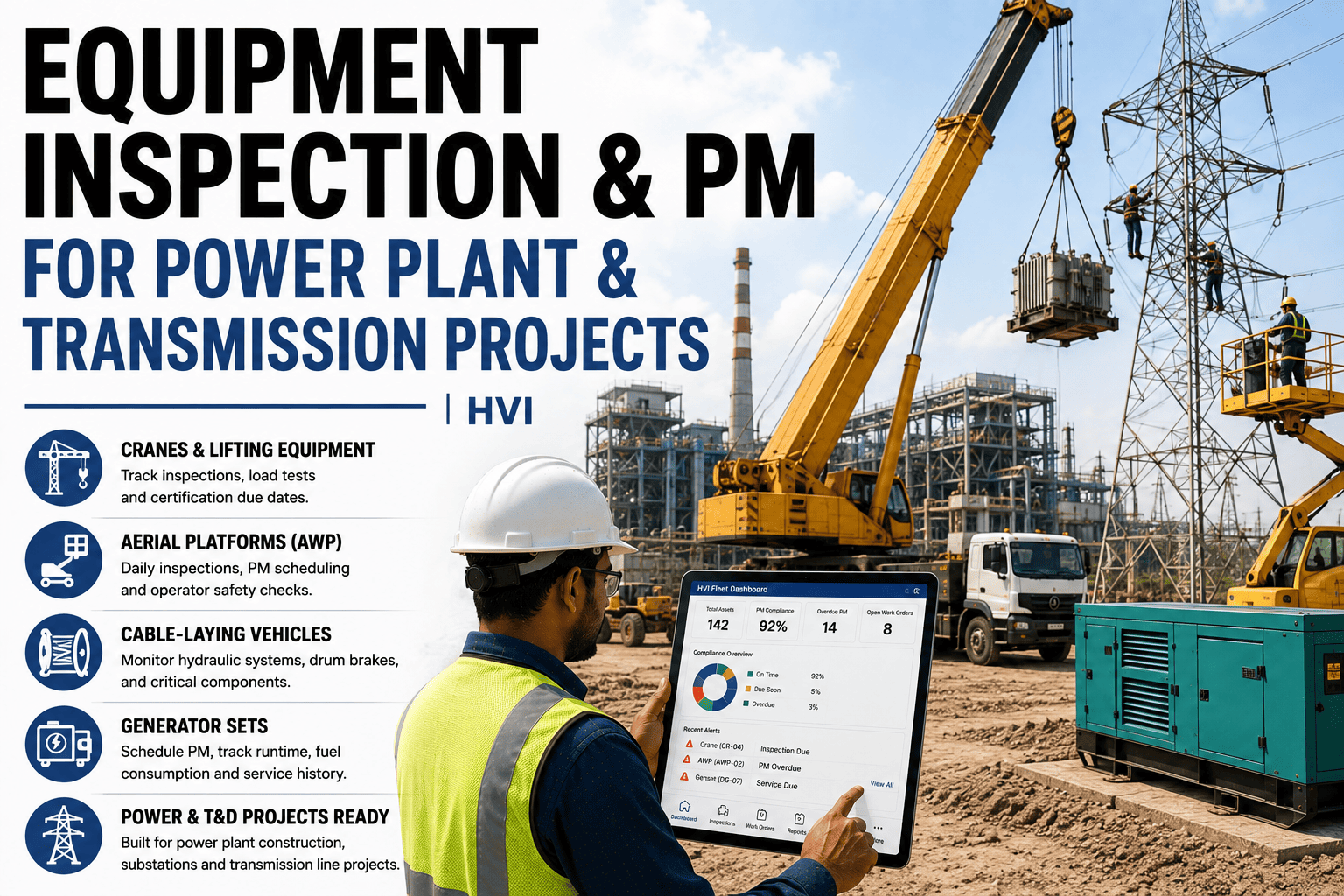
On most sites an equipment failure costs time. On transmission and distribution work it can leave someone suspended at height with no way down under their own power, at a tower location a recovery vehicle cannot easily reach, possibly close to conductors. The maintenance requirement follows from that consequence rather than from the machines themselves, which are ordinary cranes, platforms, and generators. What changes is that certain failures stop being a downtime problem and become a rescue problem, and the checks that prevent them deserve treating differently from the rest of the list. You can review how your own fleet is checked in a free 30-minute session.
Some Failures Are Downtime. Others Are a Rescue.
Inspection and maintenance for cranes, aerial work platforms, and gensets on power and T&D projects, built around access, height, and consequence.
Why the Consequence Profile Is Different
People are in the machine, at height
A platform that will not lower is a different category of event from a machine that will not start. The checks that prevent it should not sit in the same undifferentiated list as everything else.
Recovery is slow and sometimes impossible
Tower locations are frequently off-road, remote, and reached by tracks that a recovery vehicle cannot use. The time between failure and assistance is measured in hours.
Proximity to conductors constrains everything
What can be done to a stranded machine, and by whom, is limited by clearance requirements that do not apply on ordinary sites.
A genset failure stops the work, not one machine
Where site power depends on it, the generator is not one asset among many. Its availability sets everyone else's.
Three Machine Families, Three Focuses
Setup on uneven or made-up ground at tower locations, where outrigger support and levelling are more demanding than on a prepared site.
Focus: ground assessment and full outrigger deployment, load chart validity for the configuration in use, and rope and hook condition. Statutory examination records current and available on site.
The machines where a fault has an occupant. Emergency lowering, controls, interlocks, and stability systems carry the consequence.
Focus: emergency lowering function tested rather than assumed, guardrails and anchor points intact, tilt and interlock systems functional, and a rescue plan that has been rehearsed for this location.
Often running continuously and often the thing everything else depends on, yet checked less carefully than the machines they power.
Focus: fuel condition and contamination, cooling, battery and starting reliability, load testing rather than no-load running, and earthing arrangements verified.
Separate the Checks That Carry Consequence
Critical items marked so they hold the machine, with evidence captured at the tower location and synced when the device reaches coverage.
Access Is the Constraint Behind Everything
A fault found at the yard costs an hour. The same fault found at a tower costs a day, so pre-departure checks carry more weight here than almost anywhere.
Spares carried with the crew matter more than spares held at a depot that cannot be reached quickly.
Coverage along a transmission route is usually poor, so inspection capture has to work fully offline.
Machines move between tower locations continuously, so records have to follow the asset rather than a site.
Recovery arrangements should be established before the machine goes out, not worked out while it is stranded.
Frequently Asked Questions
Should emergency lowering be tested every shift?
Test frequency should follow the manufacturer's instructions and your own safety procedures, and the important point is that it is actually tested rather than assumed functional. Confirm the required regime with your safety officer. We can show how critical items are configured to hold a machine on failure during a call with our team.
Why do gensets get neglected?
Because they run unattended and produce no obvious signal until they stop. A machine nobody stands next to is a machine nobody inspects, which is why a defined schedule matters more for gensets than for equipment with a daily operator.
What working clearances apply near live conductors?
These are set by voltage, regulation, and the utility's own requirements, and they are not something to take from a general webpage. Your safety officer and the asset owner define them for each job.
How do we handle inspections with no signal along the route?
Everything captures offline including photos and syncs when the device reaches coverage, with the original completion time preserved rather than the upload time.
What matters most to get right first?
The pre-departure check, because the cost of finding a fault at the yard rather than at a tower is larger on this work than on almost any other. Start with a free trial.
Check Hardest Where Recovery Is Slowest
Mark the items whose failure creates a rescue rather than a delay, test emergency functions instead of assuming them, give gensets a defined schedule because nobody stands beside them, and catch faults before the machine leaves for a location you cannot easily reach.