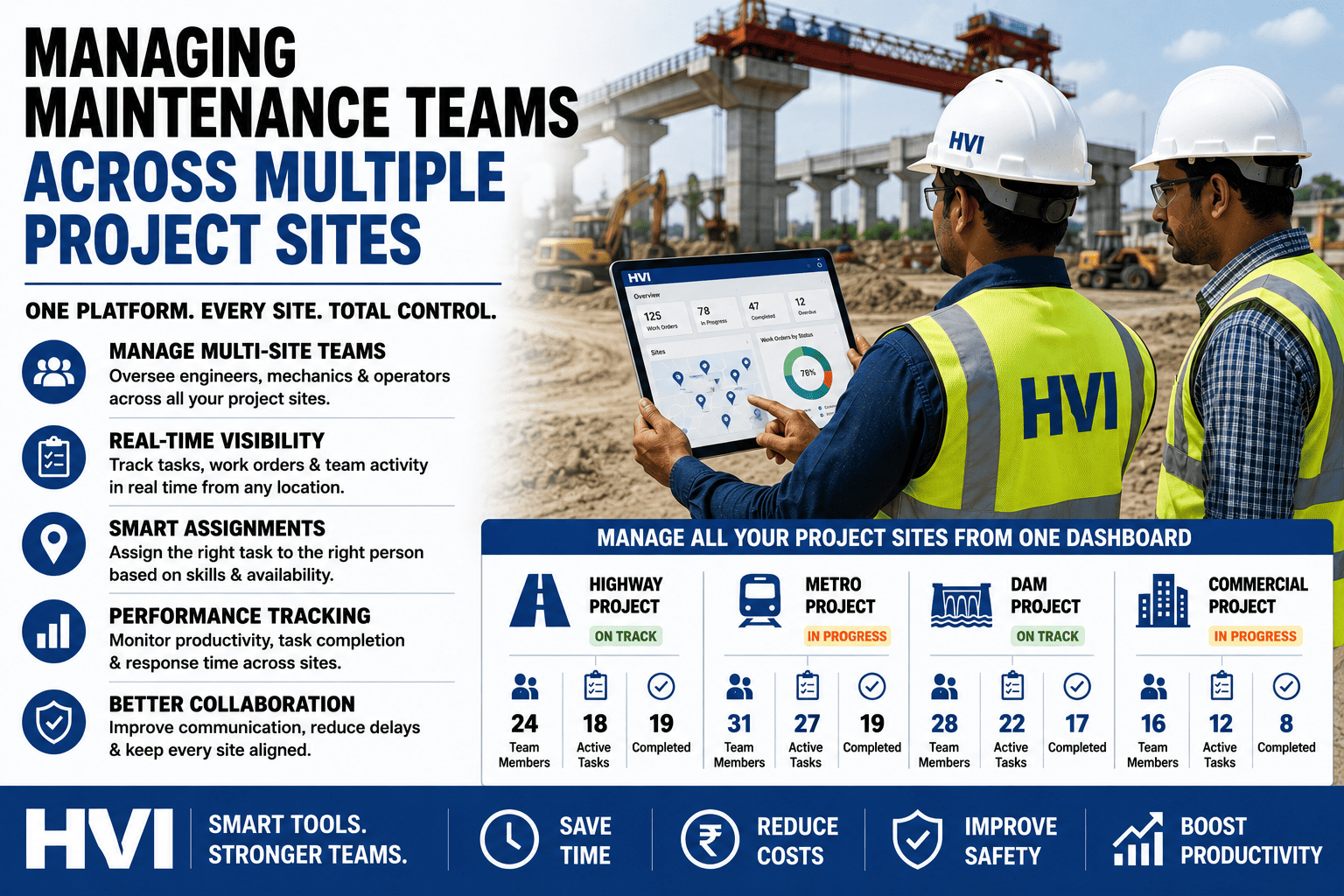
Ask any maintenance head running crews across a highway package, a metro depot, and a dam site the same week, and you will hear the same story: every site runs its own version of "the system," visibility ends at the site gate, and the only coordination tool is a phone that never stops ringing. Distance does not just stretch the team — it quietly forks it: checklists mutate site by site, each location grows one indispensable man who holds it together from memory, the weak site hides behind the strong one in the monthly report, and a critical breakdown travels by WhatsApp retellings that lose detail at every hop — until three sites are running three standards with one budget. The way back is not more phone calls or a stricter monthly format; it is one operating split — central standards, local execution — carried by a system where head office pushes the masters and sees every site live, while each site runs its own day on mobile, fully offline where the tunnel or dam face has no signal. This page is that playbook: what breaks at distance, the six plays that fix it, the cross-site numbers that make outliers visible, and the thirty-minute Monday review that replaces four late-night PowerPoints — sign up free and put your sites on one system this month.
Managing Maintenance Teams Across Multiple Project Sites
A practical playbook for maintenance heads running engineers, mechanics, and operators across distributed Indian highway, metro, dam, and mining projects — central standards, local execution, and one dashboard over all of it.
What Breaks When the Team Spreads Out
Standards Drift
Each site's supervisor "improves" the checklist, the PM intervals, and the paperwork until no two sites inspect, service, or record the same way — and no result can be compared to another.
Hero Dependence
Every site grows one indispensable person who holds it together from memory. He cannot be transferred, promoted, or replaced — and his site's system leaves with him.
Invisible Underperformance
Without common numbers, the site with 84% availability hides behind the one at 91% in the same monthly report — and the head office learns about problems from breakdowns, not dashboards.
Slow, Lossy Escalations
A critical breakdown at the dam site travels by phone call, WhatsApp photo, and retelling before it reaches anyone who can help — losing detail at every hop and hours at every handoff.
The Operating Principle: Central Standards, Local Execution
Head Office Owns
Each Site Owns
Sites resist central control of their day and head offices distrust local versions of the truth — this split gives each side what it actually needs. The system enforces it naturally: masters are edited only at HO, execution happens only on site, and both see the same live record.
The Six Plays That Make It Work
One System, Site-Scoped
Every site works in the same platform, seeing only its own machines and jobs — while HO sees all of it live. No site-wise Excels to merge, no month-end consolidation project.
Push the Masters, Not Memos
Checklists, PM intervals, and SOPs live centrally and update everywhere at once — the monsoon inspection item added today runs at all four sites tomorrow morning.
Same Numbers, Every Site
Availability, PM compliance, MTTR, and cost per hour computed identically from the same data — so sites compare fairly, outliers surface honestly, and good practice has a way to spread.
Float the Scarce Skills
The hydraulic specialist and the electrical expert belong to a pool, not a site — visible load and skill tags let HO route them to the breakdown that needs them, with the job history travelling ahead.
Escalations With a Clock
A critical unacknowledged in 30 minutes jumps to the site engineer; unresolved past your window, it lands on the HO board with photos and history attached — no retelling, no lost hours.
Run One Weekly Review
Thirty minutes, all sites, one live dashboard — not four PowerPoints prepared the night before. The agenda below runs itself because the numbers are already on screen.
Put Your First Two Sites on One System This Month
Multi-site rollouts work best in waves: two sites live in week one, standards proven, then the rest follow the working template. Bring your site list and current registers to a 30-minute session — our India team maps the rollout, sets up the first site's masters live, and shows the cross-site dashboard your Monday review will run on.
When Sites Share Numbers, Outliers Cannot Hide
| KPI (same formula everywhere) | Highway Pkg 12 | Metro Depot | Dam Site |
|---|---|---|---|
| Fleet availability | 91% | 89% | 84% — review |
| PM compliance | 93% | 88% | 76% — review |
| Mean time to repair | 6.5 hrs | 7.8 hrs | 11.2 hrs — review |
| Open criticals > 48 hrs | 1 | 2 | 6 — review |
| Maintenance cost / hr (20T class) | ₹540 | ₹565 | ₹720 — review |
One weak site drags the whole portfolio — and without shared numbers it does so invisibly. Here the pattern is unmistakable in one glance: the dam site is under-resourced or under-led, and the fix (a floated specialist, a PM catch-up drive, a leadership conversation) starts this week instead of after the client notices.
The Monday Review: Five Numbers, Thirty Minutes
Frequently Asked Questions
What is the right rollout sequence across many sites?
Start with two contrasting sites — your best-run and a struggling one — to prove the standards under both conditions, then template the rollout: masters copied, roles cloned, one training day per site. Most fleets bring a new site live in under a week once the first two have settled the pattern.
How do machine and technician transfers between sites work?
A transfer moves the asset or person to the new site's scope in one action — with the full history attached, so the receiving engineer sees every inspection, job, and cost from day one. HO keeps the movement log, which ends the "where is that grader now?" phenomenon permanently.
Our dam and tunnel sites have no network for days. Does this still work?
Yes — every site runs fully offline on mobile: inspections, jobs, and parts issues queue on the device and sync when connectivity returns, timestamped at capture. The dashboard marks data freshness per site, so HO always knows what it is looking at.
Sites run a mix of our crew and contractor mechanics. How is that handled?
Contractor staff get site-scoped technician roles — same jobs, same labour logging, same quality trail — so site performance reflects everyone who wrenches there, and contractor billing gets backed by logged hours. Access ends with the contract in one click; sign up free and set up your mixed crews this week.
What should HO see daily versus weekly?
Daily: criticals, escalations past their window, and safety grounds — the exceptions, pushed as alerts. Weekly: the five-number Monday review above. Everything else stays available but unpushed, so head office manages by exception instead of drowning in noise. See both views live in a 30-minute demo.
Distance Is Permanent. The Forking Doesn't Have to Be.
Your sites will always be hundreds of kilometres apart — but they can run one set of standards, report one set of numbers, share one pool of scarce skills, and escalate to one board that sees everything with photos attached. Put the playbook on a system built for it: central masters, site-scoped execution, offline-first mobile, and a Monday review that runs off a live dashboard instead of four late-night PowerPoints. Start free and bring your first two sites on this month, or walk through the rollout plan in a 30-minute session with our India team.