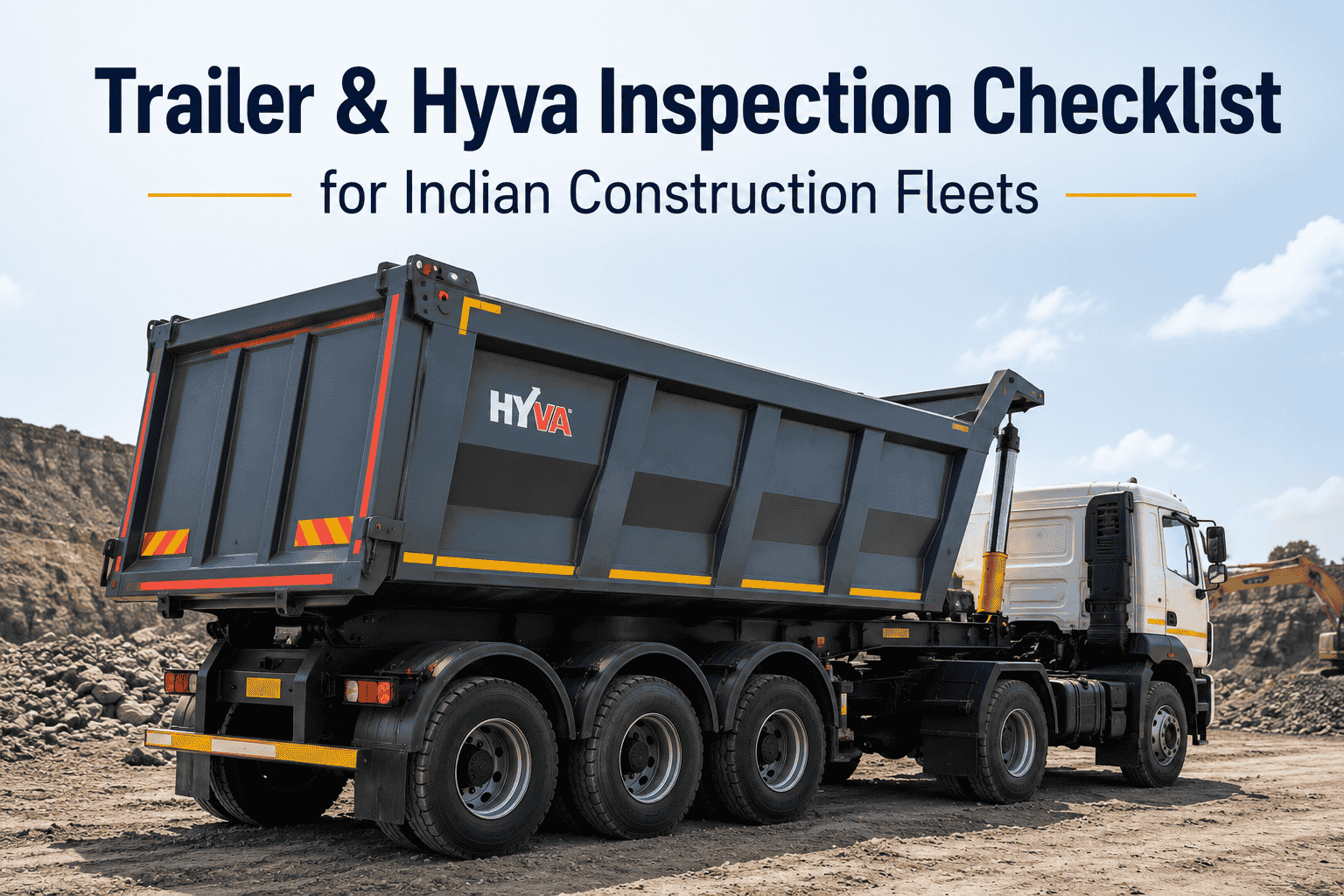
A single overloaded axle on a multi-axle tractor-trailer no longer just risks a roadside fine in India — weigh-in-motion sensors at toll plazas now record the violation automatically before the driver has even stopped, and from April 2026 heavily overloaded trucks face toll surcharges of up to four times the base rate on top of the statutory fine. Add an expired fitness certificate, a brake test the transporter never actually logged, and a permit suspension becomes a real possibility rather than a distant threat. Fleet operators running bulk-cargo and multi-axle logistics routes are increasingly moving fitness tracking, brake inspection, and load compliance off paper and onto a system that catches the problem before the truck leaves the yard. Start a free HVI account and see your fleet's compliance status before your next dispatch.
Logistics & Bulk Cargo — Compliance Software
Multi-Axle Truck & Trailer Inspection Compliance Software for India
Track fitness certificate expiry, brake and suspension inspections, and axle load compliance for your tractor-trailer fleet — so overloading, expired documents, and missed brake checks get caught at the yard gate, not at a toll plaza or an RTO checkpoint.
₹50,000
Maximum overloading fine per vehicle
4x
Toll penalty on heavy overloads from Apr 2026
Every trip
Pre-dispatch load and fitness check
What One Overloaded Trip Actually Costs
Overloading rarely shows up as a single line-item fine anymore. Under Section 112 of the Motor Vehicles Act and the 2019 amendment, the costs stack on top of each other the moment a multi-axle vehicle is flagged at a weighbridge or a toll plaza.
Base statutory fine
Additional tonnage penalty
Toll surcharge (Apr 2026 framework)
Operational cost
Repeat offence risk
The Three Compliance Gaps Multi-Axle Fleets Keep Repeating
Across bulk-cargo and multi-axle logistics operators, the same three gaps show up in almost every compliance review, regardless of how experienced the transport team is. None of them are hard to fix once they are visible — the problem is that paper-based fleet management rarely makes them visible until an inspection or a checkpoint stop forces the issue.
Weight
Total GVW Looks Fine, One Axle Doesn'tA trailer can sit within its overall gross vehicle weight limit while one axle group is still overloaded because of uneven load distribution. Enforcement checks axle group weight separately from total GVW, and an axle violation carries the same penalty as a full GVW breach — most paper load sheets never check this.
Documents
Fitness Certificates Tracked in Someone's HeadCommercial vehicle fitness certificates are valid for two years up to eight years of age, then must be renewed annually. Across a mixed-age multi-axle fleet, tracking which trailer and which tractor unit is due for renewal — and at which Automated Testing Station — is rarely centralised anywhere beyond a transport manager's memory.
Brakes
Brake Inspection Logged, Not Actually DoneSince October 2024, fitness testing for commercial vehicles has moved to Automated Testing Stations, which measure braking efficiency, suspension performance, and steering geometry with calibrated instruments. Between ATS visits, day-to-day brake checks on a multi-axle trailer are still frequently a signature on a register rather than an actual walk-around inspection.
Fitness Certificate Renewal — What Changes as Your Fleet Ages
Fitness renewal frequency changes as a commercial vehicle ages, and HVI tracks each unit against the rule that actually applies to it.
0–8 Years
Fitness certificate renewed every 2 years at an Automated Testing Station
8+ Years
Renewal becomes annual as braking, chassis, and emission components face greater wear
Every Renewal
HVI flags the unit 30 days ahead so the ATS slot is booked before the certificate lapses
This staggered renewal cycle is exactly where mixed-age multi-axle fleets lose track fastest — a tractor unit bought two years apart from its trailer can be on entirely different renewal clocks, and a transport manager tracking this across a fleet of thirty or more units in a spreadsheet is one missed row away from a vehicle running with a lapsed certificate.
Stop Tracking Fitness Dates in a Spreadsheet
HVI keeps every tractor unit and trailer's fitness expiry, brake inspection, and axle compliance status on one dashboard — with alerts before anything lapses.
Quick Reference: Axle Configuration and Inspection Focus
| Configuration | Approx. Max GVW | Overloading Risk Point | Priority Inspection Items |
|---|---|---|---|
| 2-Axle Rigid Truck | ~18.5 tonnes | Rear axle overload on part-loads | Rear brake efficiency, tyre condition, suspension |
| 3-Axle Rigid Truck | ~28.5 tonnes | Uneven distribution across tandem axles | Tandem axle load balance, brake lining wear |
| Multi-Axle Tractor-Trailer | Varies by trailer type and axle count | Trailer axle group exceeding GAWR while GVW appears compliant | Fifth wheel coupling, trailer axle load sensors, ABS/EBS function |
| Bulk-Cargo Tanker Trailer | Varies by commodity density | Liquid load shift affecting axle weight distribution in transit | Baffle and valve integrity, axle load recheck post-loading, brake test |
Every configuration above can be set up as its own checklist template in HVI, with axle-specific and brake-specific checkpoints matched to how your fleet is actually configured.
How HVI Fits Into a Multi-Axle Fleet's Daily Compliance Routine
The goal is not another compliance form to fill in after the fact — it is a routine that runs alongside how a multi-axle fleet already loads, dispatches, and moves trailers every day, with each checkpoint feeding the same dashboard.
Before Loading
Driver or yard supervisor confirms the tractor and trailer's fitness certificate and last brake inspection are both current before the unit is assigned to a trip.
At Dispatch
Pre-trip inspection covers brakes, tyres, coupling, lighting, and reflective markings, with photo and GPS-tagged confirmation logged against the trailer.
Load Check
Weight and axle distribution figures from the weighbridge slip are logged against the trip, flagging any load close to or over the GVW or axle group limit before the truck leaves the yard.
On the Road
Defects reported en route — brake fade, tyre damage, coupling play — route straight to the maintenance dashboard with the trailer status flagged for the next stop.
Compliance Dashboard
Fleet managers see every unit's fitness expiry, last brake test, and open defects in one view, instead of checking a paper file per vehicle.
Paper Logbooks vs. a Digital Compliance Record
Most multi-axle fleets already have some form of record-keeping — a logbook in the cab, a fitness folder in the transport office, a WhatsApp message when a driver flags a brake issue. The gap is not effort, it is that none of these connect to each other until something goes wrong.
Paper and WhatsApp-Based Tracking
Fitness expiry dates live in a spreadsheet or a folder, checked manually before renewal season
Brake and coupling issues are reported verbally and may or may not reach the workshop
Axle load figures from the weighbridge slip are rarely cross-checked against the trip before dispatch
No single view of which unit in the fleet is due for renewal or has an open defect
HVI Compliance Dashboard
Every tractor and trailer's fitness expiry tracked individually with advance alerts
Defects routed automatically to the maintenance dashboard with a status lock on the unit
Weighbridge and axle load figures logged against the trip before the truck leaves the yard
One dashboard showing fitness, brake history, and open defects across the entire fleet
Frequently Asked Questions
Can HVI track fitness certificate expiry for a mixed-age fleet?
Yes. Each tractor unit and trailer is logged individually with its own fitness certificate date, and HVI applies the renewal frequency that matches its age — two-yearly up to eight years, annual after that — sending alerts well before the certificate lapses. Set up your fleet to see this applied to your own vehicle list.
Does HVI check axle load compliance, or only overall vehicle weight?
HVI's load-check step captures weighbridge figures at the level of individual axle groups, not just total GVW, since an axle group can be overloaded even when total weight looks compliant. This matches how enforcement checks are actually carried out at toll plazas and weighbridges.
How does HVI handle brake and suspension inspection between ATS visits?
Drivers and yard staff complete a structured pre-trip checklist covering brake response, suspension condition, and coupling integrity before every dispatch, with photo evidence attached. This sits alongside, not instead of, the statutory Automated Testing Station inspection required at renewal.
Is HVI suitable for tanker and bulk-cargo trailers specifically?
Yes, checklist templates can include commodity-specific checkpoints such as valve and baffle integrity or post-loading axle rechecks for liquid loads, in addition to the standard trailer inspection items. You can walk through this setup directly by booking a short demo.
Will using HVI stop a fleet from ever being flagged for overloading?
HVI is built to catch load and axle issues before dispatch so they can be corrected at the yard rather than at a checkpoint, but it does not replace the transporter's responsibility to comply with Motor Vehicles Act weight limits or the driver's judgement on the road.
Get Ahead of Overloading, Fitness, and Brake Compliance
One dashboard for every tractor unit and trailer's fitness expiry, brake inspection history, and load compliance — built for how Indian multi-axle logistics fleets actually run.
No credit card required. Set up your first fleet checklist in minutes.