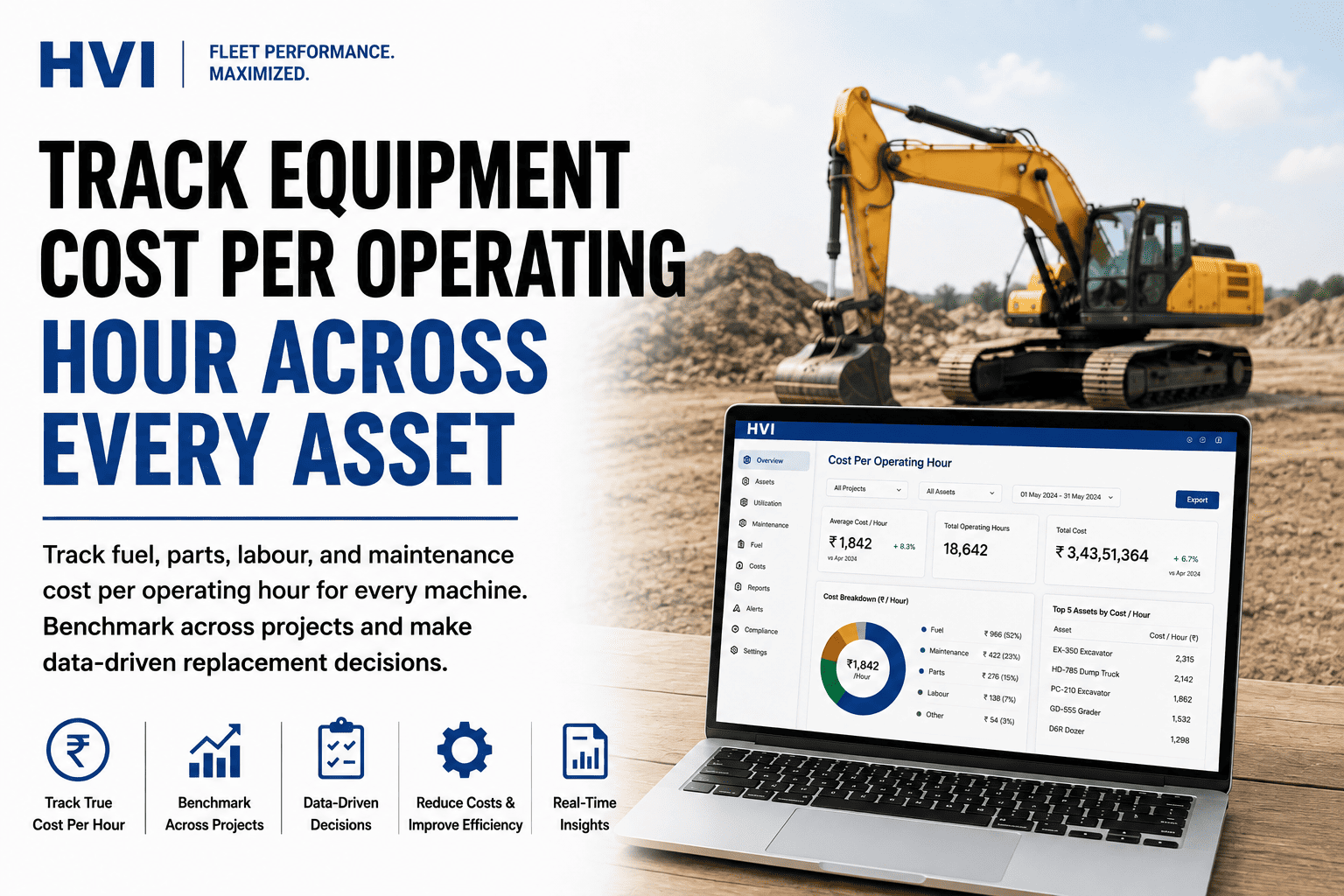
Every month, parts leave the store at mines, plants and project sites without ever being charged to the machine that used them. A filter goes out without a job card, a hose is borrowed from a parked machine, or oil is drawn from a drum unrecorded. The money is still spent, but it never reaches the right asset. The result is a cost per hour that looks better than reality and replace-or-repair decisions made on wrong numbers. This guide shows where the leak happens and how to close it, and how teams charge parts to each machine in HVI.
Parts Consumed But Never Charged to an Asset? Close That Cost Leak
Find the parts that leave the store without reaching a machine, fix the process that lets them slip, and get a true cost per hour for every asset.
Where the Leak Happens
Uncharged parts usually slip through the same few gaps on every site.
No job card
Parts issued on a verbal request or a chat message.
Fix: no issue without a machine and jobCannibalised parts
Parts taken from one machine to fix another.
Fix: record the transfer both waysBulk consumables
Oil, grease and coolant drawn from drums.
Fix: log quantity per machine at issueLocal emergency buys
Parts bought near site and paid in cash.
Fix: enter every bill against a machineHow the Leak Distorts Cost per Hour
Here is one excavator over a quarter. The figures are illustrative.
The real parts cost was half as much again as the books showed. Decisions on rates, repairs and replacement were all based on the wrong figure.
Charge Every Part to the Machine That Used It
HVI links each part used to a job, a machine and its hour meter reading, so parts costs build up against the right asset and cost per hour reflects what each machine really consumes.
Four Rules That Close the Leak
Simple rules, applied every time, stop many parts slipping through.
Machine first
No part leaves the store without a machine ID.
Job linked
Every issue is tied to a job or work order.
Hours recorded
Note the hour meter at the time of the job.
Reconcile monthly
Compare store issues with parts charged.
Allocating Hard-to-Track Items
Some items are harder to charge than a boxed part. These methods keep them honest.
| Item | Why it leaks | How to allocate |
|---|---|---|
| Engine and hydraulic oil | Drawn from drums or bulk tanks | Record litres per machine at each top-up |
| Grease | Used in small amounts every day | Log cartridges or tins issued per machine |
| Cannibalised parts | Moved between machines | Charge the receiver, note the donor |
| Workshop consumables | Rags, cleaners and small hardware | Spread by workshop hours per machine |
| Local purchases | Bought in cash near site | Enter each bill against the machine |
Why It Is Worth Fixing
Accurate parts costs change the decisions a fleet makes.
- True cost per hour for each machine
- Better replace or repair decisions
- Hire rates and bids based on real costs
- Machines with unusual parts use stand out
- Store spend rises but machine costs do not
- Some machines show almost no parts cost
- Stock counts never match the records
- Parts requests come in by phone or chat
Monthly Parts Reconciliation in HVI
A sample view comparing store issues with parts charged to machines, by site.
| Site | Issued from store | Charged to machines | Uncharged | Status |
|---|---|---|---|---|
| Mine site A | Rs 4.2 lakh | Rs 4.1 lakh | 2% | On track |
| Highway package B | Rs 3.5 lakh | Rs 3.0 lakh | 14% | Review issues |
| Plant C | Rs 2.3 lakh | Rs 1.4 lakh | 39% | Investigate |
Parts Cost Leak FAQs
What is a parts cost leak?
It is the value of parts and consumables used on machines but never charged to them. The cost is real, but it does not show up against any asset, so machine costs look lower than they are.
How do I find uncharged parts?
Compare the total value issued from the store each month with the total charged to machines. The gap is the uncharged amount, and tracing it by site shows where the process breaks.
How should oil and grease be charged?
Record the quantity drawn for each machine at every top-up or greasing, and charge it at the average cost per litre or cartridge.
Why does this affect cost per hour?
Cost per hour divides a machine's costs by its hours. If parts are missing from its costs, the figure is too low. Teams that charge parts in HVI see the true figure.
Can parts be charged to machines from a phone?
Yes. Mechanics can record parts used on each job against the machine and hour meter on a phone. Book a demo to see how HVI fits your parts process.
Every Part Charged, Every Cost Real
Tie every part to a machine and job, reconcile store issues each month and see true cost per hour in HVI. Better decisions on repairs, rates and replacement.