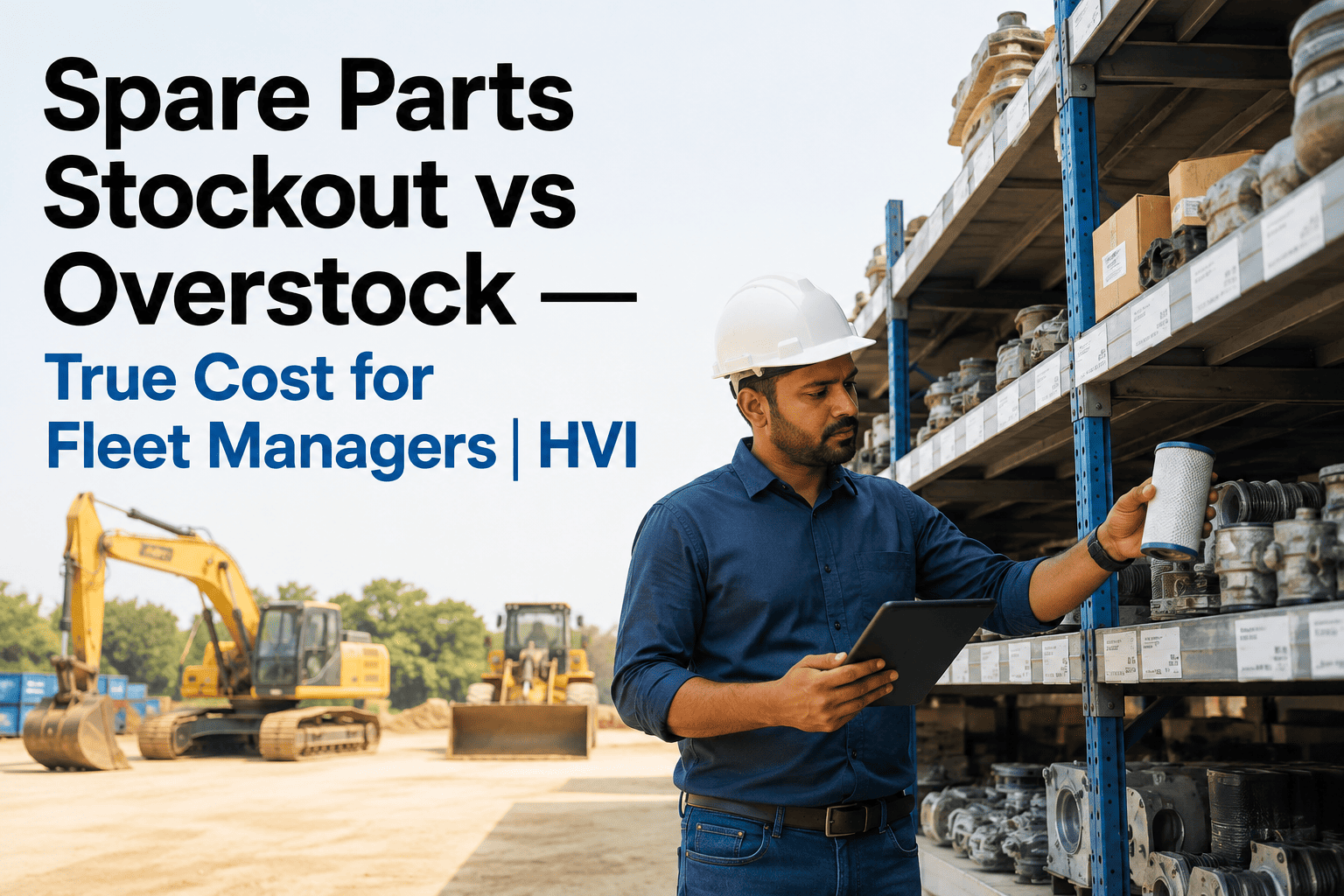
Every excavator parts store ends up holding two very different kinds of stock, whether anyone planned it that way or not: the cheap items that vanish weekly and the expensive ones that sit for months until the day the machine can't run without them. Treating both the same way is how a store ends up simultaneously overstocked and out of the one part it needed. The fix isn't stocking more of everything — it's knowing which of your excavator's parts belong in which category, so the fast movers never run dry and the slow, expensive ones aren't tying up capital they don't need to. Here's how to sort your own store into the two groups that matter, and how HVI classifies every part automatically from your work order history.
Stop Stocking Every Excavator Part the Same Way
Fast-moving consumables and slow-moving critical spares behave completely differently on the shelf. Here's how to tell them apart, and the stocking rule that fits each.
Two Kinds of Stock, Two Different Risks
Fast-Moving Consumables
Filters, O-rings, small hardware, belts — cheap individually, consumed constantly, and the reason a machine sits idle when the shelf runs dry on something that costs less than a tank of fuel.
Risk: running out
Slow-Moving Critical Spares
Cylinder seal kits, pumps, undercarriage assemblies — expensive, used rarely, but a machine grounds for weeks without one because the lead time runs into months, not days.
Risk: overpaying to hold it, or waiting weeks without it
See which of your own excavator parts fall into each category, based on your actual consumption data.
Fast-Moving: Stock by Consumption Rate, Not Guesswork
These parts turn over so often that the right stocking question isn't "do we need it" but "how many days of runway does the shelf currently have."
Engine and hydraulic filters
Changed on every service interval across the whole fleet — hold a full service cycle's worth per machine plus a buffer for early changes on dusty duty.
Fuel filter sets
The single fastest mover on most Indian sites given local diesel quality — never let stock fall below two full sets per machine.
O-rings, backup rings, small hardware
Cheap enough to hold generously, and the most common reason a job stalls for want of a part worth a fraction of the labor cost around it.
Track bolts and nuts
Shed continuously on rocky ground — stocked in bulk per model, with consumption logged per machine as an early undercarriage wear signal.
Bucket teeth and adapters
The fastest-wearing part on any rock face — tracked per machine per hundred hours, since a rising consumption rate flags duty or condition changes early.
Belts and small electrical parts
Age on the calendar as much as the meter — one set per machine on the shelf, replaced on visible wear rather than waiting for failure.
Slow-Moving Critical: Stock by Downtime Risk, Not Frequency
These parts fail rarely, but when they do, the question isn't cost — it's how many weeks the machine sits grounded waiting on a supplier.
Cylinder seal kits, boom and arm
A weeping rod today is a full kit within weeks — held one set per cylinder type across every two or three machines of a model, not per machine.
Track pins and bushes
A planned mid-life turn, not a breakdown item — ordered against measured undercarriage wear well ahead of the date it's actually needed.
Swing bearing and final drive assemblies
Long lead time, high cost, rare failure — held centrally across a multi-site fleet rather than duplicated at every location.
Main hydraulic pump
The single most expensive common failure point — a fleet running several machines of one model can often justify holding one shared spare rather than one per machine.
The Formula Behind Both Categories
Reorder Point = (Daily Consumption × Lead Time in Days) + Safety Stock
The formula doesn't change between categories — what changes is which input drives the number. For fast movers, daily consumption dominates. For slow-moving critical spares, lead time and downtime cost dominate, even with near-zero daily usage.
| Category | Example | What Drives the Reorder Point | Typical Lead Time |
|---|---|---|---|
| Fast-moving | Fuel filter set | Daily consumption across the fleet | 5 to 7 days |
| Fast-moving | Bucket teeth | Consumption rate per rock-face hour | 7 to 10 days |
| Slow-moving critical | Boom cylinder seal kit | Downtime cost if unavailable | 2 to 4 weeks |
| Slow-moving critical | Hydraulic pump | Failure consequence, not frequency | 4 to 8 weeks |
What Happens When the Two Get Mixed Up
Over-stocked slow movers
A store holding three spare hydraulic pumps because "we ran out once" ties up capital that could fund an entire year of fast-moving consumables — the classic sign of stocking on fear rather than data.
Under-stocked fast movers
A machine grounded on a ₹400 filter because the store treated it like a rare item rather than tracking its actual weekly consumption rate.
No visibility into which is which
Without consumption data by part and by machine, every item defaults to a guessed stocking level, and the two categories blur into one undifferentiated, expensive shelf.
Frequently Asked Questions
How do we know which category a part belongs to without months of data?
Historical work order records, even a year's worth from spreadsheets or paper, are usually enough to sort a store's parts into fast-moving and slow-moving critical on the first pass, refined as new consumption data comes in.
Should slow-moving critical spares be stocked at every site?
Usually not — expensive, rarely-used parts are better held centrally with visibility across sites, while fast-moving consumables make more sense stocked locally at each location.
Can a part move between categories over time?
Yes — a part that was rare can become a fast mover if duty conditions change, which is why classification needs to run on current consumption data rather than a one-time decision.
Does this connect to our purchasing process in SAP or Tally?
Yes — reorder triggers for both categories can raise purchase requests directly into SAP, Oracle, or Tally, so the classification logic feeds straight into procurement without manual re-entry.
How much capital does getting this wrong typically tie up?
Fleets that stock without classification commonly carry a meaningful share of dead or excess inventory in slow-moving parts alone; sign up free to see the breakdown against your own store.
Classify Once, Stock Correctly From Then On
A store that treats every part the same way is guessing twice — once on the fast movers that run dry, and once on the slow movers tying up capital. Start free and see your own fleet's parts sorted by consumption pattern, or bring your current stock register to a 30-minute session with our India team.



.png)