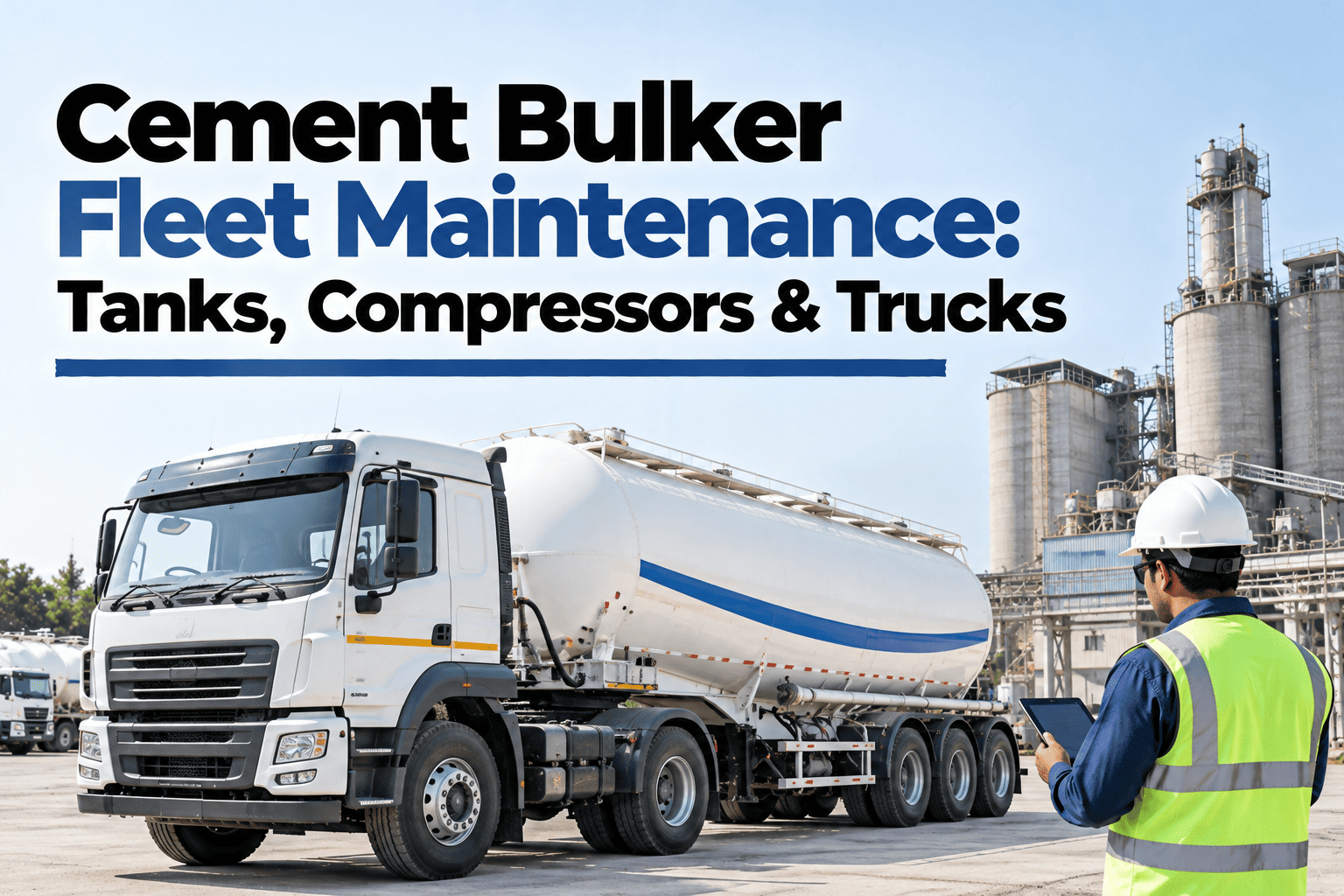
A cement bulker that arrives on time but takes two hours to discharge holds up the whole RMC plant or site. Slow unloading, blocked pipes and compressor trouble cost the fleet trips and frustrate customers. Bulkers also carry a pressurised tank, so poor maintenance is a safety risk as well as a delay. Most problems trace back to a few parts: aeration pads, the compressor, valves, pipes and the safety devices. Keeping those in good order, alongside the truck itself, keeps cement and fly ash flowing. This guide shows how, and how fleets track every bulker in HVI.
Cement Bulker Fleet Maintenance: Tanks, Compressors and Trucks
Keep the tank, aeration pads, compressor, valves, pipes and safety devices in good order for fast, safe discharge and high fleet uptime.
Key Bulker Components and What Goes Wrong
Each part has a typical failure. Knowing them makes checks quicker and faults easier to trace.
| Component | What it does | Common problem | What to check |
|---|---|---|---|
| Compressor | Supplies air to fluidise and push the load | Low output, overheating, oil carry-over | Air filter, oil level, belts or drive, output pressure |
| Aeration pads | Spread air through the powder | Torn or blocked pads | Condition during tank inspection |
| Valves | Control air and product flow | Leaks, sticking, worn seals | Smooth operation and tight shut-off |
| Discharge pipe and hose | Carries product to the silo | Blockages, wear at bends, damaged couplings | Wear, cracks and coupling seals |
| Tank and manholes | Holds product under pressure | Seal leaks, corrosion, damage | Seals, clamps and tank shell condition |
Why Bulkers Discharge Slowly
Slow unloading is a common complaint from customers. These are the usual causes.
Weak compressor
A clogged air filter or worn compressor gives too little air.
Damaged pads
Torn or blocked aeration pads leave powder packed in corners.
Air leaks
Leaking seals and valves lose pressure before it does its work.
Moist product
Damp cement or fly ash forms lumps that block pipes.
Pressure Safety Comes First
A bulker tank is a pressure vessel. Respect it every time.
Never open a manhole, hatch or coupling while the tank is under pressure. Release pressure fully and confirm the gauge reads zero first. Never adjust, block or remove the pressure relief valve, and do not exceed the working pressure marked on the tank.
Keep Every Bulker Safe and Discharging Fast
HVI gives drivers a bulker checklist for the tank, compressor and safety devices, records pressure tests and services, and flags defects before the next trip.
A Simple Bulker Maintenance Plan
Split checks by how often they are needed. Follow the tank and compressor makers' intervals where they differ.
- Gauge, relief valve and manhole seals
- Hoses and couplings for damage
- Compressor oil and air filter indicator
- Tyres, lights and brakes
- Valves for smooth operation and leaks
- Discharge pipe wear at bends
- Compressor belts or drive
- Clean the compressor air filter
- Inspect aeration pads inside the tank
- Compressor service as specified
- Tank pressure test as required
- Truck service on schedule
Safe and Quick Unloading
A consistent routine shortens unloading time and avoids blockages and accidents.
Park and secure
Level ground, brakes on, area clear.
Connect
Check hose and coupling seals.
Pressurise
Build pressure gradually within limits.
Discharge
Watch the gauge and flow throughout.
Depressurise
Release pressure fully before disconnecting.
Bulker Fleet Status in HVI
A sample view. Slow unloading and overdue tests stand out straight away.
| Bulker | Average unloading time | Pressure test | Open defects | Status |
|---|---|---|---|---|
| BK-04 | Normal | Valid | None | Ready |
| BK-09 | Slower than fleet average | Valid | Compressor air filter | Service soon |
| BK-12 | Normal | Overdue | Relief valve seal | Off road until tested |
Cement Bulker Maintenance FAQs
Why is my cement bulker discharging slowly?
Common causes are a clogged compressor air filter or worn compressor, torn or blocked aeration pads, air leaks at seals and valves, and damp product forming lumps. Check the compressor output first, then pads, seals and pipes.
How often should bulker aeration pads be checked?
Inspect them at planned intervals during tank inspections, and sooner if discharge slows or product is left in the tank. Follow the tank maker's guidance for your bulker.
Is it safe to open a bulker manhole after unloading?
Only after the tank is fully depressurised and the gauge reads zero. Opening any hatch or coupling under pressure can cause serious injury.
Does a bulker tank need pressure testing?
Yes. Pressure tanks need periodic testing and inspection as required by applicable rules and the maker. Teams that record tests in HVI get reminders before they fall due.
How can a bulker fleet improve uptime?
Run daily checks on the tank, compressor and safety devices, service on schedule, track unloading times and fix defects quickly. Book a demo to see bulker tracking in HVI.
Faster Discharge, Safer Tanks, Happier Customers
Check tanks, compressors and safety devices every trip, track pressure tests and unloading times, and manage every bulker in HVI. Fewer delays and more trips every month.