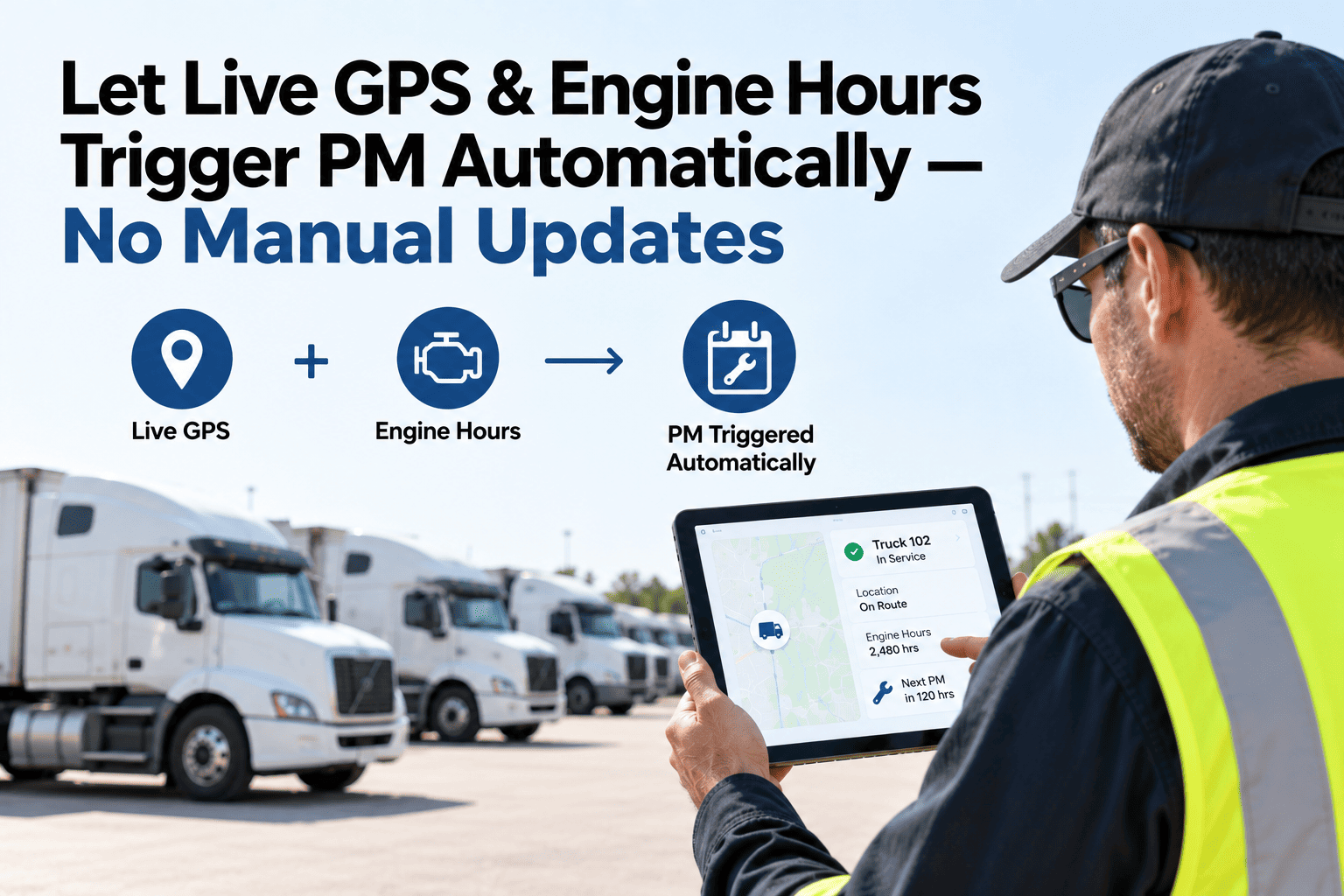
Automating PM triggers off live machine data removes a genuine piece of administrative drudgery — someone walking the yard with a notebook, or chasing site engineers for readings that arrive three days late and are already stale. It also introduces a dependency most fleets do not think about until it bites: the schedule is now only as reliable as the data feed behind it. A meter that stops reporting, an ECU replaced without anyone recording it, or a machine sitting off-hire and still sending hours will all quietly corrupt the schedule while looking like everything is working. Worth planning for, and you can look at how your own feeds behave in a free 30-minute session.
Let Machine Data Trigger PM, With Checks on the Data
Services falling due automatically from live engine hours and location, with the safeguards that keep an automated schedule honest.
What the Automation Actually Removes
Someone collecting readings by walking the yard or phoning sites.
Readings that arrive days late, by which point the service window has moved.
Transcription errors between a notebook, a spreadsheet, and the schedule.
Machines serviced on calendar dates because nobody had current hours.
The monthly argument about whether a service was actually due or not.
When the Feed Is Wrong, and What Should Happen
Every one of these occurs in practice. A system that assumes the feed is always correct will silently produce a wrong schedule.
A device fails, loses power, or the subscription lapses. Hours stop accumulating and the machine appears to have stopped working.
Should happen: the gap is flagged rather than treated as zero usage, because a machine that quietly stops reporting will never come due for service.
Common, and the difference tends to widen over time rather than stay constant.
Should happen: periodic comparison against a manually captured reading during inspection, with a meaningful divergence raised for someone to resolve.
The reading resets or jumps, and every interval calculated from it becomes wrong from that point.
Should happen: the change recorded as an event with both readings, so history stays continuous rather than showing an unexplained discontinuity.
Idling, testing, or an auxiliary circuit keeps generating hours against equipment not in productive use.
Should happen: asset status respected, so a parked machine does not consume its service interval doing nothing.
Automate the Trigger, Keep the Check
Live hours driving the schedule, with inspection-captured readings as an independent cross-check.
What Location Adds That Hours Cannot
Service scheduled around where the machine is
A service falling due is more useful when planning knows the machine is forty kilometres from the workshop and due back next week.
Site transfers detected rather than reported
Equipment arriving at a new site updates the register on its own, instead of depending on someone remembering to tell the office.
Duty severity inferred from movement
Haul distance and cycle patterns indicate how hard a machine is working, which matters for tyres and drivetrain more than raw hours do.
Machines that should not be where they are
Equipment leaving a site outside working hours, or appearing somewhere it was never assigned, is worth knowing about promptly.
Frequently Asked Questions
Do we need telematics on every machine for this to work?
No. Mixed fleets are normal — connected machines trigger automatically and the rest run on readings captured during inspection. Both feed the same schedule, so you do not need to fit everything before starting. You can plan the mix on a call with our team.
Which reading wins if telematics and the manual meter differ?
That should be a decision you make explicitly rather than something the system resolves quietly. Most fleets treat the physical meter as authoritative and use telematics for currency between readings.
Does this work with our existing telematics provider?
It depends on what that provider exposes and how, which is worth confirming for your specific setup rather than assuming either way.
Will automated triggers create more services than we can handle?
Initially they may, because accurate hours often reveal machines that were overdue and nobody knew. That backlog is real work that was already owed, not new work the system invented.
What should we watch in the first month?
Machines whose feed goes quiet, and the gap between telematics and manual readings. Both tell you how much to trust the automation. Start with a free trial.
Trust the Trigger, Verify the Feed
Let live hours and location drive the schedule, flag feeds that go quiet, cross-check against readings captured at the machine, record meter replacements as events, and respect asset status so parked equipment does not consume its interval.