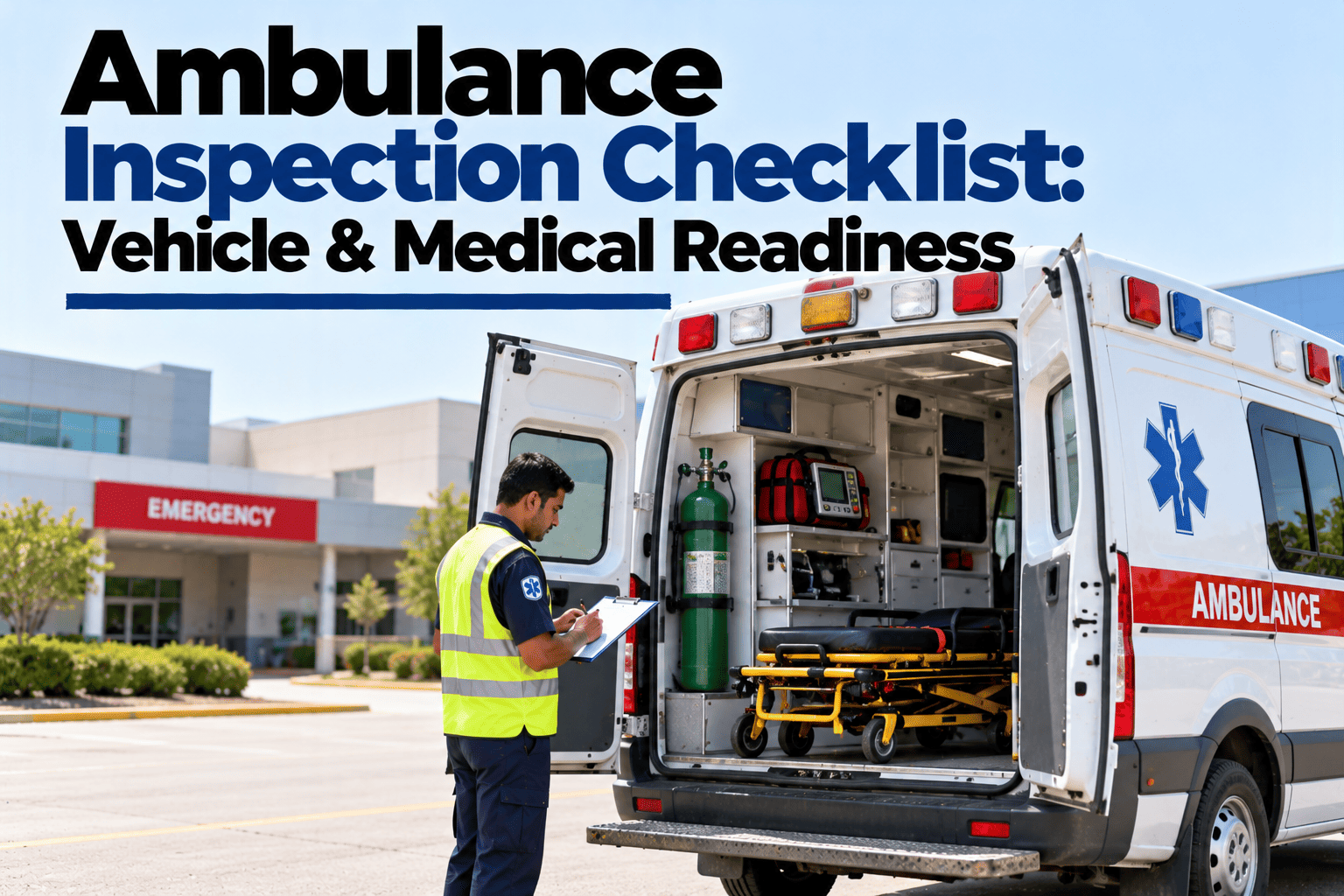
An ambulance has to be ready the moment a call comes in, at any hour. If the battery is flat, a tyre is soft or the oxygen cylinder is nearly empty, minutes are lost when they matter most. Unlike most fleet vehicles, an ambulance must pass two kinds of check every shift: the vehicle must be ready to drive, and the patient compartment must be ready to treat. This checklist covers both, for 108 services, hospitals and private fleets, and shows how operators track ambulance readiness shift by shift in HVI.
Ambulance Inspection Checklist: Vehicle and Medical Readiness
Engine, tyres, battery, lights and siren, oxygen, stretcher, medical equipment and hygiene, checked at the start of every shift.
The Shift Start Checklist
The driver checks the vehicle and the medical crew checks the patient compartment. Both sign off before the ambulance goes on call.
- Engine oil, coolant and fuel at least half
- Battery starts the engine first time
- Tyres, wheel nuts and spare
- Brakes and parking brake
- Beacon lights, siren and horn
- Headlights, indicators and reverse lights
- Tracking device and radio or phone working
- Main and portable oxygen cylinder levels
- Stretcher and its locks secure
- Suction unit working
- Medical equipment present and charged
- Medicines and consumables in date
- Compartment lights and power sockets
- Compartment cleaned and disinfected
Oxygen Checks
Oxygen is one of the items most likely to stop an ambulance from treating a patient. Check it every shift and after every call.
| Item | What to check | Action if not right |
|---|---|---|
| Main cylinder | Pressure or level, securing straps | Replace or refill before going on call |
| Portable cylinder | Level, carrier and strap | Swap for a full cylinder |
| Regulator and flowmeter | Reads correctly, no leaks | Replace faulty unit |
| Pipeline and outlets | Leaks and connections | Repair before use |
| Masks and tubing | Sizes available, sealed packs | Restock from stores |
Keep oil and grease away from oxygen fittings, secure every cylinder so it cannot move while driving, and never allow smoking or flames near oxygen. Close cylinder valves when not in use.
Know Which Ambulances Are Truly Ready
HVI gives drivers and medical crews their own shift checklists, records defects with photos and shows control rooms which ambulances are fully ready for the next call.
Equipment Depends on the Ambulance Type
AIS-125, the National Ambulance Code, sets requirements by ambulance type. Check the list that applies to each vehicle in your fleet.
Patient transport
Stretcher, oxygen and basic first aid for stable patients.
Basic life support
Adds suction, airway kits, splints and more equipment.
Advanced life support
Adds monitors, defibrillator and advanced medicines.
Cleaning After Every Patient
Infection control protects the next patient and the crew. Follow your hospital or service protocol.
Remove waste
Dispose of used items as biomedical waste.
Clean surfaces
Wipe the stretcher, rails and touch points.
Disinfect
Use the approved disinfectant and contact time.
Restock
Replace used items before the next call.
Ambulance Readiness in HVI
A sample control room view across a service's ambulances.
| Ambulance | Type | Vehicle check | Medical check | Status |
|---|---|---|---|---|
| AMB-03 | Basic life support | Passed | Passed | Ready |
| AMB-06 | Advanced life support | Passed | Oxygen low | Refill oxygen |
| AMB-08 | Basic life support | Siren not working | Passed | Off duty |
Ambulance Inspection FAQs
What should be checked on an ambulance every shift?
The vehicle's fluids, battery, tyres, brakes, lights, siren and communication, plus the oxygen supply, stretcher, suction, medical equipment, medicines and the cleanliness of the patient compartment.
How often should ambulance oxygen be checked?
At the start of every shift and after every call. Refill or replace main and portable cylinders before the ambulance goes back on call if levels are low.
What is AIS-125?
AIS-125 is the National Ambulance Code, which sets design, safety and equipment requirements for road ambulances in India by type. Check which type each ambulance is built and registered as.
How should an ambulance be cleaned between patients?
Remove waste, clean and disinfect all touched surfaces and restock used items, following your service's protocol. Teams that log cleaning in HVI keep a record for audits.
Can ambulance readiness be tracked digitally?
Yes. Drivers and medical crews complete their checklists on a phone, and the control room sees which ambulances are fully ready. Book a demo to see ambulance checklists in HVI.
Ready for Every Call
Check every ambulance's vehicle and medical readiness at each shift, keep oxygen topped up and track every defect in HVI. Fewer delays and better care when it matters most.