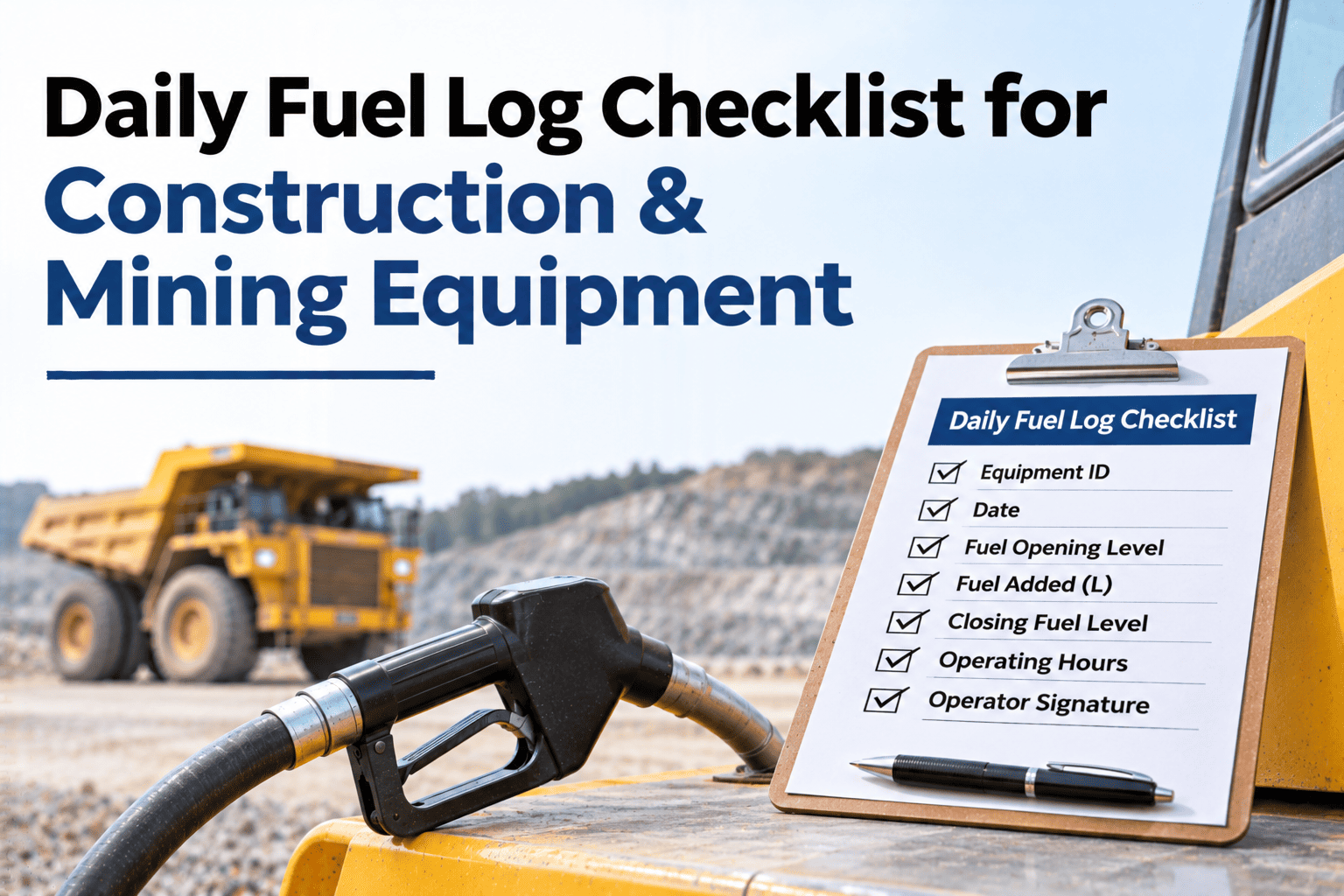
Every litre of diesel on a construction or mining site passes through a fuel log, whether it is a notebook in the bowser cab or a form on a phone. When that log is complete, it shows exactly which machine got how much fuel and at what hour reading. When it is not, fuel use cannot be checked, theft cannot be proved and cost per hour is a guess. A good log takes a minute per fill: the same details every time, reconciled each evening. This checklist covers what to record, and how teams keep fuel logs on a phone with HVI.
Daily Fuel Log Checklist for Construction and Mining Equipment
What to record at every fill, the bowser checks at the start and end of each day, and a simple reconciliation that shows whether every litre is accounted for.
Record These at Every Fill
The same details, every time, for every machine. Missing any one makes the log hard to check later.
Bowser Checks at the Start and End of the Day
The bowser or fuel tank is where the day's log begins and ends.
- Record the opening meter reading
- Dip the tank and note the level
- Check seals and locks are intact
- Check hose, nozzle and meter for damage
- Record the closing meter reading
- Dip the tank again
- Add up all fill entries
- Lock and seal the bowser
Common Fuel Log Mistakes
Small gaps in the log make fuel use hard to check later.
Hours not recorded
Without hours, litres per hour cannot be worked out.
Fix: no fill without an hour readingRounded figures
Every fill written as 200 L hides real use.
Fix: record the exact meter figureFilled in later
Entries written from memory at the end of shift.
Fix: record at the moment of fillingTotals never checked
Nobody adds up entries against the meter.
Fix: reconcile every eveningKeep the Fuel Log on a Phone
HVI lets the bowser operator record each fill with the machine, hour reading, litres and a meter photo, so every day's log is complete, legible and ready to check against machine hours.
The Five-Minute Evening Reconciliation
A quick check at the end of each day catches many gaps while people still remember what happened.
Meter difference
Closing minus opening meter.
Add the entries
Total of all fills in the log.
Compare
The two figures should match.
Explain gaps
Find and note the reason the same day.
What to Look For Each Week
Once the daily log is reliable, a weekly look at the figures shows patterns a single day cannot.
| Look for | What it may mean | Next step |
|---|---|---|
| Litres per hour rising | Mechanical fault, idling or loss | Inspect the machine and check records |
| Fills with no hours change | Fuel issued to a machine that did not work | Check with the site supervisor |
| Same litres every fill | Figures written from habit | Spot check the meter at fills |
| Daily gaps on one bowser | Meter error or loss | Calibrate and check seals |
Daily Fuel Log FAQs
What should a daily fuel log include?
The date and time, machine number, hour meter reading, litres issued, operator and issuer for every fill, plus opening and closing bowser meter readings and tank dips.
Why record the hour meter at every fill?
It lets you work out litres per hour for each machine, which is the main way to spot rising fuel use, faults and possible losses.
What if the entries do not match the bowser meter?
Check for missing or wrong entries first, then meter faults, and note the reason the same day. Repeated gaps on one bowser need a closer look.
Should fuel logs be paper or digital?
Either can work if complete, but digital logs with photos are easier to read, total and check. Teams that log fuel in HVI avoid lost or unreadable pages.
Can HVI record fuel fills?
Yes. Each fill can be recorded against the machine with its hour reading and a meter photo. Book a demo to see fuel logging in HVI.
Every Fill Recorded, Every Litre Accounted For
Record the same details at every fill, check the bowser morning and evening and reconcile each day, with fuel logs kept in HVI. Clear records and fuel use you can trust.