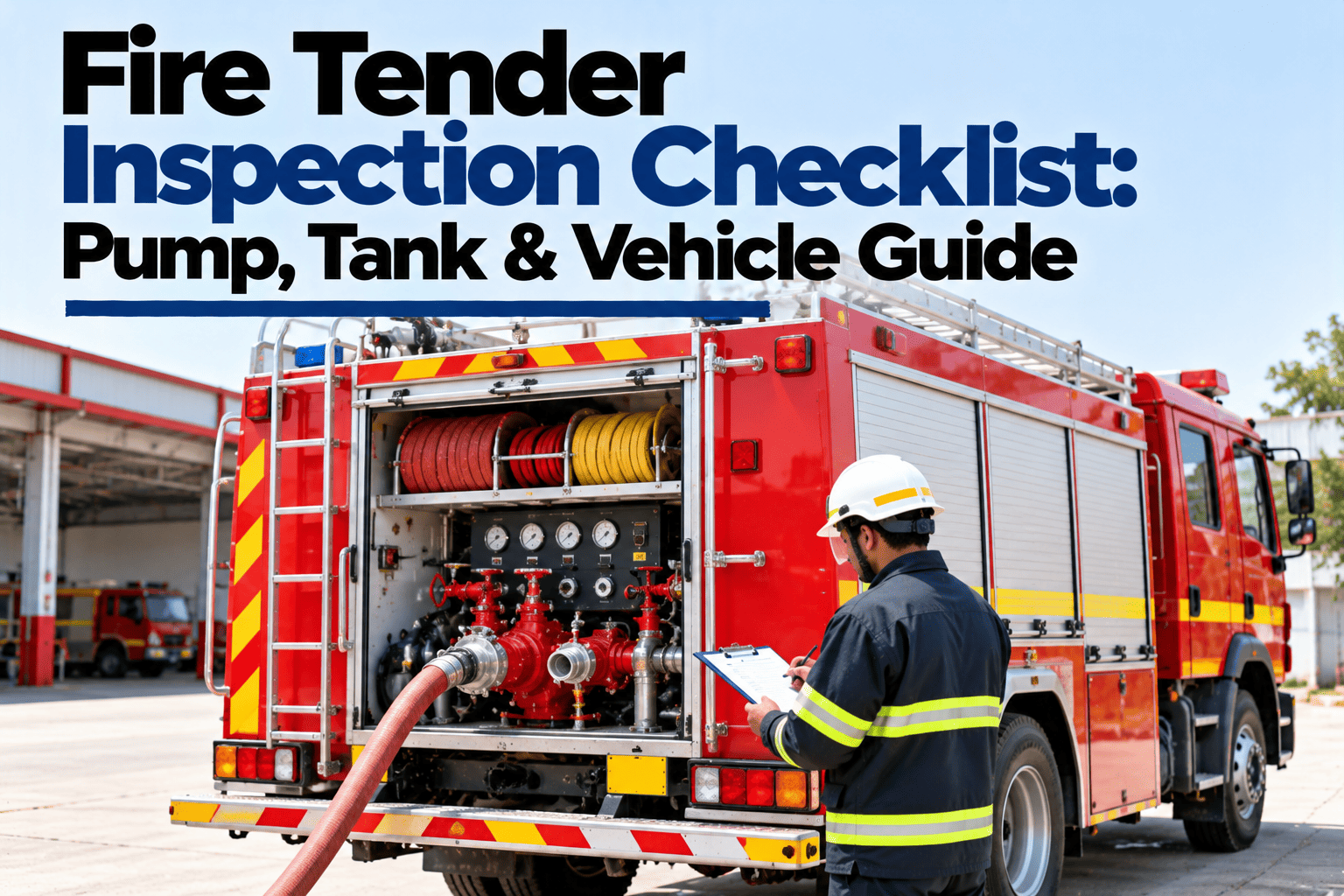
A fire tender may stand in its bay for days without a call, yet it must start, pump and reach the scene the moment an alarm sounds. Long idle periods bring their own problems: batteries drain, pumps lose their prime, valves stiffen and tyres age while the vehicle sits still. These faults stay hidden until the worst possible moment unless someone checks for them on a fixed routine. A daily readiness check and a regular pump test keep every tender ready. This checklist covers both, and shows how fire teams track tender readiness and pump tests in HVI.
Fire Tender Inspection Checklist: Pump, Tank and Vehicle Guide
Fire pump and priming, water and foam tanks, hoses and branches, ladders, lights and siren, battery and chassis, kept ready around the clock.
Daily Readiness Checklist
Complete these at every shift change so the incoming crew knows the tender is ready to respond.
Running the Pump Test
A regular pump run keeps seals wet, proves the primer and shows problems before a real fire. Follow the pump maker's procedure.
Engage the pump
Engage as the maker instructs, with the vehicle secured.
Prime
Check the primer lifts water quickly from the source.
Flow and pressure
Run through a hose and note gauge readings.
Drain and record
Drain as required and log the results.
Do not run the pump without water for longer than the maker allows, as it can overheat and damage seals. Secure all hose couplings before charging lines, keep people clear of charged hoses, and stop immediately if a hose or fitting starts to leak.
Equipment Inspection Guide
Firefighting equipment must work first time. Inspect it on a fixed schedule as well as after every use.
| Equipment | What to check | Replace or repair if |
|---|---|---|
| Delivery hoses | Cuts, abrasion, couplings and rolling | Damaged lining or leaking couplings |
| Suction hoses | Strainer, couplings and walls | Cracks or collapsed sections |
| Branches and nozzles | Spray settings and shut-off | Sticking controls or damage |
| Ladders | Rungs, locks, ropes and pulleys | Bent rungs, failed locks, frayed ropes |
| Foam system | Inductor, concentrate level and pick-up | Blocked inductor or expired concentrate |
| Tank and valves | Leaks, sediment and valve movement | Leaks, heavy sediment or stiff valves |
Every Tender Ready, Every Test Recorded
HVI gives crews a shift checklist on their phones, records pump test results and equipment checks with photos and shows which tenders are fully ready to respond.
Problems Caused by Standing Idle
Vehicles that wait for long periods develop faults that busy vehicles rarely do.
Flat batteries
Lights, radios and chargers drain them while parked.
Fix: keep on charge, test dailyLost prime
Pumps and primers dry out between uses.
Fix: regular pump runsStiff valves
Valves seize when they are not operated.
Fix: operate every valve weeklyAgeing tyres
Tyres crack with age even with low mileage.
Fix: check age and conditionFire Tender Readiness in HVI
A sample view across a station's tenders.
| Tender | Type | Shift check | Last pump test | Status |
|---|---|---|---|---|
| FT-01 | Water tender | Passed | 3 days ago | Ready |
| FT-02 | Foam tender | Passed | Overdue by 4 days | Run pump test |
| FT-04 | Water tender | Battery failed to start | 5 days ago | Off the run |
Fire Tender Inspection FAQs
What should be checked on a fire tender every shift?
Engine start and warning lights, fuel, oil and coolant, water and foam tank levels, brake air pressure, beacons, siren and floodlights, tyres, locker stowage and radios.
How often should a fire tender pump be tested?
Run the pump on a regular schedule set by your service and the pump maker, often weekly, and after any repair. Regular running keeps seals wet and proves the primer works.
Why do fire tender batteries go flat?
Radios, chargers and lights draw power while the tender stands idle for long periods. Keep it on a suitable charger and test the battery at every shift change.
How should fire hoses be inspected?
Check for cuts, abrasion and damaged couplings after every use and on a fixed schedule, and pressure test as your service requires. Teams that log hose checks in HVI keep a full history.
Can fire tender readiness be tracked digitally?
Yes. Crews complete shift checks and pump tests on a phone, and officers see which tenders are ready. Book a demo to see fire tender checklists in HVI.
Ready the Moment the Alarm Sounds
Check every fire tender at each shift, test pumps on schedule, look after hoses and ladders and track every defect in HVI. Faster turnouts and equipment that works first time.