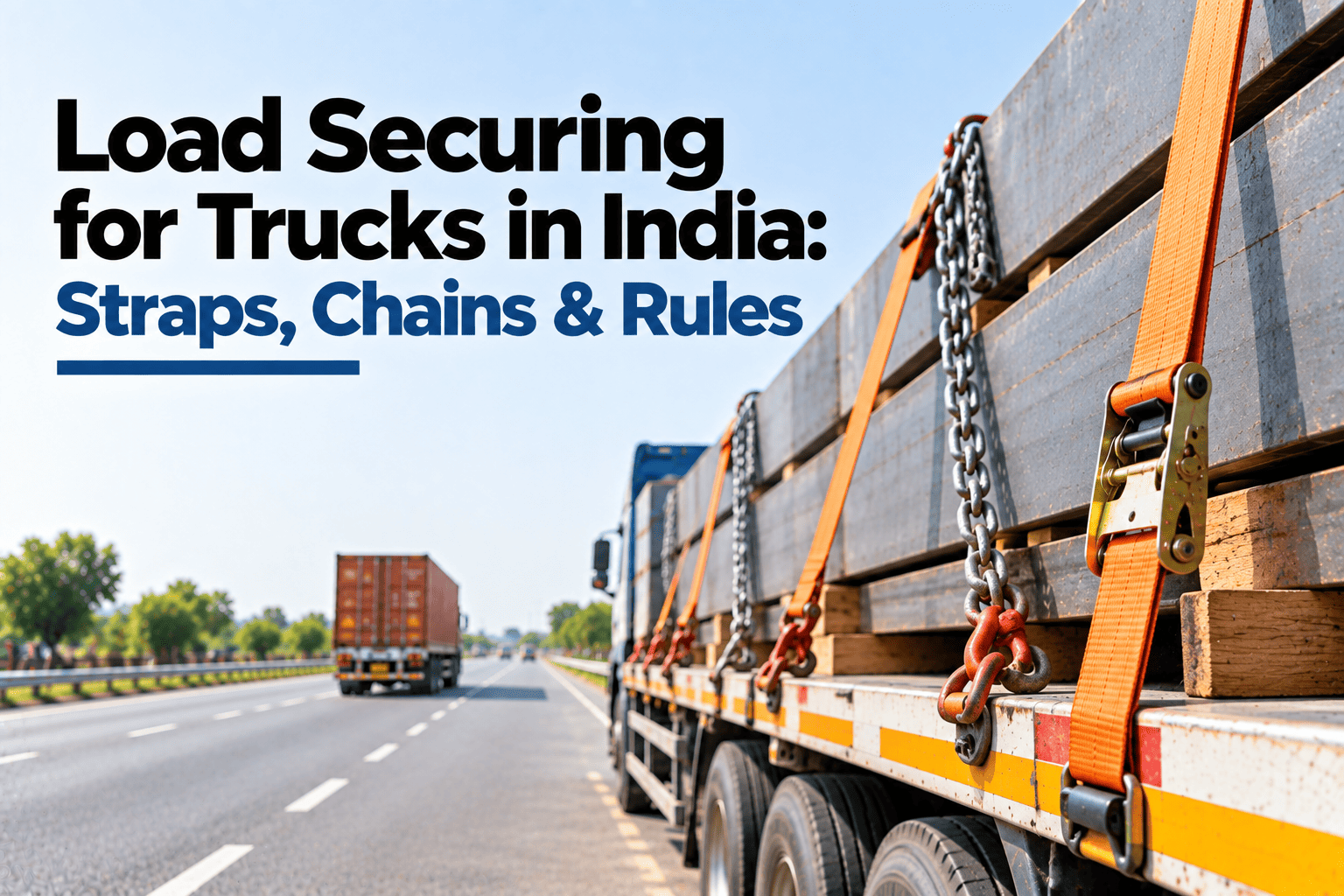
A load that shifts on a sharp turn can tip a truck over in seconds, and a coil or pipe that breaks loose can kill someone in the next lane. Most of these accidents start with the same shortcuts: too few straps, worn chains, loads placed off-centre or nobody checking the lashings after the first few kilometres. Securing a load properly takes a little more time at the yard and saves trucks, cargo and lives on the road. This guide covers equipment, methods, weight distribution and checks, and how fleets add load securing to pre-trip checklists in HVI.
Load Securing for Trucks in India: Straps, Chains and Rules
Learn how much force your lashings must hold, which equipment suits each load and what to check before and during every trip.
Securing Equipment and When to Use It
Every strap and chain has a rated lashing capacity marked on its label. Use equipment matched to the load, and never use anything without a readable rating.
| Equipment | Best for | Check before use |
|---|---|---|
| Ratchet straps | Pallets, bags, boxes, light machinery | No cuts or burns, label readable, ratchet works |
| Chains with binders | Steel coils, heavy machinery, pipes | No stretched or cracked links, hooks not opened |
| Twist locks | Containers on trailers | All four corners engaged and handles locked |
| Friction mats | Under loads to stop sliding | Clean, not torn, placed under the full load base |
| Chocks, wedges and dunnage | Coils, pipes and loads that can roll | Strong enough and fixed in place |
| Tarpaulins and nets | Weather protection and loose material | Tied tight with no flapping edges |
A tarpaulin keeps cargo dry, but it does not secure the load. Always lash first and cover afterwards.
Three Ways to Hold a Load in Place
Most good securing plans combine more than one method.
Blocking
Place the load hard against the headboard, stakes or other cargo so it has nowhere to move.
Best for: pallets, cartons, stacked goodsTop-over lashing
Straps pass over the load and press it down, so friction stops it sliding.
Best for: lighter loads with friction matsDirect lashing
Chains or straps run from lashing points on the load straight to the truck.
Best for: machinery, coils and heavy itemsHow to Secure Common Indian Loads
Each type of cargo has its own risks. These are the key points for loads Indian fleets carry most often.
Steel coils
- Use a cradle or chocks so the coil cannot roll
- Chain through the eye in both directions
- Never rely on straps alone
Machinery on trailers
- Use the maker's lashing points
- Lower bucket or boom and apply brakes
- Chain each corner directly to the trailer
Pipes and rods
- Use stakes or side supports
- Lash each bundle at several points
- Block the front against the headboard
Timber and logs
- Keep within stake height
- Lash each stack separately
- Recheck as wood settles
Bags and pallets
- Stack evenly with no gaps
- Use friction mats and corner protectors
- Strap every row
Containers
- Lock all four twist locks
- Check locks are the right type for the trailer
- Never move with a lock open
Make Load Securing Part of Every Pre-Trip Check
HVI lets you add load securing items, with compulsory photos, to each vehicle's pre-trip checklist, so nothing leaves the yard unchecked.
Weight Distribution on the Truck Bed
Where the load sits matters as much as how it is tied. Poor placement overloads one axle, makes steering light or raises rollover risk.
Spread along the bed, kept low and blocked against the headboard.
Front axle goes light, steering and braking suffer.
High centre of gravity raises rollover risk on bends.
Stay within the registered gross weight and each axle limit. Loads projecting beyond the body or over-dimensional cargo need the markings, lights and permits required under Indian rules.
Check Before the Trip and Again on the Road
Loads settle and straps loosen in the first part of a journey. A securing plan is only safe if it is checked more than once.
- Load placed and blocked correctly
- Enough lashings for the load weight
- All straps and chains tight
- Photos of the secured load taken
- Retighten straps and binders
- Look for any load movement
- Check tarpaulin ties
- Walk around the load
- Check for rubbing or cut straps
- Recheck after rough roads
Load Securing Items in an HVI Pre-Trip Checklist
A sample section from a flatbed pre-trip checklist. Each item needs a pass or fail, and photos are required before the truck can leave.
Load Securing FAQs
How many straps does a truck load need?
It depends on the load weight, the lashing capacity of each strap, the securing method and friction. A common good-practice approach is to restrain at least 0.8 times the load weight forward and 0.5 times sideways and backward. Many fleets use a load plan or calculator for regular cargo types, and when in doubt, add more lashings.
What is lashing capacity on a strap or chain?
Lashing capacity is the maximum force the strap or chain is rated to hold in use, usually marked on the label in daN. Never exceed it, and never use equipment without a readable rating. Chains generally have much higher capacity than straps of similar size.
Why should straps be rechecked after starting the trip?
Loads settle and straps stretch slightly in the first part of the journey, especially on rough roads. A quick check and retightening after the first stretch catches this before the load can move. Teams that record load checks in HVI can confirm the recheck was done.
Does a tarpaulin count as securing the load?
No. A tarpaulin protects cargo from rain and dust and keeps loose material in place, but it cannot hold a load against braking or cornering forces. Secure the load with straps, chains or blocking first, then cover it.
Who is responsible for load securing?
Responsibility is usually shared between the consignor who loads, the transporter and the driver who checks before and during the trip. Clear procedures and records show who checked what. Book a demo to see load securing checklists in HVI.
Every Load Secured, Every Check Recorded
Add load securing items and photos to pre-trip checklists, flag damaged straps before departure and keep a record of every check. Fewer shifted loads, fewer cargo claims and safer roads.