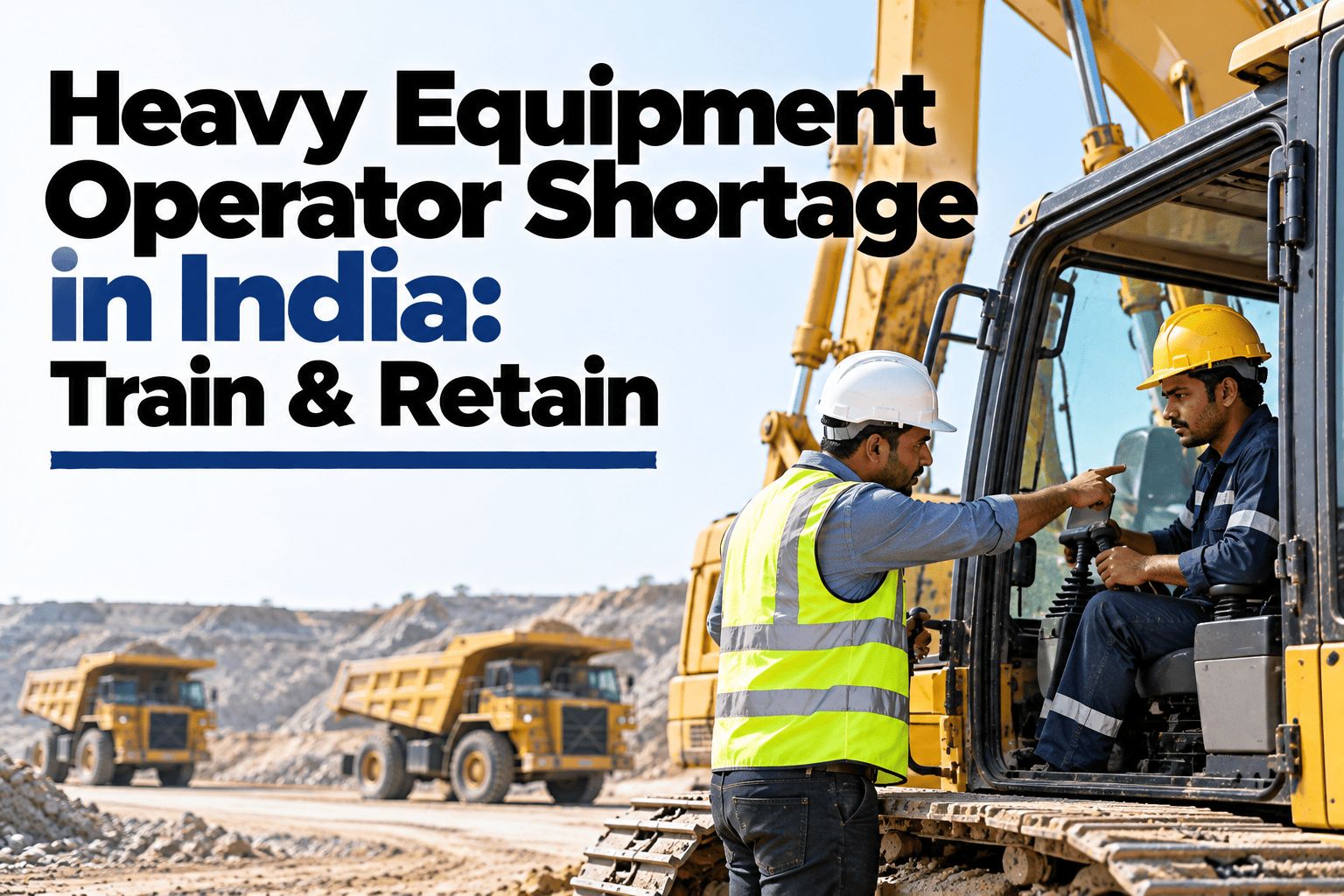
Ask any contractor or mine manager in India what slows them down, and finding good operators will be near the top of the list. Excavators, cranes and loaders are arriving faster than skilled people to run them. When an untrained operator takes the seat, productivity drops, machines get damaged and the risk of accidents rises. The companies that cope best grow their own operators and give them reasons to stay. This guide shows how, and how teams track operator skills and machine damage in HVI.
Heavy Equipment Operator Shortage in India: Train and Retain
Practical ways to close the operator gap through structured training, simulators, certification, mentoring, fair pay and the right incentives.
What the Shortage Really Costs
The gap shows up in more places than an empty seat. Unskilled operators cost money every shift.
Machine damage
Rough operation breaks pins, buckets, hoses and undercarriage.
Accidents
Poor judgement around people, slopes and loads raises risk.
Low output
Slow cycles mean fewer tonnes or trenches per shift.
Idle machines
Expensive equipment stands still with no one to run it.
Training Paths That Work
Most companies combine several of these. The right mix depends on your machines, sites and budget.
| Training path | What it offers | Best suited to |
|---|---|---|
| In-house mentoring | Learning on your machines from senior operators | Every company, at low cost |
| Maker training centres | Structured courses from equipment manufacturers | New operators on specific brands |
| Simulators | Safe practice without risk to machines or people | Basics and complex tasks such as crane lifts |
| Skill council certification | Formal assessment and recognised certificates | Proving skills to clients and auditors |
| Apprenticeships | Earn while learning over a longer period | Building a steady pipeline of young operators |
Where Simulators Help, and Where They Do Not
Simulators are a useful step between the classroom and the real machine, not a replacement for site experience.
- Learning controls without risk
- Practising rare or dangerous situations
- Measuring skills consistently
- Saving fuel and machine hours in training
- Feel for ground, load and machine response
- Working safely around people on site
- Daily checks and basic care of the machine
- Building confidence in real conditions
Know Every Operator's Skills and Impact
HVI records operator training, certifications, daily checks and damage reports by operator and machine, so you can see who needs coaching and who is ready to mentor others.
A Simple Skill Ladder
A clear path from trainee to trainer gives operators a reason to improve and to stay.
Keeping Good Operators
Training an operator who then leaves for a small pay rise is costly. These levers help them stay.
Pay by skill
Higher grades for certified and multi-skilled operators.
Fair incentives
Rewards for output, care of the machine and safety.
Rest and fatigue
Sensible shift lengths and decent site facilities.
Career growth
A real path to senior operator and trainer roles.
Operator Skills and Damage in HVI
A sample view for a site team. Linking skills to machine damage shows where training pays off most.
| Operator | Grade | Machines certified | Damage reports in 90 days | Action |
|---|---|---|---|---|
| Operator A | Senior operator | Excavator, loader, crane | 0 | Make mentor |
| Operator B | Operator | Excavator | 2 | Refresher training |
| Operator C | Trainee | None yet | 4 | Supervised work only |
Operator Shortage FAQs
Why is there a shortage of heavy equipment operators in India?
Construction and mining have grown quickly, and machines are arriving faster than skilled operators are trained. Many operators also learn informally on site, so formal training and certification have not kept pace with demand.
How can contractors train their own operators?
Combine in-house mentoring by senior operators with maker training courses, simulator practice and formal skill assessment. A clear skill ladder from trainee to trainer helps structure the process.
Are operator simulators worth it?
Simulators help new operators learn controls and practise risky tasks safely, and they save machine hours. They work best as a step before supervised time on the real machine, not as a replacement for it.
How do I stop trained operators from leaving?
Pay by skill level, reward output and machine care, manage fatigue and offer a clear path to senior and trainer roles. Teams that track operator skills in HVI can link grades to real performance.
Can damage be tracked by operator?
Yes. When damage reports and daily checks are recorded with the operator and machine, patterns show who needs coaching. Book a demo to see operator tracking in HVI.
Grow Your Own Operators and Keep Them
Train, certify and mentor operators, and track their skills, checks and machine damage in HVI. Better operators, fewer accidents and machines that keep working.