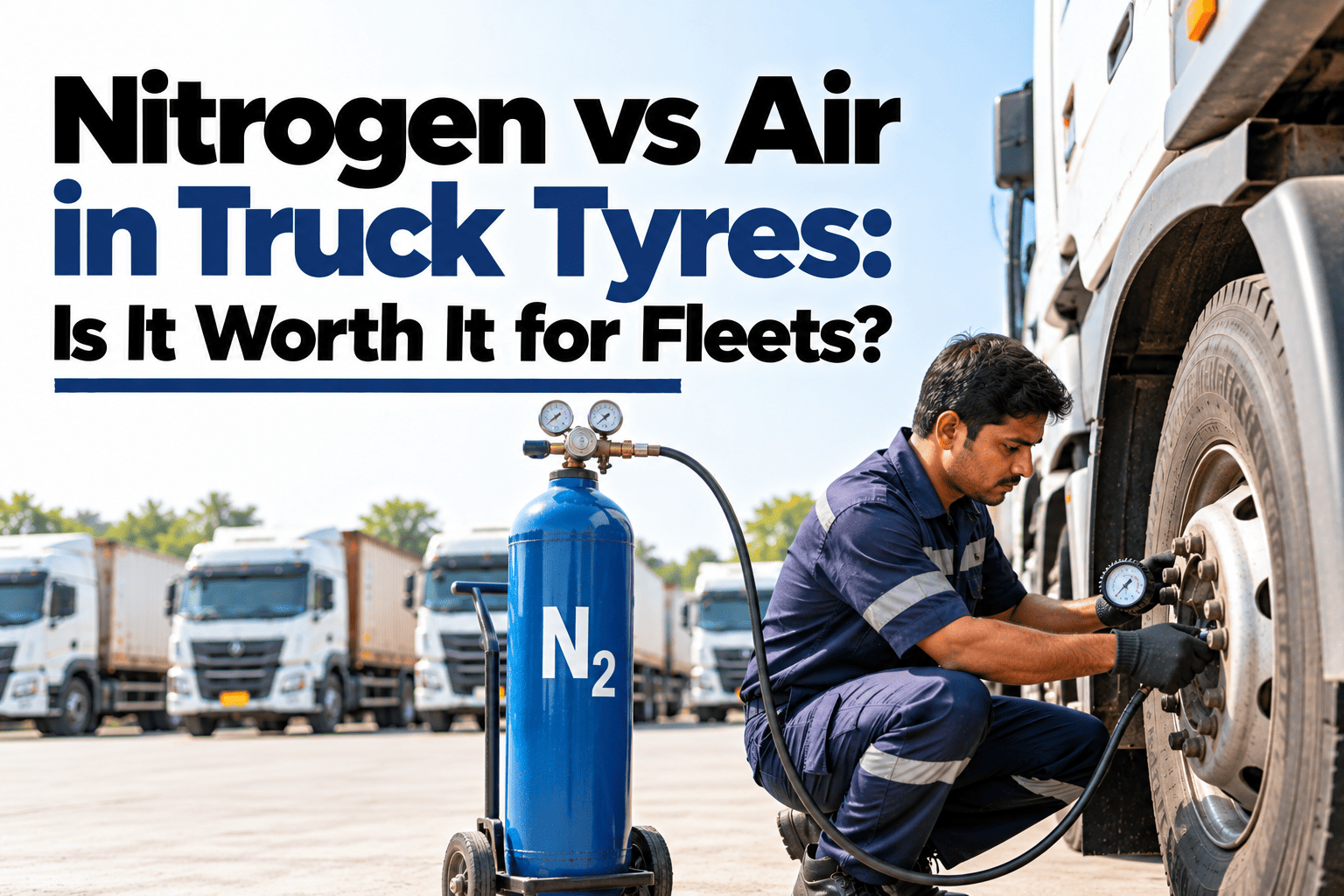
Pull into many tyre shops in India and you will be offered nitrogen inflation for your trucks and buses, with promises of longer tyre life and better mileage. Some of those claims have a basis, and some are stretched. Nitrogen does lose pressure more slowly than ordinary air, but it cannot fix a fleet that rarely checks its tyres. What really decides tyre life and fuel use is keeping every tyre at the right pressure, whatever is inside it. This guide separates fact from sales talk, and shows how fleets track tyre pressure checks in HVI.
Nitrogen vs Air in Truck Tyres: Is It Worth It for Fleets?
What nitrogen really changes, what it does not, what it costs and whether it pays off compared with simply checking air pressure more often.
What Nitrogen Changes, and What It Does Not
Nitrogen has real but modest benefits. The biggest gains still come from checking and correcting pressure regularly.
- Pressure drops more slowly between checks
- Less moisture inside the tyre
- Pressure varies a little less with temperature
- Less oxidation of the inner rubber over time
- Leaks from punctures, valves or rims
- Damage from overloading or bad roads
- The need to check pressure regularly
- Wear from poor alignment or driving
Common Claims, Checked
Some claims about nitrogen are accurate, some are partly true and some are overstated.
| Claim | Reality | Verdict |
|---|---|---|
| Nitrogen keeps pressure longer | It escapes through rubber more slowly than oxygen, so pressure drops more slowly | Largely true |
| Nitrogen makes tyres last longer | Only by helping keep pressure correct; regular air checks give a similar result | Partly true |
| Nitrogen improves mileage | Correct pressure helps fuel use, whatever the gas | Partly true |
| You can never top up with air | Mixing is safe; it just reduces the nitrogen share | Not true |
| Nitrogen means no pressure checks | Tyres still lose pressure and get punctures | Not true |
Nitrogen or Better Air Checks?
For many fleets, the real choice is between paying for nitrogen and simply checking air pressure more often.
- Extra cost per tyre at most outlets
- Not always available on the road
- Pressure stays steadier between checks
- Still needs regular pressure checks
- Air is cheap and available almost everywhere
- Needs disciplined checks when tyres are cold
- Catches leaks and damage at the same time
- Gives most of the benefit for little cost
Whichever you choose, the habit of checking and correcting pressure matters far more than the gas inside the tyre.
Make Pressure Checks a Habit, Not a Hope
HVI gives drivers a quick tyre pressure checklist, records readings for every wheel and flags under-inflated tyres, whether they are filled with air or nitrogen.
Where Nitrogen Makes the Most Sense
Nitrogen tends to add more value in some operations than others.
Long-haul highway runs
Long gaps between checks and high running temperatures.
Large mining tyres
Some tyre makers recommend nitrogen for large off-road tyres.
Short city routes
Vehicles return to base often and can be checked easily.
Fleets with daily checks
Regular checks already keep pressure right with air.
Good Pressure Habits, Whatever You Use
These habits make the biggest difference to tyre life and fuel use.
Check cold
Measure before driving, when tyres are cold.
Use a good gauge
A calibrated gauge gives readings you can trust.
Set the right pressure
Follow the tyre maker's pressure for the load.
Record and act
Log readings and fix tyres that keep losing pressure.
Tyre Pressure Checks in HVI
A sample weekly view. Tyres that keep losing pressure stand out, whatever they are filled with.
| Vehicle | Fill | Checks this week | Tyres low | Status |
|---|---|---|---|---|
| TRK-03 | Nitrogen | 2 | 0 | All correct |
| TRK-09 | Air | 5 | 1 | Top up and recheck |
| BUS-11 | Nitrogen | 1 | 3 | Check for leaks |
Nitrogen vs Air FAQs
Is nitrogen better than air for truck tyres?
Nitrogen loses pressure more slowly and carries less moisture, so pressure stays steadier between checks. But the main benefits come from correct pressure, which regular air checks can also deliver at lower cost.
Can I mix air and nitrogen in a tyre?
Yes. Mixing is safe. Topping up a nitrogen-filled tyre with air simply reduces the share of nitrogen. It is far better to top up with air than to run a tyre under-inflated.
Does nitrogen improve fuel efficiency?
Fuel efficiency improves when tyres are at the correct pressure. Nitrogen can help keep pressure steady, but the same benefit comes from checking and correcting air pressure regularly.
Do I still need to check pressure with nitrogen?
Yes. Nitrogen-filled tyres still lose pressure over time and through punctures, valves and rims. Teams that log pressure checks in HVI catch slow leaks early, whatever the fill.
Is nitrogen worth it for my fleet?
It is most worth considering for long-haul runs and large off-road tyres where checks are infrequent. Fleets with daily pressure checks usually get most of the benefit from air. Book a demo to see pressure tracking in HVI.
Right Pressure, Every Tyre, Every Week
Whether you use nitrogen or air, track pressure checks for every wheel in HVI. Catch slow leaks early, extend tyre life and keep fuel use down.