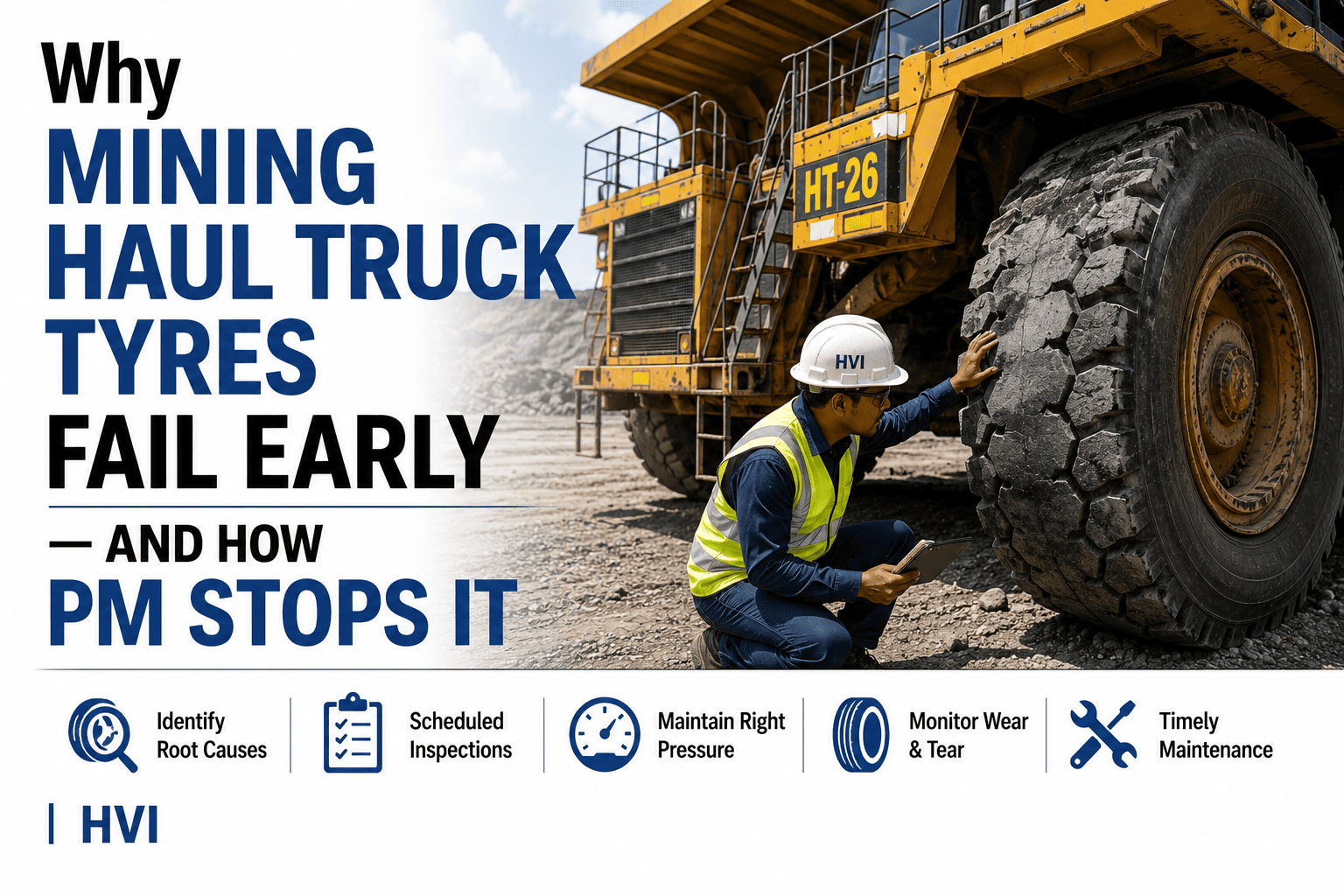
A haul truck tyre rated for tens of thousands of hours sometimes doesn't make it past a fraction of that before it needs replacing, and the difference between a tyre that reaches its full life and one that fails early almost never comes down to a bad batch of rubber. It comes down to four preventable conditions: a load beyond what the tyre was rated for, pressure that drifted low without anyone checking, a rim that was never properly matched or seated during mounting, and a rotation schedule that existed on paper but not in practice. Each one is invisible on a casual walk-around and each one is exactly what a structured PM schedule is built to catch. Here's how each cause actually damages a tyre, and how HVI's PM scheduling catches all four before they turn into an early failure.
Why Mining Haul Truck Tyres Fail Early — and How PM Stops It
The four main causes of premature tyre failure on BEML and Komatsu haul trucks in Indian mines, and how a structured PM schedule prevents each one.
The Four Causes
Cause 1
Overloading
A load beyond a tyre's rated capacity raises internal pressure and casing stress on every haul cycle, causing casing fatigue, radial cracking, and inner liner damage well before it's visible from outside.
Cause 2
Under-Inflation
A tyre running below its correct pressure flexes more with every rotation, building internal heat faster than it can dissipate — one of the most common precursors to failure.
Cause 3
Rim Damage
A mismatched tyre-rim combination, or bead damage from improper mounting, prevents the tyre from seating correctly — a fault that can sit hidden until pressure or load exposes it under working conditions.
Cause 4
Missed Rotation
A tyre run past its intended rotation interval wears unevenly, concentrating stress on one section of tread rather than spreading it across the full circumference.
See how a PM schedule built around these four causes would run against your own haul truck fleet.
How PM Catches Each Cause
| Cause | PM Check That Catches It | Frequency |
|---|---|---|
| Overloading | Load logged per trip, compared against the tyre's rated capacity | Every haul cycle |
| Under-inflation | Pressure check against the specified range for that tyre and load | Fixed PM cadence, alongside other checks |
| Rim damage | Visual inspection of bead seating and rim condition at mounting and each service | At every tyre change and scheduled service |
| Missed rotation | Rotation logged against actual hours run, not a calendar guess | Per manufacturer-specified interval |
Why These Four Causes Compound Each Other
Overloading makes under-inflation worse
A tyre carrying more load than intended needs correct pressure more, not less — the two failure modes accelerate each other rather than acting independently.
Rim damage hides until conditions expose it
A poorly seated bead can survive light duty without issue, then fail exactly when load or heat pushes the tyre toward its limit.
Missed rotation concentrates the other three
A tyre that should have moved position keeps absorbing the same overload or pressure stress on the same section, instead of spreading wear evenly.
Each one alone looks minor
A single overloaded trip, one missed pressure check, or a slightly late rotation rarely fails a tyre on its own — it's the accumulation across weeks that does.
Frequently Asked Questions
Does this apply the same way across BEML, Komatsu, and other haul truck brands?
The four causes and the PM logic behind preventing them apply across brands, though exact load ratings, pressure specs, and rotation intervals should follow each manufacturer's specification for the specific truck and tyre combination.
How is overloading actually detected on a haul cycle, not just assumed?
Comparing logged payload per trip against the tyre's rated capacity, rather than relying on visual judgement of a full versus overloaded bed, is what turns overloading from a guess into a tracked figure.
Can rim damage really cause a failure if the tyre looks fine on the outside?
Yes — a poorly seated bead or damaged rim can sit undetected during light use and only manifest as a failure once load or heat pushes the tyre toward its operating limits, which is why mounting-time inspection matters as much as ongoing checks.
Does this integrate with our SAP, Oracle, or Tally maintenance and cost tracking?
Yes — PM schedules, tyre checks, and replacement records can sync with these systems, so tyre-related cost and compliance data stays connected to your existing financial records.
How soon would this PM schedule show results on our own fleet?
Once load, pressure, and rotation checks run consistently, early signs of improvement in tyre life typically become visible within a few months of tracked data; sign up free to set this schedule up for your haul trucks.
Catch All Four Causes Before the Tyre Fails
Premature tyre failure is rarely one dramatic event — it's four preventable conditions compounding quietly over weeks. Start free and put a PM schedule against all four, or bring your current haul truck tyre records to a 30-minute session with our India team.