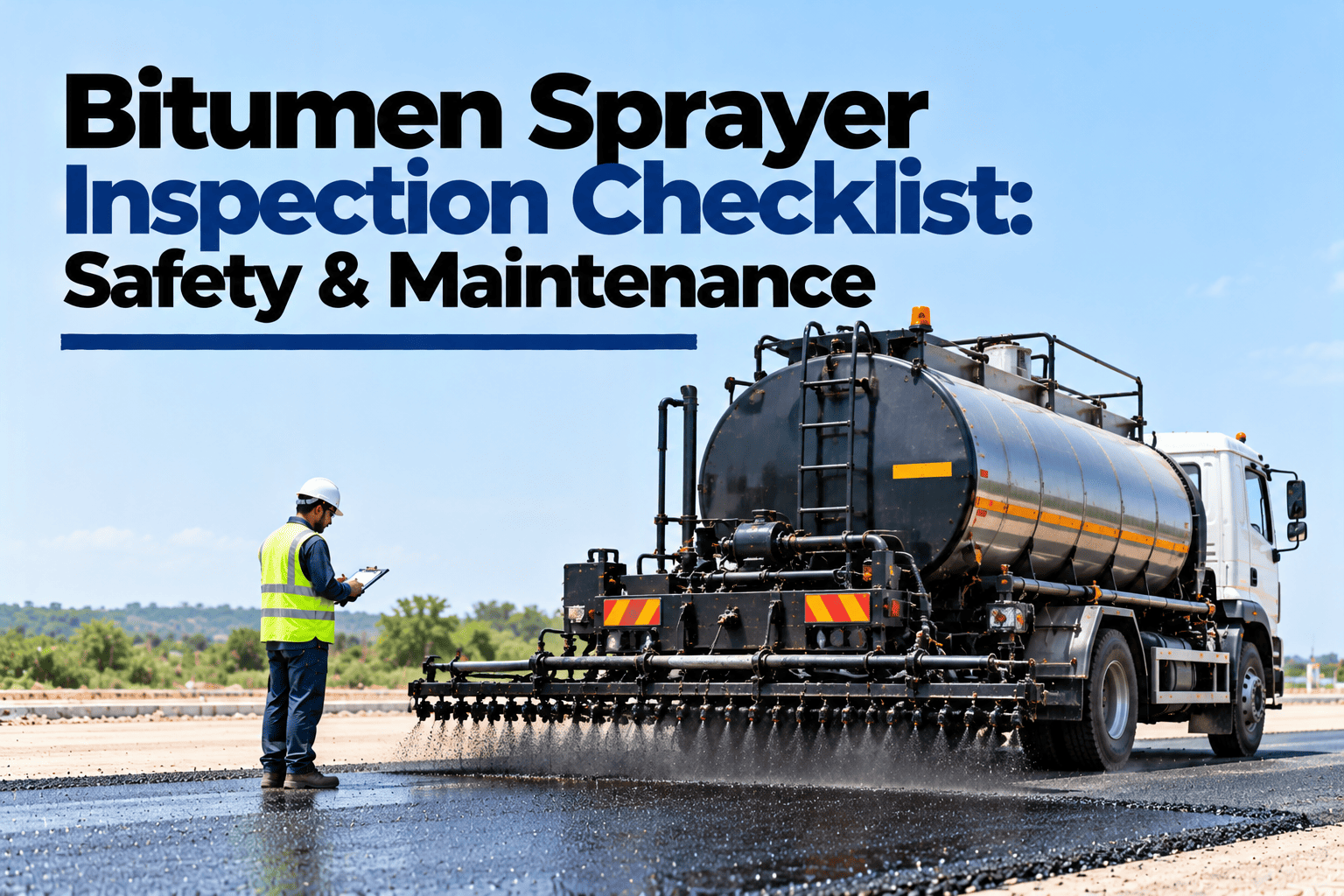
A bitumen sprayer lays the prime and tack coats that bond each road layer to the next. If a nozzle blocks, the coat goes on in stripes and the layers may not bond properly. If the binder is too cold it will not spray, and if it is heated carelessly it can catch fire. Sprayers carry hot binder and open burners, so burns and fires are real risks alongside ordinary breakdowns. A short daily check, a regular calibration test and careful cleaning keep the sprayer safe and the coat even. This guide covers them, and shows how crews record sprayer checks in HVI.
Bitumen Sprayer Inspection Checklist: Safety and Maintenance
Insulated tank and burner, thermometer, pump, spray bar and nozzles, calibration, fire safety and cleaning, for prime and tack coat work.
Pre-Start Checklist
Complete these before heating the binder each day. Do not light the burner if any safety item fails.
Component Inspection Guide
Inspect these regularly alongside the daily check. Follow the sprayer maker's manual and your binder supplier's guidance.
| Component | What to check | Warning signs |
|---|---|---|
| Tank and insulation | Shell, cladding, lid seal and vents | Hot spots, damaged insulation, leaks |
| Burner and flues | Flame, fuel supply, flue condition | Smoky flame, hard lighting, soot build-up |
| Thermometer | Reading against a reference | Stuck or inaccurate reading |
| Bitumen pump | Seals, drive and output | Leaks, noise, falling pressure |
| Spray bar | Height, valves and sections | Uneven bar height, sticking valves |
| Nozzles | Clean openings and correct angle | Blocked, worn or misaligned nozzles |
Checking the Application Rate
A simple tray test shows whether the sprayer is applying the rate the specification asks for. The figures below are illustrative.
Compare the result with the rate in your project specification. If it is off, adjust speed, pump output or bar height and test again.
Every Sprayer Check and Cleaning on Record
HVI gives sprayer crews this checklist on their phone, records calibration results, defects and cleaning with photos and keeps a full history for each sprayer.
Heating and Burn Safety
Hot binder and burners cause serious burns and fires when rules are skipped.
Never fire the burner unless the heating flues are fully covered by binder, as the maker instructs. Do not heat above the binder supplier's maximum temperature, never leave a lit burner unattended, and keep water away from hot bitumen, as it can boil over violently. Wear heat-resistant gloves, face shield and long sleeves.
- Park away from people and flammable material
- Watch the thermometer throughout
- Keep the lid closed and vents clear
- Keep an extinguisher within reach
- Follow the maker's rule on burner use
- Keep crew clear of the spray bar
- Spray only at the correct temperature
- Stop if a hose or valve leaks
End-of-Day Cleaning
Binder left in the bar, nozzles and pump sets hard and blocks the next day's work.
Return binder
Circulate remaining binder back to the tank.
Flush the system
Flush pump, bar and hoses as instructed.
Clean nozzles
Clear every nozzle opening.
Shut down safely
Burner off, fuel valve closed, park safely.
Bitumen Sprayer Status in HVI
A sample morning view across a contractor's sprayers.
| Sprayer | Project | Pre-start check | Last calibration | Status |
|---|---|---|---|---|
| BS-01 | Highway package 3 | Passed | Within specification | Ready to spray |
| BS-02 | City roads | Two nozzles blocked | Within specification | Clean nozzles first |
| BS-04 | State highway | Burner fuel leak | Due | Do not heat |
Bitumen Sprayer Inspection FAQs
What should be checked on a bitumen sprayer every day?
The tank level and lid, burner and fuel line, thermometer, pump, valves and hoses, spray bar and nozzles, fire extinguishers and protective equipment, all before heating starts.
Why does a bitumen sprayer leave stripes?
Stripes usually come from blocked or misaligned nozzles, an uneven spray bar height or binder that is too cold to spray evenly. Clean the nozzles and check bar height and temperature.
How do I check the application rate?
Place a tray of known area under the spray, weigh the binder collected and divide by the tray area. Compare the result with the project specification and adjust if needed.
How can burns and fires be prevented?
Only fire the burner with flues covered, never exceed the binder's maximum temperature, keep water away from hot bitumen and wear protective gear. Teams that record checks in HVI catch faults before heating.
Can sprayer checks be done on a phone?
Yes. Crews complete the checklist and calibration tests with photos, and supervisors see which sprayers are ready. Book a demo to see bitumen sprayer checklists in HVI.
Even Coats, Safe Crews
Check every bitumen sprayer before heating, calibrate the application rate, clean thoroughly and track every defect in HVI. Better bonding between layers and fewer burns and fires.