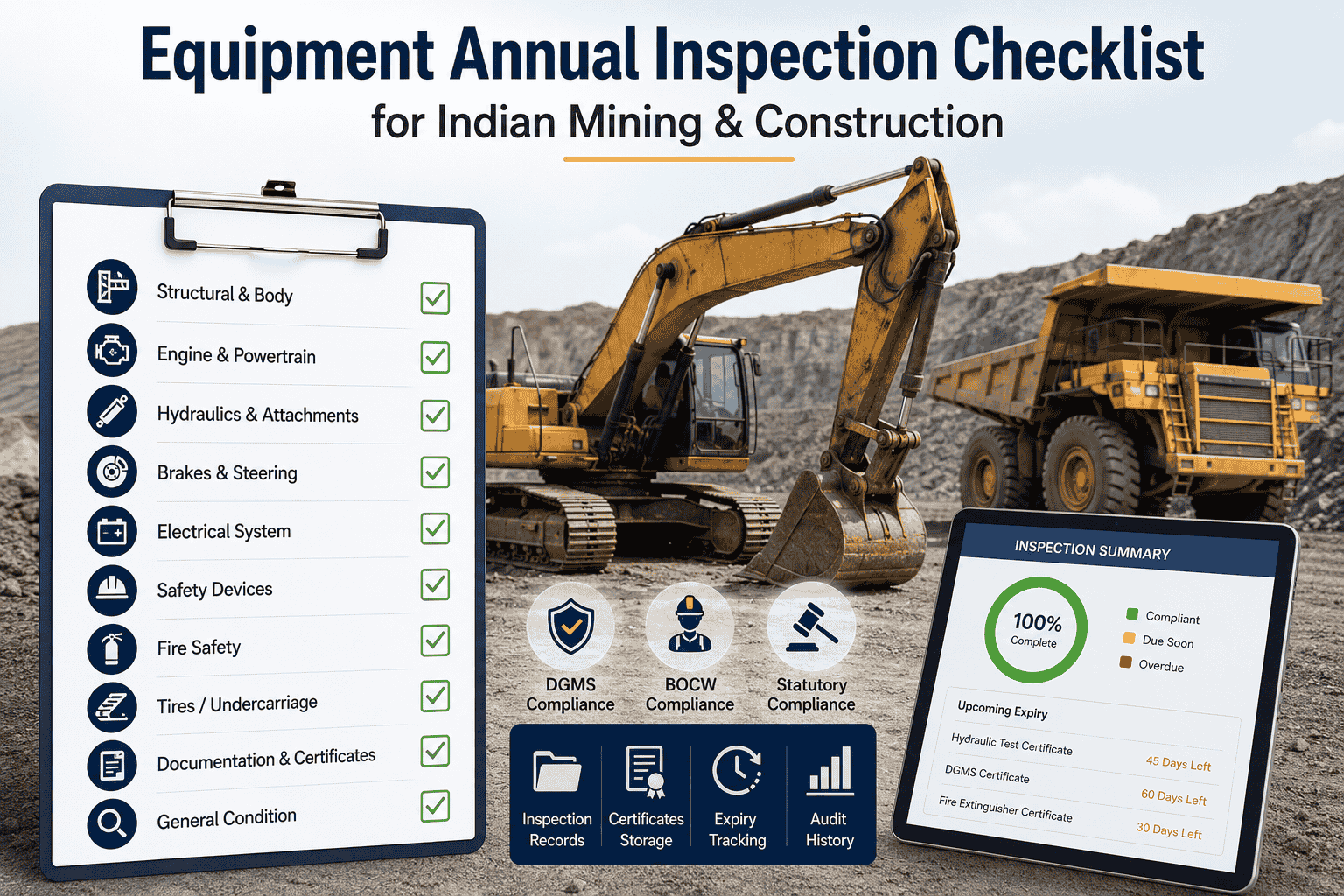
India's top EPC contractors — L&T, Dilip Buildcon, Afcons, NCC, Megha Engineering — are managing fleets of 200 to 2,000 machines across highway packages, tunnels, bridges, and mining projects. Every one of those machines needs a pre-shift inspection before it moves. For decades, that inspection meant a paper register, a pen, and a site supervisor who may or may not have read what was written. That era is ending — not because paper is philosophically wrong, but because it is failing EPC companies in ways that cost money, delay projects, and create compliance gaps that auditors are increasingly flagging. This guide breaks down exactly where paper breaks down, what digital inspection delivers in real terms, and why fleet managers at India's largest infrastructure companies are making the switch in 2025 and 2026. Start your free HVI trial and see how digital inspection changes everything your team does on site.
The Scale of the Problem — By the Numbers
India's infrastructure pipeline is the largest in the country's history. The National Infrastructure Pipeline targets ₹111 lakh crore of investment through 2025, and the EPC sector is executing the bulk of it — highways under Bharatmala, railways under the dedicated freight corridors, tunnels under NHIDCL, and mines under Coal India and NMDC. At this scale, equipment inspection is not a formality. A single uninspected excavator that fails mid-shift can halt a paver train, delay a concrete pour, and cost ₹4–8 lakh in idle time before the shift ends.
68%
of paper inspection records on Indian construction sites contain at least one incomplete field (CII field survey, 2023)
2.4 hrs
average time lost per defect when identified at breakdown vs at pre-shift inspection
22% CAGR
growth projected for India's EPC market through 2031 — scale makes inspection process critical
40%
of NHAI audit findings on equipment maintenance trace back to incomplete or missing inspection records
Head-to-Head: Paper vs Digital Inspection
The comparison below is based on how inspection actually works across Indian EPC site conditions — remote highway alignments, underground mines, tunnel headings, and urban civil projects. These are not theoretical differences. They are the gaps site managers and equipment heads deal with every shift.
Where Paper Inspection Actually Breaks Down
The failures of paper inspection on Indian EPC sites are not abstract. They follow predictable patterns — the same five or six failure modes that equipment heads see repeatedly across projects. Understanding them is the first step to fixing them.
Operators on remote highway and mining sites routinely fill inspection registers at the end of the shift — or in the site office — rather than at the machine. The timestamp says 5:30 AM; the register was actually filled at 7 PM. No paper-based system can prevent this. Digital inspection locks the timestamp and GPS at the moment the form is submitted from the device at the machine location.
Site registers go missing. They get soaked in monsoon rain, torn, left in a machine cab, or simply misplaced during site moves. When a DGMS inspector or NHAI auditor asks for records going back six months, a missing register is a compliance failure — regardless of whether the inspections actually happened. Digital records exist in the cloud and cannot be lost, damaged, or destroyed.
Paper defect notes are almost always too vague to be actionable. "Knocking sound from engine" or "brakes soft" tells the workshop very little. Without a photo, without GPS, without the specific checklist item flagged, the workshop supervisor has to inspect the machine again from scratch before they can even diagnose the problem. Digital inspection attaches a photo to every defect — the workshop opens the work order and already knows exactly what and where.
A project director managing 12 sites across two states has zero visibility into the real inspection status of their fleet on any given morning. They receive daily reports — compiled from registers, averaged, summarised, and delayed by 12 to 24 hours. By the time they see a pattern of repeated brake defects on a specific excavator, the machine may have run for three more shifts. Digital dashboards make the entire fleet visible in real time.
Most site inspection protocols require a supervisor to countersign the register after reviewing the operator's entry. On large sites, this produces a daily ritual of chasing the supervisor across the worksite with a register in hand. The machine waits. The shift starts late. Or the machine moves before the countersignature happens — which means the paper record is technically invalid. Digital sign-off is done on the same device in seconds, before the machine key is turned.
Paper registers cannot be analysed. You cannot run a query asking which machines on your Rajasthan package had three or more brake-related defects in the last 90 days. You cannot identify which operator consistently skips the hydraulic fluid check. You cannot build a predictive maintenance case for a machine category that is failing more than expected. Digital inspection generates structured data — and that data becomes the foundation for maintenance intelligence.
See the Difference on Your Own Site
Run HVI on airplane mode for one shift. Complete a full inspection — checklists, photos, defect flags, supervisor sign-off — entirely offline. Then reconnect and watch it appear on the dashboard. No setup fees. No hardware.
What Digital Inspection Delivers in Real Numbers
When EPC companies move from paper to digital inspection, the improvements are not vague or qualitative. They show up in measurable outcomes across inspection time, defect detection rate, compliance record completeness, and breakdown response speed. Here is what the data shows across infrastructure site deployments.
Mandatory field enforcement and mobile accessibility drive near-complete inspection submission rates on digital platforms — vs the chronic skip-and-rush reality of paper.
Structured checklists with photo prompts surface defects that operators miss or skip on paper forms. Catching a defect at 5 AM costs minutes. Catching it at 2 PM breakdown costs hours.
Digital records are never lost, damaged, or incomplete. Every inspection is timestamped, GPS-tagged, and operator-signed — making NHAI and DGMS audits a dashboard lookup rather than a register search.
Auto-generated work orders sent to the workshop supervisor at the moment of defect flagging eliminate the paper handoff delay that costs fleets hours of machine downtime daily.
How Indian EPC Sites Are Making the Switch
The transition from paper to digital inspection does not have to be disruptive. The EPC companies doing it successfully are following a phased approach — starting with high-value machine categories, proving the system over 30 days, and then rolling out fleet-wide. Here is what that playbook looks like on a typical NH package or mining project.
Start with the machines that have the highest breakdown history or the most compliance scrutiny — typically excavators, dumpers, and cranes on highway packages, or LHD loaders and underground dumpers on mine sites. These are the machines where a missed pre-shift inspection has the highest consequence.
Your digital inspection system must mirror your compliance checklist exactly — not a generic list. For mines, this means DGMS pre-shift items under the Mines Act. For highway packages, this means NHAI's equipment checklist under contract conditions. HVI allows custom checklists configured per machine category.
Do not kill paper immediately. Run both systems in parallel on one site for 30 days — paper as backup, digital as primary. Use this period to measure completion rates, identify operators who need additional training, and validate that offline sync is working correctly for your site conditions.
Once the trial validates digital inspection performance, paper becomes the exception. Assign devices to operators, configure fleet-wide dashboards for your equipment head and safety manager, and set up automatic work order routing to the workshop. The register stays on the shelf — as a legal fallback, not a daily tool.
Compliance: What DGMS and NHAI Actually Require
Before any EPC company switches inspection systems, the compliance question must be answered clearly. Does a digital inspection record satisfy the Mines Act 1952, DGMS circulars, NHAI equipment maintenance requirements, and MoRTH road safety obligations? The answer is yes — provided the digital record captures all required elements. Here is what each framework requires and how digital inspection delivers it.
Requires pre-shift inspection of all underground and opencast mining equipment before each shift, with operator certification. Records must be available for inspection for a minimum of one year.
Digital inspection records carry operator ID, digital sign-off, timestamp, and GPS location of inspection — fully satisfying the certification and record retention requirements. PDF reports exportable for DGMS visits.
EPC contractors on NHAI packages are required to maintain equipment maintenance records showing regular pre-use inspection. Audits during NHAI review cycles check for completeness and contemporaneity of records.
Digital inspection provides timestamped, GPS-verified records that cannot be backdated — directly addressing NHAI's requirement for contemporaneous inspection documentation. Dashboard reports cover any date range requested.
Indian Standard codes for construction site safety require documented evidence of equipment inspection, with defect records and corrective action tracking maintained per machine.
Digital platforms maintain per-machine inspection history with defect records, linked work orders, and resolution tracking — creating the complete audit trail IS codes require across the equipment lifecycle.
Expert View: From the Equipment Head's Desk
We had 340 machines across four highway packages. Every site had its own register, its own format, its own way of filling it. When I asked for last month's inspection data for a machine that broke down, my site manager took three days to compile it from four different registers — and even then, there were 11 days where the records were missing or illegible. After we switched, I pulled the same data in 40 seconds from the dashboard. That is not a marginal improvement. That is a fundamentally different capability.
Equipment Head, EPC Contractor
Managing 340 machines across NH packages in UP, Rajasthan and Bihar
Frequently Asked Questions
Is digital inspection legally valid under Indian mining and highway regulations?
Yes. Digital inspection records are legally valid provided they contain all required elements — operator identity, timestamp, inspection items, defect notes, and sign-off. HVI's inspection records include GPS location, timestamped photo evidence, and operator digital certification. These records satisfy DGMS, NHAI, and MoRTH compliance requirements. Sign up and see a sample compliance report.
What happens if the operator's phone has no internet on site?
True offline-first apps like HVI store everything locally on the device — checklists, photo capture, GPS tagging, defect records, and sign-off all work with zero network. The moment any connection returns (Wi-Fi at camp, a 2G signal at the site boundary), everything syncs automatically. No data is lost and no operator action is needed. Book a demo to see offline mode live.
How long does it take to set up digital inspection for a 50-machine fleet?
Most HVI customers are running live inspections within 24 to 48 hours of signup. Machine setup, checklist configuration, and operator onboarding typically take one working day with support. No hardware procurement, no server setup, and no IT project required — the app runs on standard Android phones your operators already carry.
Can different sites use different inspection checklists within the same account?
Yes. HVI allows you to configure separate checklists per machine category, per site, and per shift type — all within a single account. An excavator on an NH package can use a different checklist than an underground LHD loader at a mine site, and the dashboards remain consolidated at the fleet level for your equipment head and regional managers.
Do operators need smartphones or does HVI supply devices?
HVI runs on any Android device with Android 8 or above, including budget smartphones common on Indian construction sites. No proprietary hardware is required. Most EPC companies deploy inspection on existing operator devices or procure basic Android handsets at ₹5,000–8,000 per unit for site use. Start your trial today and test on the devices you already have.
Ready to Make the Switch?
Run Your First Digital Inspection Today — No Paper, No Setup Fees
Join the EPC contractors, mining operators, and fleet managers across India who have moved from paper registers to real-time fleet visibility. HVI is live on site in 24 hours.
No credit card. No hardware. Offline-capable from day one.