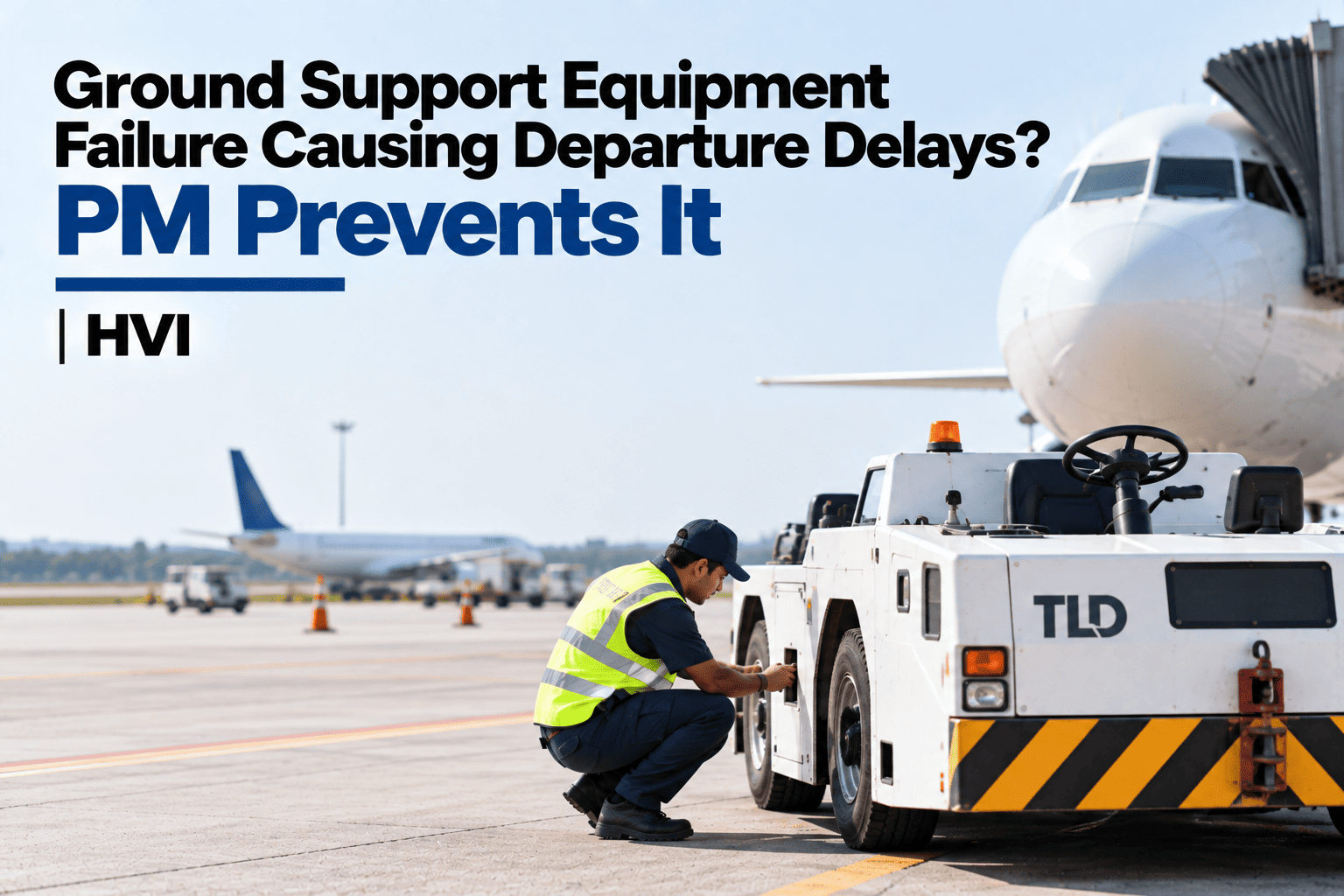
An aircraft turnaround at an Indian airport runs on a tight clock, and every minute of it depends on ground support equipment that has to work on the first try — a baggage tractor that won't start, a GPU that trips, or a towbar that fails mid-pushback does not just delay one task, it pushes the entire departure back. Most GSE fleets still run PM on paper logs and tribal knowledge about which unit "usually" needs attention, which means the first sign of a developing fault is often the fault itself, in the middle of a turnaround. HVI schedules PM around actual usage and flags developing issues before they reach the tarmac, and you can see it mapped to your own ground fleet in a free 30-minute session.
Ground Support Equipment Failure Shouldn't Decide Your Departure Time
Inspection checklists, PM scheduling, and compliance records for baggage tractors, GPUs, towbars, passenger buses, and aviation fuellers, so the turnaround clock never gets held up by equipment that PM could have caught.
The Turnaround Clock Doesn't Wait for a Breakdown
Baggage tractors and towbars positioned as the aircraft docks at the gate.
GPU connects for ground power while baggage unload and fuelling begin.
Passenger bus cycles complete as final loading and checks wrap up.
Towbar disconnects and the aircraft pushes back on schedule.
One piece of equipment failing at any point on this clock pushes every step after it.
A GPU that trips at T-30 doesn't cost you a GPU repair. It costs you the baggage window, the boarding window, and the pushback slot that follows it, all at once.
Keep the Turnaround Clock Running on Time
Schedule PM around actual usage so ground support equipment doesn't fail during a live turnaround.
PM Built Around Every Turnaround-Critical Unit
Engine, hydraulics, and towing hitch checked against actual duty cycles.
Output, cabling, and connector condition checked before each shift.
Pin, coupling, and hydraulic checks tied to pushback-critical reliability.
Engine, brakes, and door systems checked on a schedule matched to usage.
Pump, hose, and valve checks tracked with the same rigor as the aircraft they fuel.
Conveyor, hydraulics, and ramp alignment checked before every baggage cycle.
Output pressure and hose condition checked so engine start-up is never the delay.
Fluid levels, boom operation, and spray nozzles checked ahead of winter operations.
Tank, pump, and hose connections checked to keep turnaround servicing on schedule.
Engine, hydraulics, and coupling checks tied to the same pushback-critical reliability as towbars.
Lift platform and hydraulic checks logged before every cargo turnaround cycle.
Frequently Asked Questions
Can PM schedules be tied to actual GSE usage instead of a fixed calendar?
Yes. PM intervals can trigger off operating hours or duty cycles, so heavily used units get serviced sooner than equipment sitting idle on the same fixed schedule. You can review this on a call with our team.
Can operators complete pre-shift checks on their own devices?
Yes. Checklists run on a simple mobile form with pass or fail options, so ground crew can complete them before a unit goes into service.
Does this work across multiple airport locations under one fleet?
Yes. GSE across multiple stations can be tracked under one fleet-wide view while keeping each location's records separate.
What happens when a critical GSE item fails a pre-shift check?
A corrective work order generates immediately, so the unit is flagged before it gets assigned to a turnaround it isn't ready for.
How quickly can our ground support fleet be set up?
Most GSE fleets have their first units tracked within hours of setup. Start with a free trial to load your equipment list.
Don't Let a Preventable Failure Set the Departure Time
Put PM in place for every turnaround-critical unit before the next tight schedule tests it. Baggage tractors, GPUs, towbars, passenger buses, and aviation fuellers all get checked on a schedule matched to actual usage, so a developing fault surfaces during a routine check instead of in the middle of a live turnaround. Compliance records for DGMS, Factories Act, and CMV Rules build automatically alongside every inspection, so your ground fleet stays audit-ready without a separate paper trail to maintain.