.png)
A preventive maintenance plan decides whether your JCB or Tata Hitachi runs 5,000 hours a year or waits weeks for a hydraulic pump. Reactive repairs on HEMM cost 3–5 times more than planned service, and every idle hour burns ₹8,000–₹25,000 in lost production. Yet most Indian sites still track services in diaries and WhatsApp groups, where intervals slip, filters run past their limits, and breakdowns pile up during peak execution months. The fix is not more mechanics — it is a structured PM program built on hour-meter data, model-wise checklists, and parts planned before they are needed. This guide walks you through OEM service intervals, spare parts forecasting, and DGMS records step by step for JCB, Tata Hitachi, Komatsu, BEML, Volvo, and SANY fleets — start a free HVI trial and build your plan alongside it.
How to Build a PM Plan for Construction Equipment in India
A working preventive maintenance program for JCB, Tata Hitachi, Komatsu, and SANY fleets — with real service intervals, spare parts reorder logic, and DGMS-ready records. Built for site engineers, workshop heads, and plant & machinery managers.
What Reactive Maintenance Really Costs an Indian Fleet
Before building the plan, know what you are fixing. These numbers come from construction and mining operators running heavy earthmoving machinery across multi-site projects in India.
The 7-Step PM Plan: From Equipment Register to DGMS File
Follow these steps in order. Each one builds on the previous, and skipping a step is why most PM programs collapse back into breakdown mode within six months.
Build Your Equipment Register and Rank Criticality
List every machine with make, model, serial number, year, current hour meter reading, and site location. Then rank each asset A, B, or C by criticality: an A-class machine (the only 50-tonne crane on site, the primary excavator feeding crushers) gets the tightest PM discipline, while C-class support equipment can run wider tolerances. Most Indian fleets discover 10–15% of their machines are missing accurate hour meter data at this stage — fix that first, because every interval in your plan depends on it.
Collect OEM Service Schedules for Every Model
Pull the operation and maintenance manual for each model — JCB 3DX, Tata Hitachi EX 210, Komatsu PC210, BEML BD80, Volvo EC210, SANY SY220. Extract the service chart: engine oil and filter, hydraulic oil, transmission oil, air filter, fuel filter, coolant, and greasing points, each with its hour interval. Where a dealer AMC exists, map what the dealer covers versus what your workshop owns, so nothing falls between the two.
Set Meter-Based PM Intervals — Not Calendar Guesswork
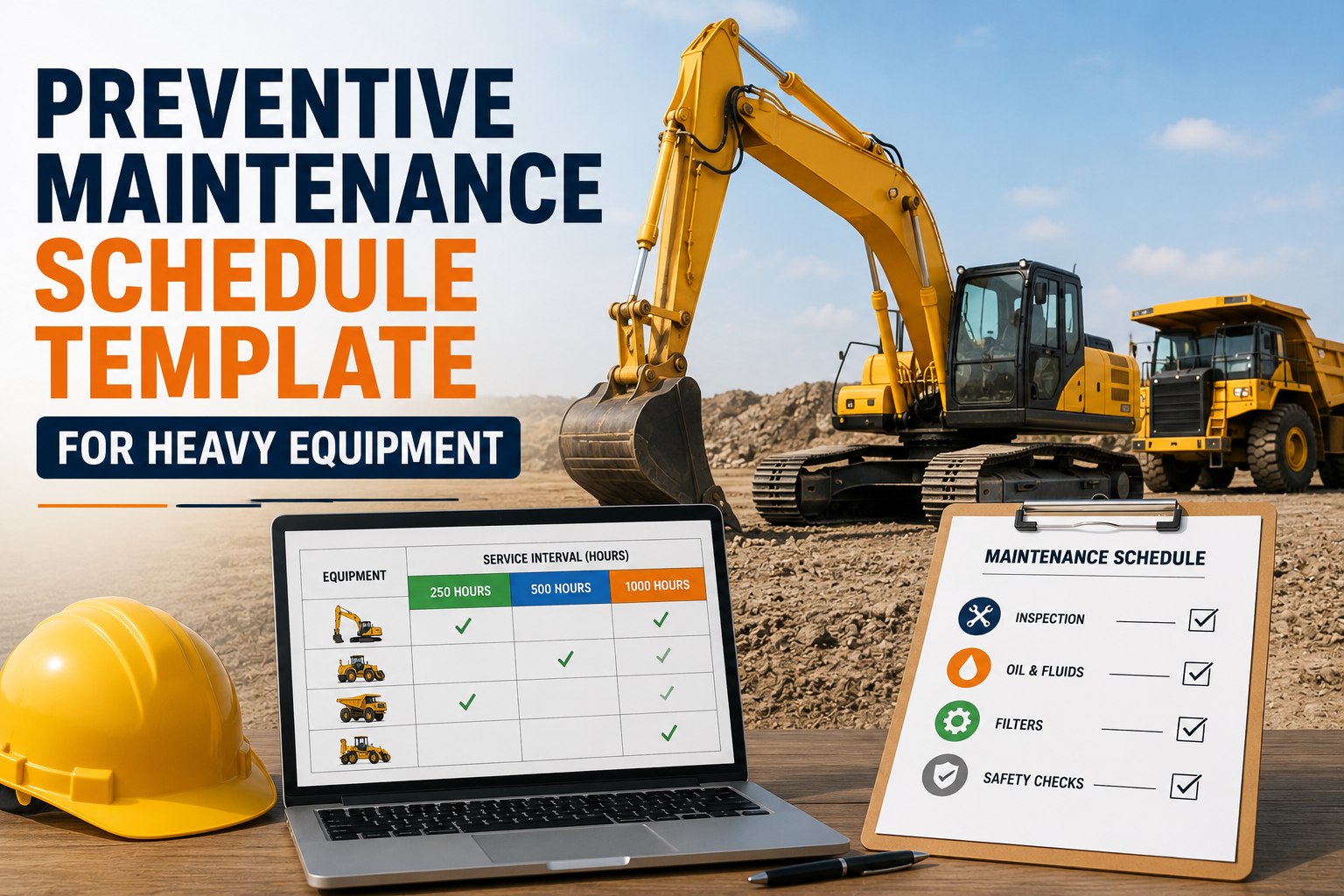
Construction equipment wears by hours worked, not weeks passed. A machine doing double shifts on a mining bench hits its 500-hour service in 6 weeks; the same model on a slow urban project takes 4 months. Structure your plan around the standard ladder — PM1 at 250 hours, PM2 at 500, PM3 at 1000, PM4 at 2000 — and trigger work orders from actual meter readings. Dusty Indian site conditions often justify shortening air filter and greasing intervals by 20–30% below the OEM book figure.
Create Model-Specific Inspection Checklists
A generic checklist catches nothing. Build daily walkaround and PM-level checklists per model: undercarriage wear and track tension for excavators, boom pins and bucket teeth for backhoes, brake and steering tests for dumpers, tyre pressure and TKPH tracking for rigid haulers. Operators complete the daily check before start-up; failed items flow straight to the workshop as defects — this inspection-to-work-order link is where paper systems break and digital systems pay for themselves.
Forecast Spare Parts and Set Reorder Points
Multiply each PM kit (filters, oils, seals, greases) by the number of services each machine will hit in the next quarter, based on projected hours. Set minimum stock and reorder points for fast-moving items — filter kits, GET (ground engaging tools), hoses — keeping in mind that genuine parts for imported models can take 2–6 weeks to reach remote sites in Rajasthan, Odisha, or the Northeast. A PM plan without parts on the shelf is just a schedule of delays.
Automate the Inspection-to-Work-Order Flow
Connect the pieces: meter readings update automatically, upcoming PMs appear on a planner, defects from inspections convert to work orders with parts and labour attached, and completed jobs update the machine history. This is the layer where software like HVI replaces the whiteboard — the system chases the schedule so your maintenance planner does not have to, and every rupee of parts and labour lands against the right asset.
Track KPIs and Keep DGMS / Factories Act Records Ready
Review PM compliance, mean time between failures, downtime percentage, and maintenance cost per hour every month. For mining fleets, DGMS circulars require documented examination and maintenance records for HEMM; for plant workshops, the Factories Act demands equipment safety documentation. When records are generated automatically from completed work orders, an inspector visit becomes a report export instead of a week of panic.
Standard PM Interval Reference for Indian Construction Fleets
Use this ladder as your baseline, then adjust against each OEM manual and your site's dust, load, and duty-cycle conditions.
| Service Level | Interval | Typical Tasks | Applies To |
|---|---|---|---|
| Daily Check | Every shift | Walkaround, fluid levels, leaks, tyres/tracks, lights, horn, brakes, greasing points | All machines — operator responsibility |
| PM1 | 250 hours | Engine oil and filter change, air filter clean, full greasing, visual undercarriage check | JCB 3DX, Tata Hitachi EX series, wheel loaders |
| PM2 | 500 hours | PM1 tasks plus fuel filters, hydraulic return filter, coolant check, track tension adjustment | Excavators, dozers, graders, rigid dumpers |
| PM3 | 1000 hours | PM2 tasks plus hydraulic oil sample, transmission oil change, swing gear inspection | Komatsu PC series, Volvo EC series, SANY SY series |
| PM4 | 2000 hours | Major service — hydraulic oil change, final drive oil, injector check, structural crack inspection | All HEMM, mandatory record for DGMS mining sites |
Stop Planning PMs on WhatsApp and Whiteboards
HVI turns this entire 7-step plan into a running system: meter-based PM triggers, mobile inspection checklists in Hindi and English, automatic work orders, spare parts alerts, and DGMS-ready reports — for every JCB, Tata Hitachi, Komatsu, and SANY machine across all your sites.
Benchmarks: What a Healthy PM Program Looks Like
Measure your fleet against these targets from well-run Indian construction and mining operations. If your numbers sit far below the bar, your PM plan exists on paper but not on the ground.
Fleets that move from register-and-diary tracking to a digital PM system typically report 20–35% lower breakdown frequency within the first two quarters — mostly because services stop slipping and daily inspection defects get repaired before they escalate into failures.
Frequently Asked Questions
What should a preventive maintenance plan for construction equipment include?
A complete PM plan includes an equipment register with criticality ranking, OEM-based service intervals for each model, model-specific inspection checklists, a spare parts forecast with reorder points, work order procedures, and KPI tracking. For Indian mining fleets it must also produce DGMS-compliant examination records. You can set all of this up digitally in a day when you sign up for HVI.
Should PM be scheduled by hours or by calendar in India?
Always by hour meter for construction equipment, because utilisation varies hugely between sites — a mining excavator can log 500 hours in six weeks while an urban project machine takes four months. Calendar dates work only as a backup ceiling for low-use machines, for example "every 250 hours or 3 months, whichever comes first."
How do I plan spare parts for JCB and Tata Hitachi PM services?
Project each machine's hours for the next quarter, count how many PM1/PM2/PM3 services will fall due, and multiply by the filter and oil kit for each service level. Hold minimum stock for fast movers and add lead-time buffers of 2–6 weeks for imported parts reaching remote sites. Software can auto-generate this forecast from live meter readings.
What records does DGMS require for HEMM maintenance?
DGMS expects documented proof of scheduled examination and maintenance of heavy earthmoving machinery — service history, inspection reports, defect rectification, and competent-person sign-offs. Digital work order history satisfies this far more reliably than site registers, and reports export in minutes. A specialist can walk you through the compliance setup if you book a 30-minute demo.
How long does it take to see results from a PM program?
Most Indian fleets see measurable results within one to two quarters: breakdown frequency drops 20–35%, parts consumption becomes predictable, and availability climbs as services stop slipping. The first month is setup — register, intervals, checklists — and improvement compounds from there as machine history accumulates.
Build Your PM Plan Once. Let HVI Run It Forever.
Join Indian construction and mining fleets that replaced diaries and spreadsheets with automated PM scheduling, mobile inspections, and DGMS-ready records. Set up your first machines free, or let our India team map your fleet onto HVI in a live 30-minute session.