On a high-rise site, the hoist is the building's lift until the real lifts are installed. It carries bricks, steel, tiles and often workers up and down dozens of times a day. If a landing gate opens while the cage is away, or a brake or overload device fails, the result can be a fall from height or a dropped load. These safety systems sit quietly in the background, so they need deliberate checking every day and every week. This checklist covers material and passenger hoists, and shows how sites keep hoist inspection records in HVI.
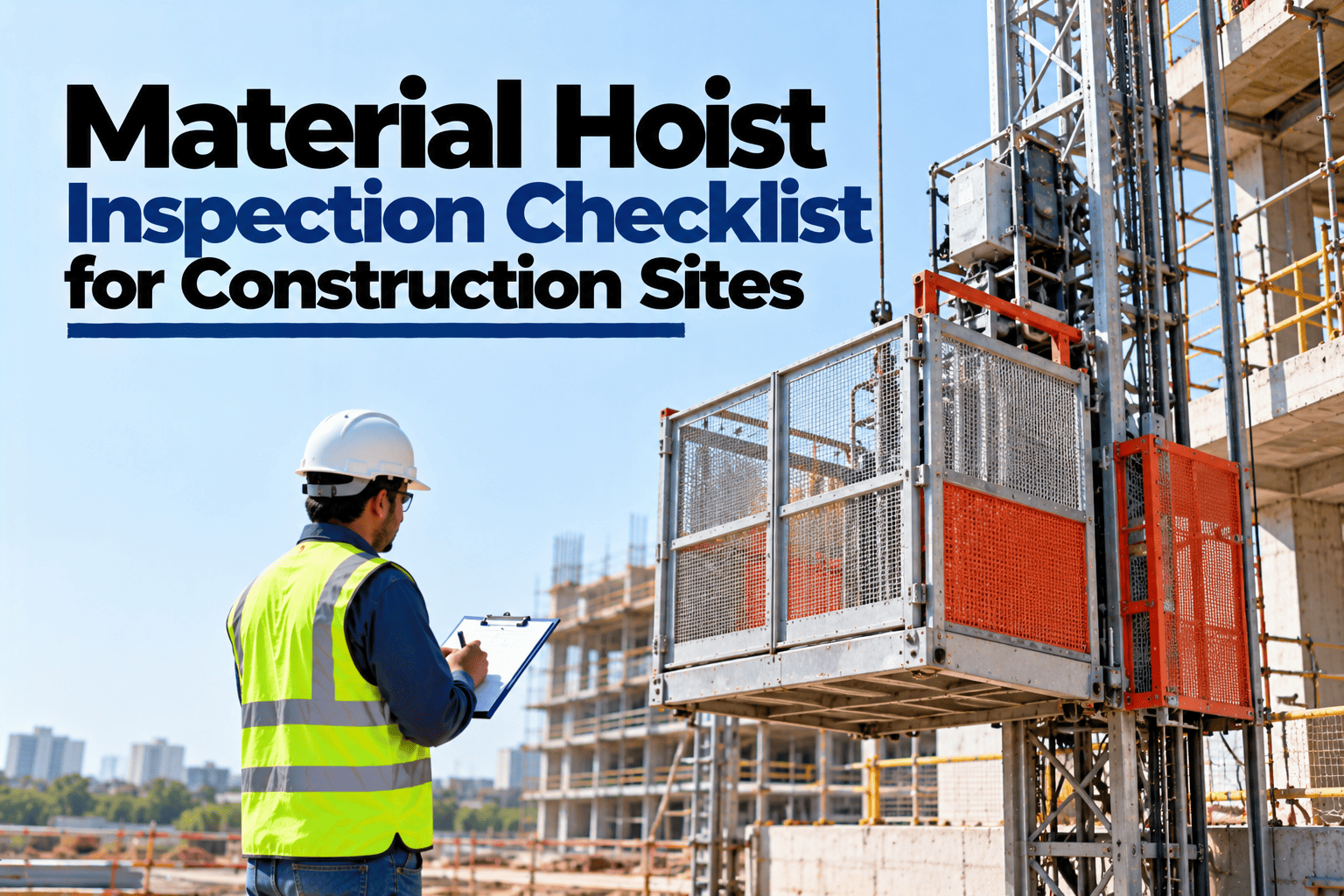
Material Hoist Inspection Checklist for Construction Sites
Mast and wall ties, cage and landing gates, interlocks, brakes, limit switches, overload devices and emergency stops, with daily and weekly tasks.
Daily Pre-Use Checklist
The hoist operator should complete these before the first run. Do not use the hoist if any safety item fails.
Weekly Inspection
A competent person should carry out these checks every week, and after any bad weather or alteration. Follow the hoist maker's manual.
| Part | What to check | Stop use if |
|---|---|---|
| Mast sections | Bolts, welds and alignment | Loose bolts, cracks or bent sections |
| Wall ties | Anchors, clamps and spacing | Loose or missing ties |
| Rack and pinion | Tooth wear and lubrication | Broken or badly worn teeth |
| Wire ropes, if fitted | Broken wires, kinks and terminations | Rope beyond discard limits |
| Brakes | Holding and stopping performance | Cage drifts or stops late |
| Overload device | Test as the maker instructs | Does not prevent overloading |
| Safety device | Tag date and condition | Overdue for its periodic test |
Testing the Safety Systems
Safety devices that are never tested may not work when needed. Build these tests into the routine.
Gate interlocks
Try each gate with the cage away. It must stay locked.
Limit switches
Run to the top and bottom limits without load.
Overload device
Test as the maker specifies.
Record results
Log every test with the date and tester.
Never bypass a gate interlock, limit switch or overload device. Never let people ride a hoist that is rated for materials only, and never exceed the rated load shown in the cage. Stop the hoist at once if any gate can be opened with the cage away.
Every Hoist Check Recorded and Ready for Audit
HVI records daily and weekly hoist inspections with photos, logs safety device tests and keeps certificates in one place, ready for safety officers, clients and statutory inspections.
When the Hoist Grows With the Building
Adding mast sections and new landings is a high-risk job. Inspect thoroughly after every change.
New mast sections
Bolted and torqued as the maker instructs.
New wall ties
Fitted at the specified spacing.
New landing gates
Interlocked before the floor is used.
Top limit moved
Reset and tested at the new height.
Hoist Status in HVI
A sample view across a developer's sites.
| Hoist | Site | Daily check | Weekly inspection | Status |
|---|---|---|---|---|
| HS-01 | Tower A, 18 floors | Passed | Done 3 days ago | In use |
| HS-02 | Tower B, 12 floors | Passed | Due tomorrow | Book inspection |
| HS-04 | Tower C, 9 floors | Level 4 gate interlock failed | Done 2 days ago | Out of service |
Hoist Inspection FAQs
What should be checked on a construction hoist every day?
The base enclosure, every landing gate and its lock, cage doors and interlocks, emergency stop, upper and lower limits, the rated load plate, loose material and the signals between floors.
Why are landing gate interlocks so important?
They stop a landing gate opening unless the cage is at that floor. A failed interlock leaves an open edge into the hoist shaft, creating a serious fall risk.
Can people ride a material hoist?
No. Only hoists designed and certified to carry passengers may carry people. A material-only hoist must be clearly marked and never used to transport workers.
Who should inspect a hoist?
The operator checks it daily, and a competent person inspects it weekly and after changes, with periodic examinations as rules require. Teams that record inspections in HVI keep a full history.
Can hoist inspections be recorded digitally?
Yes. Daily checks, weekly inspections and device tests can be recorded with photos for each hoist. Book a demo to see hoist inspection records in HVI.
Safe Hoists on Every Floor
Check every hoist daily, inspect it weekly, test every safety device and keep every record in HVI. Fewer falls, fewer dropped loads and safer high-rise sites.