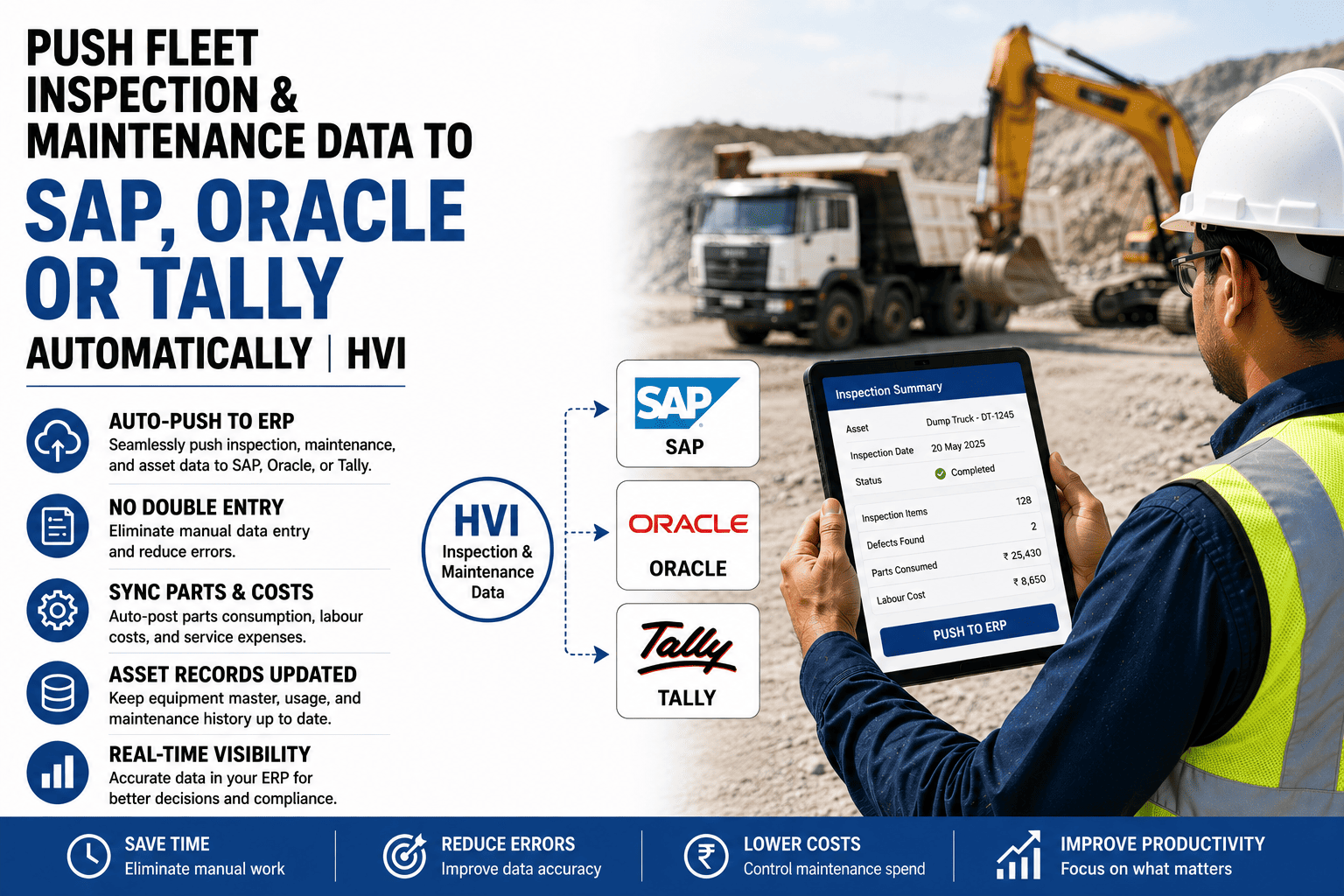
Somewhere between the pit and the P&L, every Indian fleet's maintenance data changes hands from people who fix machines to people who close books — and that handover is where a month disappears. Parts drawn at site stores wait weeks to become consumption entries; fitter hours never become labour cost at all; diesel becomes one giant unallocated line; and the accountant assembles the month from registers, WhatsApp confirmations, and whichever Excel version is newest. It does not matter whether the books live in SAP, Oracle, or Tally — the gap is the same, and so is the fix: capture the data once, at the machine, on mobile, and let it post to the ERP automatically. HVI does exactly that for all three worlds — PM and MM postings for SAP enterprises, maintenance and inventory flows for Oracle landscapes, and voucher-ready, cost-centre-wise entries for the Tally books that most Indian contractors actually run — offline at remote sites, timestamped at capture, reconciled daily. One field entry, three ERPs covered, zero retyping — sign up free and connect your books this month.
Push Fleet Inspection & Maintenance Data to SAP, Oracle or Tally — Automatically
Parts consumption, labour hours, fuel, and asset records captured once at the machine and posted to your ERP without manual re-entry — whether your books run on SAP, Oracle, or Tally.
Whichever ERP Runs Your Books, the Field Feeds It
SAP
For enterprise landscapes — field records post into PM and MM as notifications, orders, confirmations, measurement documents, and goods issues, through OData, BAPI/IDoc, or governed batch, with SAP staying the system of record and masters flowing only downward.
Oracle
For EBS and Fusion environments — maintenance work, inventory transactions, and asset cost flow into your maintenance, inventory, and projects modules through APIs or managed file exchange, keeping Oracle's asset and item masters authoritative.
Tally
For the books most Indian contractors actually run — parts consumption, fuel, and maintenance expenses land as clean, cost-centre-wise entries mapped to your ledgers and stock items, so machine-wise costing finally exists in the same Tally your CA already trusts.
Mixed groups are normal in India — SAP at the parent, Tally at subsidiaries, Oracle at a JV. One field layer feeds all of them simultaneously, each through its own connector, while your fleet dashboards stay unified across the group.
What Crosses the Wire — and Where It Lands
Month-End, Before and After the Connection
Before: three days chasing site registers to book parts consumption — half of it estimated, none of it machine-wise.
Now: consumption posted daily from work orders; month-end opens with the entries already in the books, machine by machine.
Before: diesel booked as one unallocated lump; maintenance cost per machine a quarterly guessing exercise.
Now: fuel, parts, and labour land cost-centre-wise as they happen — machine-wise P&L is a report, not a project.
Before: audit queries answered by hunting paper — "show the basis of this consumption entry" could take a day.
Now: every ERP entry traces to a field record with user, timestamp, GPS, and photos — the basis is one click deep.
Before: site truth and book truth disagreed, and month-end was the negotiation between them.
Now: one capture at the machine is both truths — the site and the accountant read the same record.
See Your Own Chart of Accounts Mapped in 30 Minutes
Bring your ERP details — SAP module owners, your Oracle setup, or simply your Tally ledger and cost-centre list — and our India team maps the connection live: which field records post where, at what frequency, and what your first reconciled month looks like. Tally connections in particular are lighter than most teams expect; many run without an IT project at all.
What Finance Finally Gets
Machine-Wise Costing, Continuously
Parts, labour, fuel, and outside repairs accumulate per asset in the books as they happen — cost per operating hour, owning-versus-hiring analysis, and project rate-building all read live figures instead of quarter-old reconstructions.
Verified Numbers, Not Estimates
Consumption entries come from issues logged at the shelf and nozzle, receipts from dip-verified deliveries, labour from hours booked on jobs — the provisional entries and month-end adjustments that plagued the old close mostly disappear.
An Audit Trail That Answers Itself
Every posted entry links back to its field record — who, when, where, with photos. Statutory and internal audits stop being document hunts, and the DGMS or Factories Act compliance file draws from the same records the books do.
Frequently Asked Questions
Which Tally versions are supported, and does it need an IT team?
Current Tally releases used by Indian businesses connect through standard import mechanisms mapped to your ledgers, stock items, and cost centres — setup is a mapping exercise with your accountant, not an IT project, and most Tally connections go live within days. Your CA's existing workflow and GST processes continue untouched.
Who does the code mapping — asset to cost centre, spare to stock item?
You do it once, with our team beside you: machines map to cost centres or equipment codes, spares to item codes, expense heads to ledgers. After that the mapping just runs, and new machines or items get flagged for mapping the first time they appear rather than posting wrongly.
Real-time or batch — how fresh is the ERP?
Your choice per connection: near-real-time posting for API-connected SAP and Oracle landscapes, or scheduled batches — daily is the common rhythm — where change control prefers it. Offline sites post when they sync, with the true work date on every document either way.
We run a custom or industry ERP. Can it still connect?
Yes — the same data set exports through documented APIs or validated file formats that any ERP's import framework can consume, with the same reconciliation reports proving completeness. If your system can import a voucher or a journal, it can receive the field's truth; sign up free and ask us about your specific stack.
What happens if a posting is rejected by the ERP?
It queues with the rejection reason for correction — nothing vanishes silently, and the daily reconciliation report shows posted, pending, and rejected counts per site so both sides always match. See the full round trip, rejection handling included, in a 30-minute demo with our India team.
Your Books Are Only as Good as What the Field Sends Them
SAP, Oracle, or Tally isn’t the weak link—the handwritten handover is. Capture data at the machine and automate posting to track consumption, labour, fuel, and costs accurately. Month-end becomes faster, audits become easier, and every entry stays traceable. Start free or map your ERP integration in a 30-minute session.