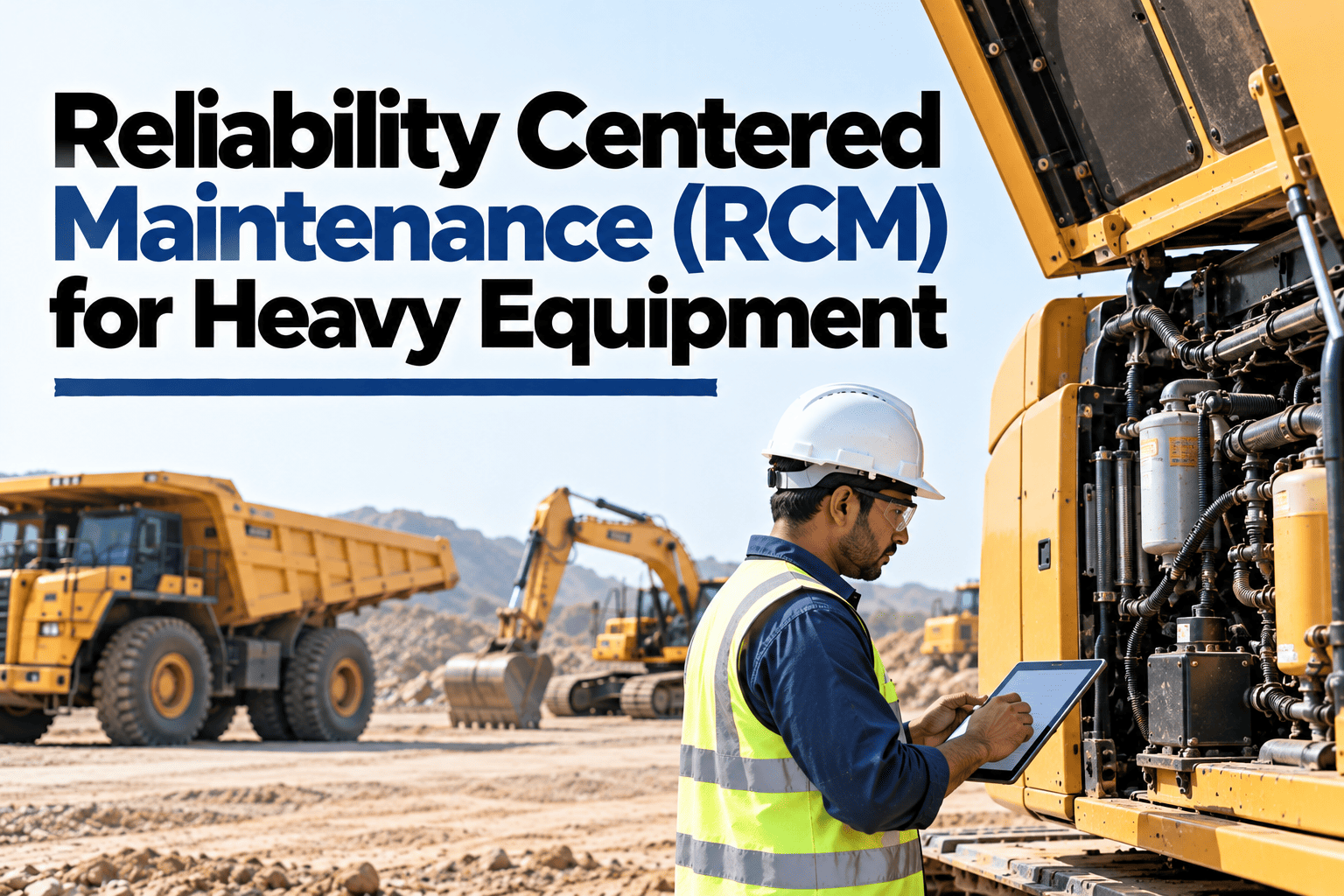
Most fleets treat every machine and every component the same way: service everything on the same schedule and fix the rest when it breaks. That spreads effort thinly. A haul truck that stops a mine needs very different care from a site generator that has a backup. Reliability centered maintenance, or RCM, is a structured way to decide which assets matter most, how each one actually fails and which task gives the best result for the money. This guide explains them, and how teams use failure data from HVI to apply RCM.
Reliability Centered Maintenance (RCM) for Heavy Equipment
Rank assets by criticality, understand how they fail and choose the most cost-effective maintenance task for each failure, in practical terms for Indian fleets.
The Seven RCM Questions, in Plain Words
Classic RCM is built on seven questions asked for each important asset. Answering them honestly is most of the work.
Ranking Assets by Criticality
Start by ranking machines, then focus deeper analysis on the most critical ones. Here is how a mining contractor might rank a few.
| Asset | Impact if it fails | How often it fails | Criticality |
|---|---|---|---|
| Primary excavator | Whole mining face stops | At times | High |
| Haul trucks | Output falls, others cover | At times | Medium |
| Water bowser | Dust rises, work can continue | Often | High |
| Site generator with backup | Backup takes over | Rarely | Low |
The water bowser ranks high because it fails often and dust control is a safety and compliance issue, not because it is expensive.
Choosing the Right Task for Each Failure
RCM picks the task that suits how each part fails, rather than servicing everything on the same calendar.
Condition monitoring
Best when failure gives warning signs, such as oil analysis for hydraulic pumps.
Example: oil sampling, vibration, temperaturePlanned replacement
Best when parts wear out at a predictable age or hour count.
Example: filters, belts, cutting edgesFailure-finding checks
Best for hidden failures in safety devices that only show when needed.
Example: alarms, load limiters, fire systemsRun to failure
Best when failure is cheap, safe and has little effect on work.
Example: cab lights, minor accessoriesBuild RCM on Real Failure Data
HVI records every failure, repair, inspection and reading by machine and component, giving your RCM team the evidence it needs to rank assets and choose the right tasks.
A Worked Example: Primary Excavator
For a high-criticality machine, list the main failure modes and match each one to a task.
| Component | Failure mode | Effect | Chosen task |
|---|---|---|---|
| Main hydraulic pump | Internal wear from contamination | Slow work, then stoppage | Oil analysis and pressure tests |
| Boom hoses | Abrasion and burst | Sudden stop, oil spill | Daily visual check, planned replacement |
| Undercarriage | Gradual wear | Costly rebuild if ignored | Regular wear measurement |
| Swing bearing | Lack of grease | Major repair | Greasing on schedule, play checks |
Putting RCM Into Practice
Start small, prove the value and then extend it across the fleet.
Form a team
Mechanics, operators and a supervisor.
Rank assets
Use the criticality matrix.
Study failures
Use real repair history.
Choose tasks
Match each failure mode to a task.
Review results
Check yearly and adjust.
Measuring Whether RCM Works
Track a few measures before and after, focusing on the critical machines.
Availability
Share of time critical machines are ready to work.
Mean time between failures
Working hours between breakdowns.
Planned work share
Planned jobs compared with breakdown jobs.
Maintenance cost per hour
Total cost divided by working hours.
RCM FAQs
What is reliability centered maintenance?
RCM is a structured way to decide the best maintenance for each asset by looking at what it must do, how it can fail, what each failure costs and which task prevents or predicts it most cost-effectively.
How is RCM different from preventive maintenance?
Preventive maintenance often services everything on fixed intervals. RCM chooses different tasks for different failures, such as condition monitoring for some parts, planned replacement for others and run to failure where that is safe and cheap.
Is RCM worth it for smaller fleets?
A simple version is. Even a small fleet benefits from ranking machines by criticality and matching tasks to how parts fail. Full, detailed RCM is usually kept for the most critical assets.
What data do I need to start RCM?
Repair history, failure causes, downtime and costs for each machine and component. Teams that record failures in HVI have this data ready to use.
How often should an RCM plan be reviewed?
Review it at least once a year, and sooner after major failures or changes in how machines are used. Book a demo to see failure data for RCM reviews in HVI.
Put Maintenance Effort Where It Matters Most
Rank assets, understand how they fail and choose the right task for each failure, with real failure data from HVI. Higher availability for critical machines and less wasted effort on the rest.