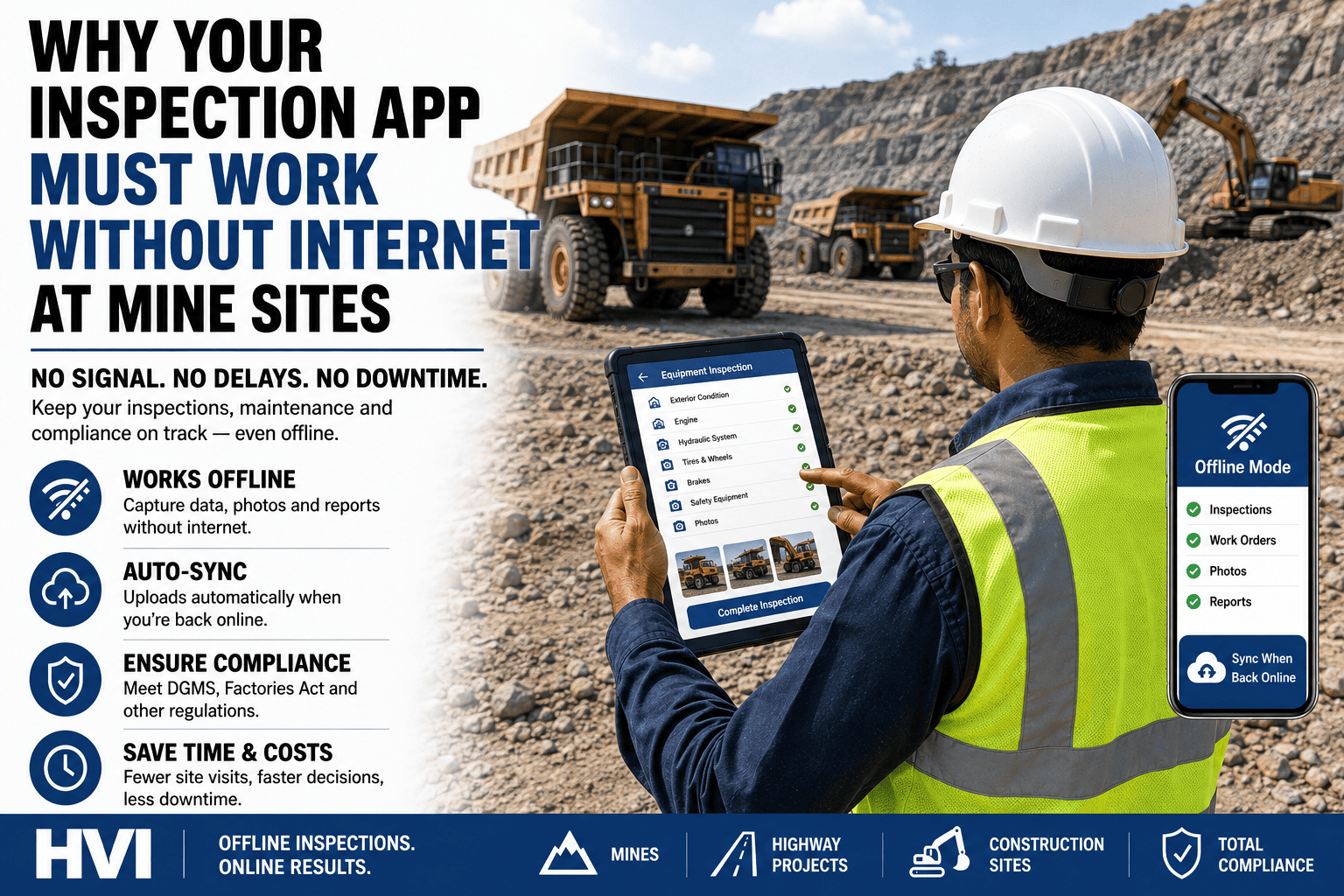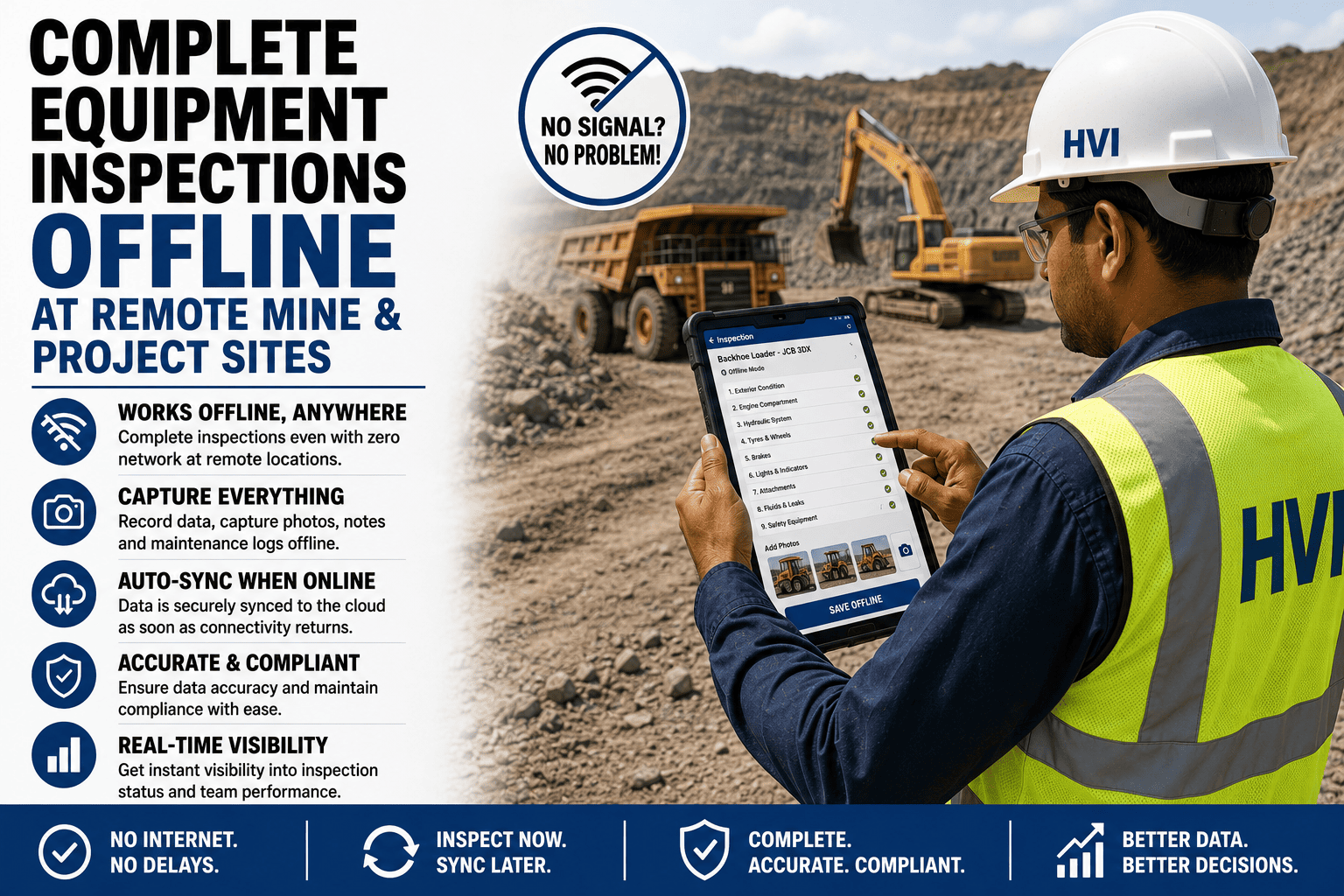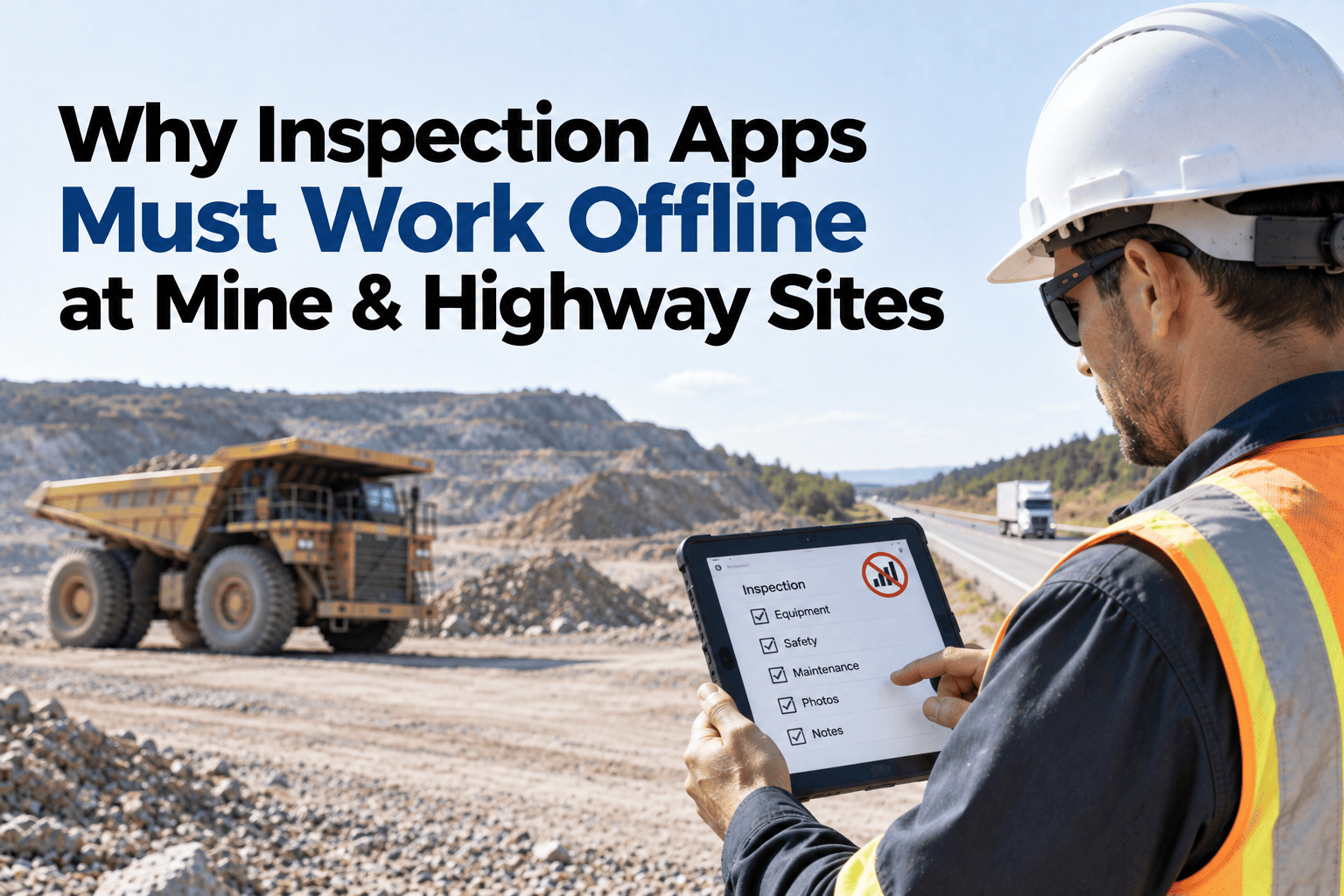
When an inspection app needs signal and the site does not have it, nobody stops inspecting. They invent a workaround, and the workaround is always worse than either the app or the paper it replaced. Operators walk to a high point to submit, or they write on paper and type it up later, or they complete the form from memory at the end of the week, or they stop bothering and mark everything as passed. Each of these produces a record that looks like an inspection and is not one. The connectivity question is not really about convenience — it determines whether the data you end up with means anything. You can look at where your own sites sit in a free 30-minute session.
Why Offline Capability Decides Whether Your Data Is Real
When an app needs signal and a site has none, crews build workarounds — and every one of them degrades the record.
Four Workarounds Crews Invent, and What Each Costs
The operator completes the check at the machine, then walks or drives somewhere with coverage to submit it.
Costs: time on every inspection, and a submission timestamp that no longer matches where or when the check happened.
Checks recorded on a pad at the machine and entered into the app back at the office.
Costs: the work is done twice, transcription errors enter the record, and photo evidence is lost entirely.
Several days of inspections entered in one sitting when someone next has connectivity.
Costs: the record shows checks at times they plainly did not occur, which is the failure mode that damages an audit most.
The friction exceeds the perceived value, and the inspection stops happening while the schedule says it does.
Costs: the worst outcome, because the absence is invisible until a failure makes it visible.
How an Online-Only App Ends Up Worse Than Paper
Paper has an underrated property: it works at the machine. Whatever its weaknesses in retrieval, aggregation, and legibility, the operator writes what they see while they are looking at it. An app that requires signal at a site without signal removes that, and what replaces it is retrospective entry.
Retrospective entry is where records stop matching reality. Details soften, borderline items get marked as passed because nothing obviously failed, and the timestamp records the office rather than the machine. The output looks more professional than a paper form and carries less truth.
This is why offline capability is not a convenience feature. It is the thing that keeps a digital record at least as honest as the paper one it replaced, while adding everything paper could not do.
Capture at the Machine, Sync Whenever
Full inspections with photo evidence completed with no coverage, carrying the time and place they actually happened.
Where Coverage Realistically Fails
Not only in obviously remote places. These are the situations that catch fleets who assumed connectivity was adequate.
Below the rim in an opencast pit, where a site with good coverage at the office has none at the working face.
Inside plant buildings, workshops, and structures that block signal entirely.
Along highway projects that move through coverage gaps as the alignment progresses.
At shift change, when everyone attempts to submit simultaneously and the local cell struggles.
On devices with exhausted data allowances, which is functionally the same as no coverage.
Frequently Asked Questions
Our sites mostly have coverage. Does this still matter?
It matters at the edges, and the edges are where inspections happen — the pit floor, inside the workshop, the far end of the alignment. Mostly-covered sites still generate the workarounds above at exactly the locations equipment is being checked. You can map your own gaps on a call with our team.
Could we just give operators better devices or plans?
It helps at the margin and does nothing where there is no network at all. It also puts the cost on hardware to work around a software limitation.
Is paper genuinely better than a badly implemented app?
At the moment of capture, sometimes yes, which is an uncomfortable but useful thing to acknowledge. The goal is a digital record that matches paper for honesty at the machine and beats it everywhere afterwards.
How do we know if our crews are already working around the app?
Look at submission times. Clusters at the end of a shift or on one day of the week, rather than spread across when machines actually start, usually indicate batch entry.
What should we test before signing a contract?
A full inspection with photos at your least connected location, with the app closed afterwards, checking the record arrives with the original time intact. Start with a free trial and test it there.
The Record Is Only as Honest as the Moment It Was Made
Let operators complete the full check at the machine with no coverage, keep the original timestamp, and remove the reasons crews invent workarounds that quietly hollow out the data.