Walk into any excavator fleet's store and the same twenty items are on the shelves — filters, seal kits, hoses, track hardware, bucket teeth — because the same twenty items are what an excavator consumes between overhauls. The question is never whether to stock them; it is how many, on which shelf, for which model, and how the store knows when a part left and when to reorder it, because a fleet that guesses at that runs out of a ₹400 filter on the day it grounds a ₹60-lakh machine. Here are the twenty, grouped by system, with the stocking rule for each and the tracking that keeps the shelf honest — sign up free and put reorder points on all twenty this week.
20 Most Stocked Excavator Spare Parts — and How to Track Them
The consumables and wear parts every excavator fleet keeps on the shelf, by system, with the stocking rule and reorder logic that turns a parts store from a guess into a system.
Filters and Fluids — Parts 1 to 5
Hydraulics — Parts 6 to 9
Undercarriage — Parts 10 to 13
Put Reorder Points on All Twenty This Week
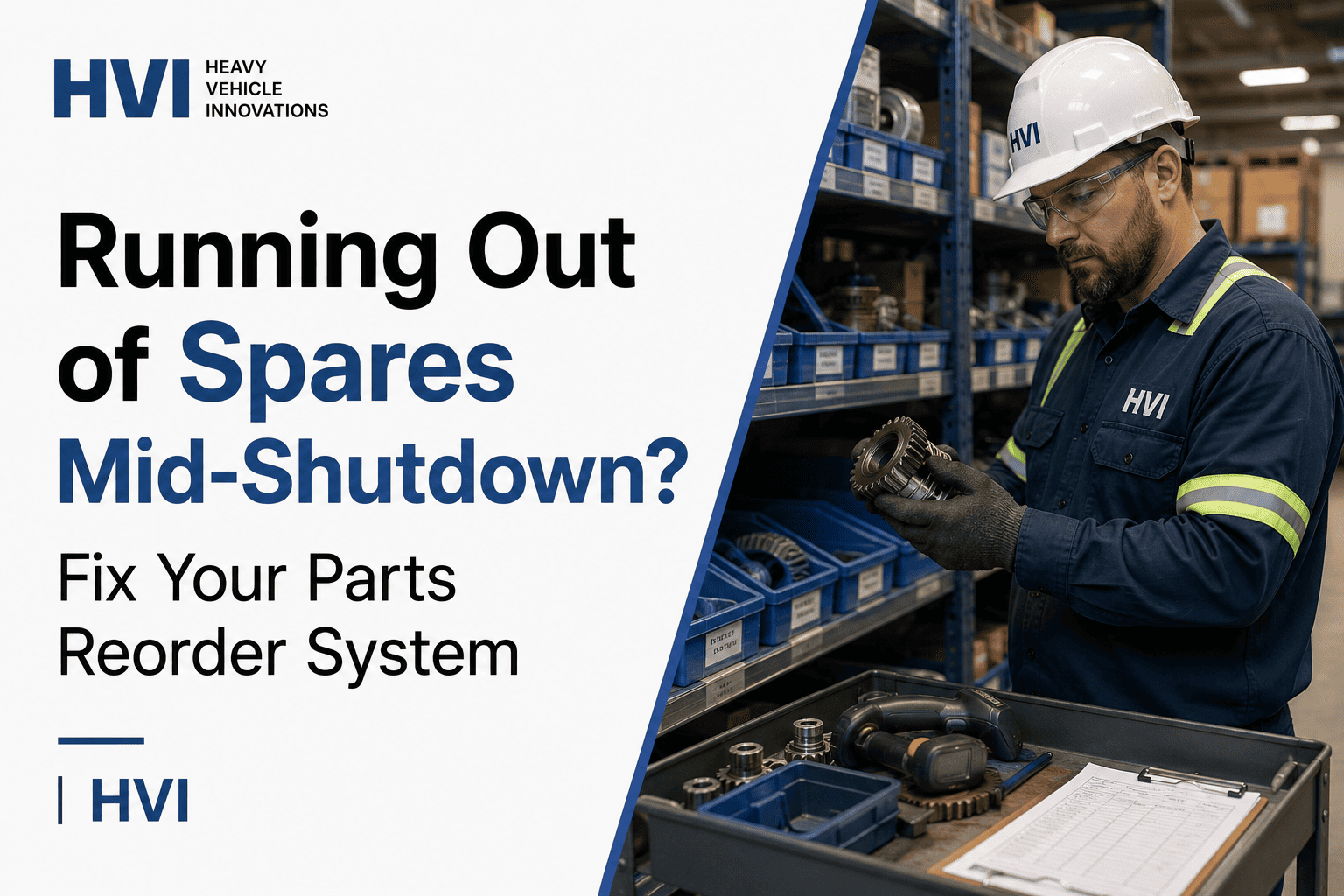
Load your parts master by model with OEM and alternate part numbers, let every work order consume stock automatically, set reorder points from real consumption and lead time, and kit the service parts so a 500-hour service is one pick instead of nine — configured in an afternoon. Bring your current stock register to a 30-minute session and our India team shows which of the twenty you are over- and under-holding right now.
Bucket and Attachment — Parts 14 to 17
Engine and Electrical — Parts 18 to 20
Twenty is the common core; your model mix, duty, and site add to it — breaker seals on demolition, extra cooling parts in the south, more undercarriage on rock. The list is the starting point; your consumption data is the finished one.
The Reorder Point Behind Every Shelf
Reorder Point = (Daily Consumption × Lead Time in Days) + Safety Stock
| Part — 8-Machine Fleet | Consumption | Lead Time | Safety Stock | Reorder Point |
|---|---|---|---|---|
| Fuel filter sets | ~1 set per machine per 250 hrs — ~0.5 sets/day fleet-wide | 7 days | 4 sets | ~8 sets |
| Bucket teeth | ~1 tooth per machine per 100 hrs on rock — ~1.2/day | 10 days | 10 teeth | ~22 teeth |
| Boom cylinder seal kits | ~1 kit per machine per 2,000 hrs — ~0.06/day | 14 days | 2 kits | ~3 kits |
Illustrative figures — your consumption comes from work orders, your lead times from your suppliers. The formula is the same for all twenty; the system runs it per part per site and raises the purchase order when the shelf crosses the line.
How to Track Them: Four Moves
Build the Parts Master by Model
Every part with its OEM number, its alternates, its models, and its shelf location — so "the filter for the Hitachi" becomes a part number the storekeeper, the technician, and the purchase order all agree on, and a JCB filter never gets issued to a Komatsu.
Consume Stock Through Work Orders
Parts leave the shelf against a work order and a machine, never on a slip — so stock is always right, consumption per machine is known, and the cost lands on the asset that used it.
Set Reorder Points From Real Consumption
After a month of work orders the consumption rate per part is a fact, the lead time is on record, and the reorder point sets itself — the purchase order raises when the shelf crosses the line, not when the technician finds it empty.
Kit the Service Parts
A 500-hour service kit per model — filters, O-rings, belts — picked as one item, reserved when the service is scheduled, and staged before the machine arrives, so the service is never delayed by the ninth part of nine.
Three Traps in Every Excavator Store
Same Part, Five Numbers
The OEM number, the distributor's number, the aftermarket number, and two handwritten ones on the shelf — the parts master with alternates is what stops the same filter being stocked three times under three names.
The Counterfeit Kit
Cheap seal kits and filters that fail in a fraction of their life — the work order history shows which supplier's parts come back early, and the supplier record makes the case with numbers instead of suspicion.
The Dead Stock Shelf
Parts for machines the fleet sold two years ago, still counted as inventory — the consumption report shows zero movement, and the money comes back as a return, a resale, or at least an honest write-off.
Frequently Asked Questions
Does this list apply to JCB, Tata Hitachi, Komatsu, and SANY alike?
The twenty categories are universal; the part numbers, quantities, and kit contents differ per model, which is exactly why the parts master is built by model with alternates. A mixed fleet runs one list with several columns, not several lists.
How much stock is too much?
More than the reorder point plus one order quantity for a fast mover, and more than one unit for a slow mover with a short lead time — the consumption report flags parts with months of cover, and that is capital sitting on a shelf that could be a tyre.
We run three sites. One store or three?
Three shelves, one system — fast movers stocked at each site, slow and expensive parts held centrally with visibility from every site, and inter-site transfers recorded so the seal kit at site B can save the machine at site A without a phone hunt.
Can consumption per machine flag a problem?
That is one of the best signals in the fleet — a machine eating twice the fleet average in teeth, filters, or track bolts is telling you about its duty, its operator, or its condition; sign up free and see the consumption report by machine after the first month.
Does it connect to our purchasing in SAP or Tally?
Yes — reorder triggers raise purchase requests, goods receipts update stock, and issues post costs to the machine, in SAP, Oracle, or Tally as you run them. See the parts-to-purchase flow on your own store in a 30-minute demo with our India team.
A ₹400 Filter Should Never Ground a ₹60-Lakh Machine
The twenty parts on this list are cheap, predictable, and consumed at a rate a fleet can know to the day — which means running out of any of them is a tracking failure, not a supply one. Start free and put reorder points on all twenty this week, or bring your stock register to a 30-minute session and see where the shelf is lying to you.