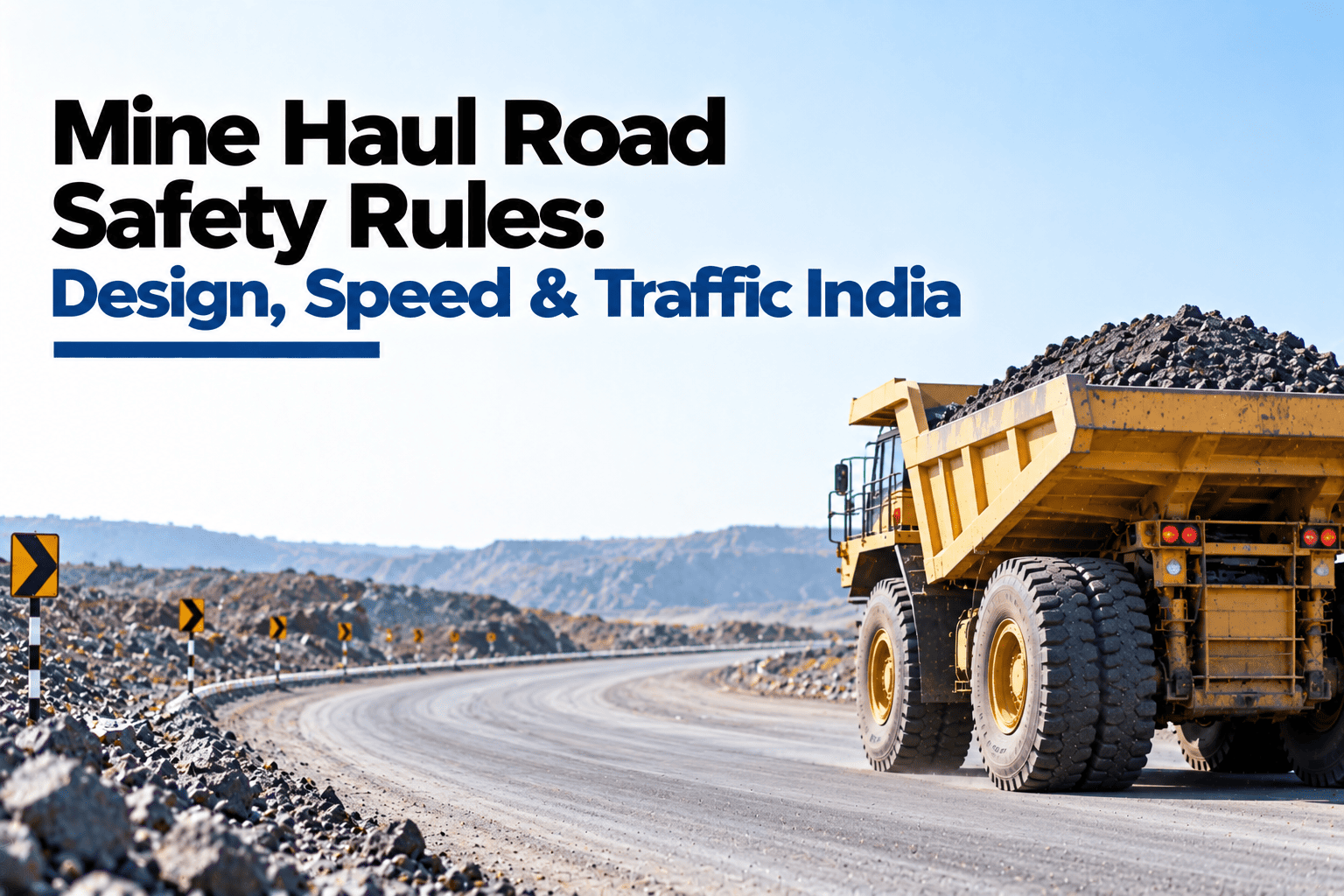
In an open-cast mine, the haul road is where the biggest machines meet the most people. A loaded dumper weighing hundreds of tonnes cannot stop quickly, and its driver cannot see a pickup in the blind spot. Many serious accidents in Indian mines trace back to the road itself: too narrow, too steep, a broken berm or no clear rule on who gives way. Safe haul roads come from good design, firm traffic rules and daily inspection. This guide covers each one and how mines record haul road inspections in HVI.
Mine Haul Road Safety Rules: Design, Speed and Traffic India
Get the road width, gradient and berms right, set speed and right of way rules everyone follows, and inspect every road section every day.
Haul Road Design Basics
Design decides how forgiving the road is when something goes wrong. These points reflect DGMS safety alerts and widely used good practice. Always check the regulations and permissions that apply to your mine.
| Element | What good looks like | Why it matters |
|---|---|---|
| Width | At least 3 times the width of the largest vehicle on the road | Room to pass and recover from drift |
| Gradient | Not steeper than 1 in 16, kept as even as possible | Loaded trucks hold speed and brakes stay cool |
| Berms | Strong, continuous berms on raised edges, built to at least mid-axle height of the largest vehicle | Stops a truck leaving the road |
| Bends | Wide radius with clear sight distance | Drivers see hazards in time to stop |
| Drainage | Crossfall and clear side drains | Prevents soft spots, potholes and skids |
| Intersections | Few, at right angles, with clear signage | Reduces conflict between vehicles |
Speed Limits and Right of Way
Clear traffic rules, written into the mine's transport rules and repeated in every briefing, stop most collisions before they happen.
Who gives way, in a common rule
Rules for light vehicles
- Flag or whip antenna and flashing beacon fitted
- Radio contact before entering haul roads
- Never overtake a dumper
- Stay out of blind spots and keep a safe gap
- Park only in marked safe areas
Record Every Road Inspection Alongside Your Equipment Checks
HVI lets supervisors inspect each haul road section on a phone, add photos of berms and potholes, and raise repair jobs that are tracked until closed.
Daily Haul Road Inspection Checklist
Inspect every road section before the first shift and after heavy rain or blasting. Record what you find and who will fix it.
- Potholes, ruts and soft spots
- Spillage and boulders on the road
- Slippery or muddy patches
- Gaps or low sections
- Erosion after rain
- Damage from vehicle contact
- Side drains clear and flowing
- No water standing on the road
- Culverts not blocked
- Speed and warning signs visible
- Lights working at night
- Reflectors on bends and edges
- Water sprinkling on schedule
- Visibility clear for drivers
- No over-watering on slopes
- Bund at the tipping edge intact
- Ground firm near the edge
- Spotter or markers in place
Lessons From Recent DGMS Safety Alerts
DGMS safety alerts describe real accidents so others can prevent them. Haul road causes come up again and again.
Loaded tipper broke the embankment
A loaded tipper left the transport road and fell to a lower bench.
Lesson: keep statutory road width and strong edge protectionDumper ran away on a steep slope
A dumper went out of control on a steep haul road and fell from the bench.
Lesson: keep gradients within 1 in 16 and berms strongSpeed too high for the road
Speed that suits a straight road becomes dangerous on a bend or descent.
Lesson: set limits by road geometry and enforce themA Haul Road Inspection Log in HVI
A sample morning view. Each road section has its inspection, findings and repair status in one place.
| Road section | Inspected | Findings | Action | Status |
|---|---|---|---|---|
| Ramp A to crusher | 6:10 am | None | None needed | Open for traffic |
| Bench 3 haul road | 6:25 am | Potholes near bend | Grader assigned | Speed restricted |
| OB dump road | 6:40 am | Berm gap 6 m long | Dozer to rebuild berm | Closed until fixed |
| Coal road to siding | 6:55 am | Heavy dust | Water tanker sent | Sprinkling in progress |
Haul Road Safety FAQs
How wide should a mine haul road be?
DGMS safety alerts recommend maintaining the statutory minimum, at least three times the width of the largest vehicle operating on the road. Wider roads give more room to pass and recover. Check the regulations and permissions that apply to your mine for the exact requirement.
What is the maximum gradient for a haul road?
DGMS safety alerts recommend that haul roads should not have a gradient steeper than 1 in 16. Even gradients help loaded trucks hold a steady speed and keep brakes from overheating on long descents.
How high should a safety berm be?
Berms on raised road edges must be strong and continuous. A widely used benchmark is at least the mid-axle height of the largest vehicle using the road. Inspect berms daily and rebuild any gaps or eroded sections straight away.
Who has right of way on a mine haul road?
A common rule is that loaded dumpers have priority, empty dumpers give way to loaded ones and light vehicles give way to all heavy machines. The exact rules should be set out in the mine's traffic management plan and explained to every driver.
How should haul road inspections be recorded?
Record each road section's inspection with time, findings, photos and the action taken, and track repairs until closed. Teams that record road inspections in HVI keep them next to equipment checks. Book a demo to see how it works.
Safer Haul Roads, Fewer Serious Accidents
Inspect every road section daily, photograph berms and potholes, and track repairs until they are done in HVI. Clear records for DGMS, safer roads for every driver.